最近,法國納米材料初創公司 NAWA Technologies 聲稱已經開發出一種技術,可以顯著提高電動汽車電池的儲能效率。根據公司創始人兼首席技術官 Pascal Boulanger 的說法,NAWA 的 UFCE 超快充碳電極可以將電動汽車電池的充電時間縮短至與汽油汽車加油差不多的水平,并同時將電池壽命最高提升 5 倍。
在接受 SAE International 采訪時,Pascal Boulanger 表示,UFCE 電極技術可以將市面上主流電動汽車的續航里程增加至 1,000 公里(620 英里),并實現 5 分鐘內充電80% 的超高速充電。他指出,“UFCE 電極的獨特之處在于采用了 3D 結構的 VACNT 垂直對齊碳納米管。每個碳納米管實質上都是一個卷成圓柱型的石墨烯片。這些納米管的直徑相較于其長度而言非常細,其比例相當于一根長約 1 公里的意大利面。而 UFCE 電極正是由數百萬億根這樣的碳納米管組成的!”Boulanger 表示,UFCE 電極適用于各類先進電池化學技術。
Boulanger 解釋說,目前鋰基電池的性能主要受電極設計和電池材料的限制。目前,粉末電極的導電性和導熱性均較差,充放電間的力學性能也不高,并且可能面臨安全和使用壽命有限等問題。
Boulanger 表示,當下電極材料的微結構決定了其中的離子難以四處自由移動,因此電導率較低。UFCE 電極采用的專利 VACNT 碳納米管,憑借 3D 結構可以取得“最高”的離子電導率,而且又借助納米管的超長長度同時獲得非常好的導電性和導熱性。Boulanger 說,這些特性可以解決電池熱失控的問題。
從力學上看,VACNT 納米管可以像“籠子”可以減少電極的體積膨脹,從而使其能夠在比粉末電極更小的“應力”下工作:“簡單地說,這意味著離子僅需移動幾納米即可穿過圓柱形的立體電極材料,但如果電極材料是平面的,則離子則可能需要移動幾微米。”Boulanger 表示,新結構“從根本上提高了電池的充電和放電速率”。此前,NAWA公司還曾發布過“下一代超級電容器”(名為超快充碳電池)產品。公司稱,這款超級電容器擁有超高的充放電速度,且取得了“市面上最低的電氣串聯電阻值。”
Boulanger 表示,NAWA 的電極技術可以幫助鋰基電池實現性能優化:電池功率提高 10 倍、能量存儲最高提升 3 倍、電池壽命周期最高提升 5 倍,而且充電時間從幾小時縮短到僅幾分鐘。“通常情況下,任何技術都有優劣勢,因此總要有所取舍,比如粉末電極的情況就是這樣。”Boulanger指出,“你要增加能量存儲,就要降低功率;汽車要跑得更快,就要更多消耗電池。不過,還有一些電池技術絕對是被低估了。”
目前,大多數電動車車主已經發現,電動汽車開的時間越長,車輛的電池就越不經用。與汽油發動機不同,電動汽車的電池損耗不是線性下降的。Boulanger 說,“我們的技術也是如此 – 然而,由于我們的功率和儲能水平都更高,這意味著您將獲得更多富余,因此無論電量如何,電池‘過度放電’的情況都將很少發生。”NAWA 公司研發合作伙伴(包括法國電池巨頭 SAFT)的初步結果表明,先進鋰離子電池使用 UFCE 電極可以將儲能量最少增加一倍。Boulanger 說,“因此,電動汽車將擁有更多能量,可以跑得更快,同時也跑得更遠。”
Boulanger 說,NAWA 公司的 3D 碳納米材料電極經過專門設計,非常易于制造。VACNT 碳納米管的制造工藝與光伏板或工業玻璃生產“非常相似”。Boulanger 聲稱,碳納米管的生產“并不昂貴”:生產設備已過驗證,產量和良率均大大提高,成本可以控制得很低。Boulanger 說,“我們預測,生產一平方米碳納米管的成本與生產同等面積的涂層應該差不多,但所需的天然材料和可持續碳源材料更少。不過,單位平方米碳納米管可以存儲的能量更多,因此如果按照單位瓦時成本來說,碳納米管應該更便宜。”
Boulanger 也意識到 UFCE 電極的商業化可能面臨一些障礙。“我們有很多種方式可以將 3D 電極概念推入市場,”他說。最簡單的方法是在銅基板上刷一層非常薄的 VACNT 碳納米管,從而與目前已經在電池行業投用的碳涂層銅基板競爭。Boulanger說,通過這種方法生產的電極材料具有更好的電性能和錨固性,并且已經可以在 2021 年實現小批量生產。從長遠來看,真正的 3D 結構 UFCE 電極“可能會在 2023 年初小批量上市,并在 2025 年實現量產。”
NAWA 公司的 UFCE 電極也有潛力應用至氫燃料電池系統,可以使用 NAWA 公司的 NAWACap 超級電容器回收本來會被浪費掉的能量。Boulanger 表示,UFCE 電極也可以作為燃料電池的膜電極。“事實證明,NACNT 使用的貴金屬鉑更少”,因此可以節省成本。此外,NAWA 集團另一個事業部還在開發各種創新材料,使用這些材料制作的氫碳復合儲罐的重量更輕、強度更高。
NAWA美國公司位于美國俄亥俄州 Dayton 市,專注于多功能超強復合材料的商業化。公司的 NAWAStitch 概念采用了一層內含數萬億個與碳纖維層垂直排列的 VACNT 碳納米管薄膜。Boulanger 表示,這層薄膜就像是一個“納米尼龍搭扣”,可以增強復合材料中連接最薄弱的環節,即層與層之間的接觸面,因此可以大大提高材料抵抗剪切和沖擊載荷的能力。
除了 3D-UFCE 和 NAWAStitch,NAWA 公司還有另外一項創新:NAWAShell。這是一種采用 VACNT 碳納米管的混合結構電池。由于采用了復合結構,這種電池的力學強度和電能存儲性能均得到優化。Boulanger 認為,未來“NAWAStitch 和 NAWAShell 的結合使用將發揮巨大潛力,創造可以儲存能量的多功能輕質堅固材料,比如可以使用這種材料制造車輛的太陽能板車頂,幫助車輛儲存更多能量,而且幾乎不會增加車輛重量。”
作者:Stuart Birch
來源:SAE《汽車工程》雜志
A French nanomaterials company has developed a technology that it claims can significantly increase the storage efficiency of electric vehicle batteries. NAWA Technologies’ Ultra-Fast Carbon Electrode (UFCE) is a key to bringing EV battery-charging time into parity with gasoline-refueling time, while improving battery life-cycle performance by a factor of up to five, according to company founder and CTO, Pascal Boulanger.
In an interview with SAE International, Pascal Boulanger said the UFCE technology can help deliver 1,000-km (620-mi) operating range for mass-market EVs, with a time of five minutes for an 80% charge. “The uniqueness of the technology is its 3D structure and use of vertically aligned carbon nanotubes [VACNT],” he noted. Each nanotube is formed from a graphene sheet that is rolled in a cylindrical shape. The tubes have “the same aspect ratio [between diameter and length] as a kilometer-long piece of spaghetti, with the electrode being made of a hundred trillion of these tubes!” The UFCE technology is compatible with any advanced battery-cell chemistry, he said.
‘Highest’ ionic conductivity
A major limitation of incumbent lithium-based battery performance is the design and material used for the electrode, Boulanger explained. Existing powder electrodes have low electrical and thermal conductivity, along with poor mechanical behavior when discharged and recharged, and can suffer from safety and life-cycle issues.
He said the micro-structures in today’s electrode material make it difficult for ions to move around, resulting in low ionic conductivity. The UFCE’s patented VACNT design, he claims, combines the “highest” ionic conductivity, thanks to its 3D fully accessible nanostructure, with continuous conductors (the nanotubes) that exhibit optimum electrical and thermal conductivity. These characteristics eliminate thermal runaway issues, Boulanger said.
Mechanically, the VACNT serves as a cage, reducing volume expansion of the electrode and allowing it to operate under less “stress” than powder electrodes: “Put simply, this means the distance an ion needs to move is just a few nanometers through the cell material, instead of micrometers with a plain electrode.” This “radically” boosts the battery’s ability to deliver fast charge and discharge rates, he said. NAWA previously demonstrated this in its next-generation ultracapacitors (known as the Ultra-Fast Carbon Battery), claimed to have “the lowest electrical serial resistance on the market.”
Applying NAWA’s technologies to lithium-based cells would improve battery power by a factor of 10 and energy storage by a factor of up to three, Boulanger stated, with battery life cycle enhanced by up to five – and charging time reduced to minutes instead of hours. “Normally, for a given technology – and that’s the case for batteries using powders – you have to find a compromise,” he noted. “And if you increase energy you will decrease power; if you accelerate [the vehicle] you will consume more. But there is something else in a battery that is absolutely underestimated.”
EV owners have learned that the more you drive, the faster you discharge the battery. Unlike a tank of gasoline, EV energy consumption is not linear. “This will also be the case for our technology – however, at a higher level of both power and energy, meaning that you will have more margin and the ‘over consumption’ will be lower, whatever the state of charge,” Boulanger said. Initial results with NAWA’s development partners, including battery giant SAFT, show that an advanced lithium-ion battery with a UFCE minimally doubles the kW-h stored. “EVs could draw on more power to go faster but farther at the same time,” he said.
Carbon nano-material synergies
The 3D electrode is designed for manufacturability, he said. The VACNT manufacturing process is “very similar” to the production of photovoltaics or industrial glass treatment. Boulanger claimed that nanotubes are “not expensive” to produce: the equipment is proven, and processes are greatly improving both in throughput and yield, keeping costs low. “We envision it can be similar in terms of dollars-per-square-meter to a coating, but with a lower bill-of-materials coming from the natural and sustainable carbon sources. We will have more energy per square meter, the cost of that energy will be lower in terms of dollars-per-watt-hour, too,” Boulanger said.
In moving toward commercialization, Boulanger is aware of the hurdles. “There are various ways of introducing our concept of 3D-electrode to the market,” he said. The easiest way to grow a very thin layer of VACNT on a copper substrate to compete with existing carbon-coated copper substrates already in use in the battery industry. This method will yield electrical performance and anchoring of the electrode material that is superior to the incumbents and can be ready in small volume production in 2021, he said. Longer term, a real 3D and thicker UFCE “could be on the market in low volumes by early 2023 in 3D electrode form, reaching mass production in 2025.”
Potential applications of NAWA’s UFCE technology extend into hydrogen fuel cell systems. One uses NAWACap ultra-capacitors to harvest energy that would otherwise be lost. The UFCE also can serve as an electrode for the fuel cell membrane “because VACNT are known to be able to reduce the loading of platinum,” thus saving cost, Boulanger said. And materials developments by another NAWA Group unit can reduce the weight and improve the strength of the hydrogen carbon-composite storage tank.
NAWA America, based in Dayton, Ohio, focuses on the commercialization of multi-functional, ultra-strong composites. Its NAWAStitch concept comprises a thin film containing the same trillions of VACNT arranged perpendicularly to carbon fiber layers. Acting as “nano-Velcro,” this reinforces the weakest part of a composite - the interface between the layers – designed to greatly improveresistance to shear and shock loading, stated Boulanger.
The 3D-UFCE and NAWAStitch are complementary to another innovation: NAWAShell. A structural hybrid battery incorporating VACNT, it provides both enhanced mechanical strength and electrical energy storage within the core of the composite structure. In the future, Boulanger sees “enormous potential in combining NAWAStitch and NAWAShell to create ultra-strong, multi-functional lightweight materials that can also store energy – for example, a solar roof panel in a car that could generate energy stored within the roof, with almost no additional mass to the vehicle structure.”
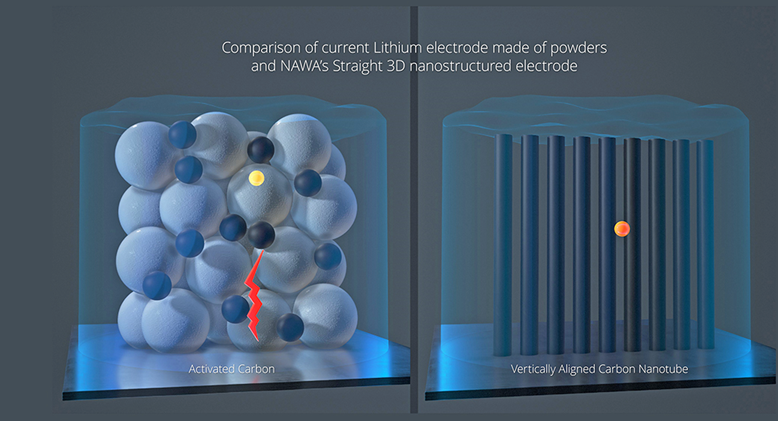 NAWA 認為,公司的納米結構電極將為電動汽車電池帶來階躍性進展。(圖片來源:NAWA)
 NAWA Technologies 公司創始人 Pascal Boulanger 堅信,公司將提供一種極具性價比的解決方案,顯著提升電動汽車的實用性。(圖片來源:NAWA)
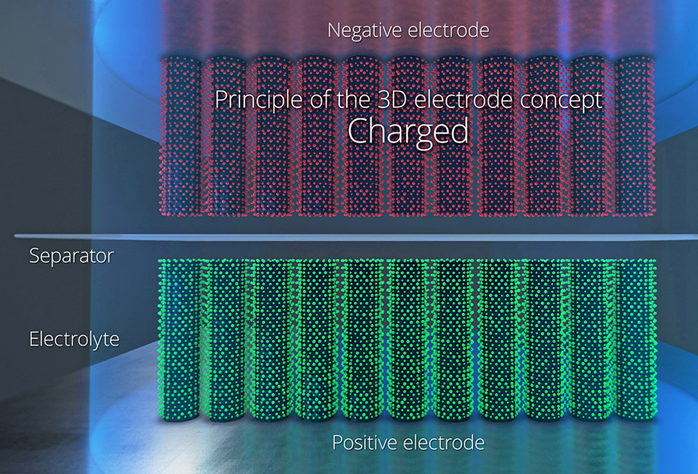 3D 垂直結構的電動汽車電池電極。(圖片來源:NAWA)