五年前還很少有人會預料到,2017年全球汽車動力總成、傳動系統和燃料領域的格局會如此多樣化。然而如今,幾乎所有人都認為,無論是要達到歐洲、北美以及亞洲等地區最新的減排標準,還是要達成更為長遠的電動化目標,發展各種類型的混合動力汽車都十分重要。
在博格華納動力驅動系統公司(BorgWarner PowerDriveSystems)產品戰略部總監John Barlage看來,“從熄火-啟動系統一路發展到純電動汽車,我們將這一歷程視作‘電動汽車進化史’。”和其他動力系統一級制造商的規劃師所見略同,他也認為下一個周期(2019年-2021年)中,更多車輛將會搭載48V混合動力系統,且“數量將會相當龐大”。
從已經登陸歐洲的48V系統來看,這些產自奧迪及其他德國整車廠的系統都能提供強大的車載電力,通過電動增壓等方式很好地達到節能減排的效果,并能為自動駕駛輔助系統(ADAS)傳感套件提供高達3千瓦的電能。
Barlage信心滿滿地表示,“由于48V系統的經濟效益非常吸引人,將會很快在北美車型上普及。”談及這一技術,業內普遍認為,只需要普通(功率分流)混合動力系統約30%的成本,就能獲得相當于其70%的性能。博格華納的工程師還認為,隨著系統架構和封裝技術不斷升級,48V甚至更高電壓的混合動力模塊都將進行研發,以實現P2架構的應用。
在P2布局中,電機將會置于內燃機和變速箱之間(詳見圖解)。其他行業認可的混合動力架構布局(從前到后依次)包括:P0(主要為履帶-交流電機-起動機構,簡稱“BAS”);P1(例如位于飛輪位置的本田IMA);P3(電機置于主減速器前的變速箱輸出軸上);以及P4(也被稱為四輪驅動混合動力架構,采用后橋電動驅動方式)。除P2外,其他幾種方式都具有扭矩矢量控制功能。
Barlage注意到,“對傳動系統而言,P2架構的出現帶來了很多良機,包括能和雙離合變速器(DCT)甚至自動離合裝置配合工作(詳情請參閱: http://articles.sae.org/15576/),同時也非常適合插電式混合動力車。P2配置下的插電式混合電動車(PHEV),在純電動模式下的整體能效,甚至要高于混動模式。如果想要打造適合高速公路駕駛的電動車,或實現卡車的電動化,P2架構一定是首選。
同軸和異軸
“在其他的48V應用架構研發中,我們選擇首先從P0開始。”博格華納高級工程部的技術研究員JoelMaguire 說,“這樣可以將同樣的電機用于各個不同位置,能夠產生規模效應。”
Maguire告訴《國際汽車工程》(AutomotiveEngineering International)記者,他的產品研發小組根據OEM的各項需求,對應用于P2, P3或P4型混合動力系統的電機電磁材料進行優化,從而設計出了“一系列滿足OEM汽車封裝要求的,結構緊湊、動力強勁的電機,而有些(競爭對手的)功率分流型的產品,甚至有些P2架構,也必須在設計上做出一些妥協,因為其車結構的靈活性和現有的汽車封裝技術而言,還并不能很好地配合48V硬件設備。”
博格華納P2架構的一大特點,就是其167毫米(合6.57英寸)的軸向長度。根據公司內部數據顯示,這一長度下的額定最大扭矩可以超過330牛·米(合243磅·英尺),最大功率則能超過80千瓦(合107馬力)。無論是同軸(指和變速箱輸入軸、發動機曲軸以及扭矩減震器位于同一根軸上)還是異軸,這一模型都適用。而對于異軸而言,由于其安裝位置在驅動橋箱上方,因此這也算是一種傳動鏈驅動的解決方案,可以滿足較小的橫置發動機/前輪驅動車輛的封裝要求。
“空間上的節省主要在車輪之間,同時由于軸長不變,因此可以避免可能發生的機械損壞。”Maguire解釋道,“這一模型棄用了交流電機,可以將空調壓縮機整合到同一個鏈傳動裝置上,在發動機關閉時,仍可以用48V系統讓空調保持運轉。”
上述兩種P2模塊中都包含一個分離式離合器,置于電機和雙質量飛輪的集成結構內,可以與當下最流行的傳動技術搭配使用,其中包括行星齒輪步進式自動變速箱,雙離合變速器(DCT)、無級變速器(CVT)以及自動換擋系統等。博格華納的工程師指出,P2架構的另一大優勢就是:可以繼續使用目前已有的發動機和傳動系統。
“采用了P2架構,就可以在發動機和變速箱之間加入一個模塊。當然,這一方案并非絕對理想。”Barlage說,“但同專門用于混合動力的變速器相比,這仍是更經濟的選擇,涉及的調整也會少很多,而且還能改變尺寸大小。”而在配合DCT的配置時,使用P2架構則可以成為三離合器布置,也就是博格華納所說的“K-Zero”系統,其中包括了連接到電機的分離式離合器,以及負責在兩套齒輪組之間進行切換的K1和K2離合器。
Maguire特別指出,“我們的戰略規劃是要玩轉各種驅動架構涉及,從P0到P4都能應用自如。而通過觀察OEM對各種混合動力驅動架構的探索,以及不斷的學習研究,我們已經打造出了一套可用于各種設計布局的系統。”
Five years ago, few predicted the high level of fragmentation in powertrains, drivelines and fuels that exists in 2017. Nearly everyone now agrees, however, that Hybridization of all types is essential to meeting the latest European, North American and Asian emissions regulations and in bridging toward the long-term electric future—whenever that comes.
“We see it as a ‘spectrum of electrification’ from stop-start systems all the way to pure EV—and everything’s in play,” observed John Barlage, Director of Product Strategy, of BorgWarner PowerDrive Systems. Like other Tier 1 powertrain systems planners, he sees “very large volumes” of 48V hybrid applications coming in the next (2019-2021) cycle.
Already arriving in Europe from Audi and other German OEMs, the 48V systems provide greater on-board electrical power for CO2-reducing features such as e-boosting, and for ADAS (automated driver assistance systems) sensor suites which can gobble up to 3 kW.
“We’re going to see North America adopt 48V because it has such interesting economics,” Barlage asserted. The technology is often described as delivering about 70% of the performance of a conventional [powersplit-type] dedicated hybrid for about 30% of the cost. BorgWarner engineers also considered system architecture and packaging in developing a broad new portfolio of 48V and higher voltage hybrid-power modules aimed at P2 (position 2) applications.
In the so-called P2 location, the electric motor is located between the combustion engine and transmission; see diagram. The other industry-recognized hybrid positions include (starting from the front of the vehicle) P0 (belt-alternator-starter ‘BAS’); P1 (such as Honda’s IMA in the flywheel position); P3 has the motor on the transmission output shaft ahead of the final drive, and P4 (electric rear axle drives) often called ‘through the road’ AWD hybrids. The latter also offers torque-vectoring capability.
“P2 offers a lot of very interesting driveline opportunities,” Barlage observed, “including paired with dual-clutch (DCT) and even automated-clutch manuals [see http://articles.sae.org/15576/]. It also presents a very nice combination for plug-in hybrids. A P2 with PHEV capability actually delivers better overall efficiency in pure electric mode than a powersplit type does. If you want to go on the autobahn in electrically, or want to electrify a truck, you want a P2 type hybrid.”
On- and off-axis
“P-Zero ‘BAS’ systems were the starting point of our development with the same 48-V motor module used in the other positions,” explained Joel Maguire, BorgWarner’s Technical Fellow, Advanced Engineering. The engineering strategy “has economies of scale by applying a common electric machine across the locations.”
The product development team designed what Maguire calls “a nice, compact motor-generator ‘form factor’ based on a broad set of OEM vehicle-packaging requirements,” optimizing use of the e-motor’s magnetic material for P2, P3 or P4 applications, depending on what the OEM needs. “Some [competitors’] powersplit and even P2 architectures have had to compromise because their hardware wasn’t so ‘comfortable’ in terms of its flexibility with the existing vehicle package,” he told Automotive Engineering.
BorgWarner’s P2 module features an axial length of 6.57 in (167 mm). Rated peak torque is greater than 330 N·m (243 lb·ft). Peak power is greater than 80 kW (107 hp), according to the company. It is engineered for both on-axis (meaning located on the same axis as the transmission input shaft, engine crankshaft and torsional damper) and off-axis fitments. The latter, mounted piggyback on the transaxle case, is a chain-driven solution designed for the tight packaging needs of smaller transverse-engine/front drive vehicles.
“The key savings is the space from wheel to wheel; it avoids potential tear up, with zero length in axial growth,” Maguire explained. “You eliminate the alternator and can integrate the AC compressor on the same chain drive and can still run the compressor off the 48V when the engine is off.”
Both P2 modules include a disconnect clutch nested within the e-motor and an integrated dual-mass flywheel, enabling integration with popular transmissions: planetary step-type automatics, DCTs, continuously variable (CVTs) and automated manuals. The BorgWarner engineers note another P2 advantage: re-use of the existing engine and transmission.
“With P2 you’re dropping a module in between the engine and trans. For sure, it’s not a perfectly ‘clean’ addition,” Barlage said. “But compared with a dedicated hybrid transmission it’s still less expensive and requires a lot less modification. And it’s scalable.” Engineered into a DCT, the P2 unit becomes a triple-clutch arrangement or what BorgWarner calls ‘K-Zero’ with the disconnect clutch connected to the e-motor and the K1 and K2 clutches handling the shifting between the two gear clusters.
“Our strategy is to play in all architectures, from P-Zero to P4, so as we see OEM movement into any of the hybrid positions, we’ve got a system engineered for them all,” Maguire noted.
Author: Lindsay Brooke
Source: SAE Automotive Engineering Magazine
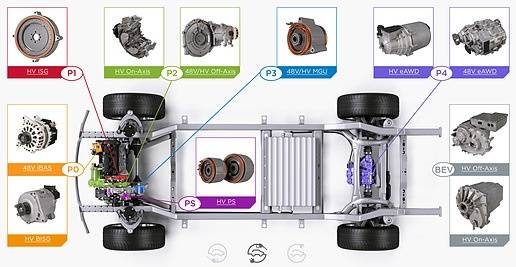 “P”代表產品已進入預備階段:圖中的P0到P4,都是博格華納目前正在研發中的電動推進系統架構。(圖型來源:博格華納)
 博格華納高級工程部門的技術研究員Joel Maguire表示,公司的戰略規劃就是要“玩轉各種混動架構”。(圖片來源:博格華納)