如今,汽車行業已經開始爭先采用48V混動系統。近日,雷諾(Renault)宣布,將于下月進入量產的全新2017款風景(Scenic)MPV將采用大陸(Continental)公司的低壓“輕”混合技術。在此之前,奧迪(Audi)也曾宣布旗下2017款SQ7將采用法雷奧(Valeo)的48V系統。此外,梅賽德斯-奔馳(Mercedes-Benz)也在近日宣布,新型六缸和四缸直列發動機系列也將采用48V子系統。
據了解,大陸的48V系統將作為一種標配,同時登陸汽油和柴油版的雷諾風景混合動力多功能車(Scenic Hybrid Assist)。該系統直接將液冷電機和逆變器集成至電機殼體之內,共同組成啟動器發電機(ISG)。系統具體位于內燃發動機前端輔機驅動的一般稱為“P0”的位置,通過筋帶與曲軸連接。大陸北美公司混合電動車工程主管Juergen Wiesenberger表示,系統內含一個5 kW·h的鋰離子電池,電池重約15kg(33lb)。
Wiesenberger告訴《汽車工程》雜志,登陸雷諾對大陸集團龐大的48V計劃來說,只是冰山一角。大陸集團計劃在未來幾年內向北美、歐洲和中國市場大量輸送48V系統,同時登陸汽油和柴油車型。大陸集團混合電動業務部執行副總裁Rudolf Stark稱,預計到2020年,全球采用48V系統的車輛總數將達到400萬輛;到2025年,全球約有20%的新車均將配備48V系統。
Stark認為,48V系統將成為混合電動和純電動汽車之間的“過渡技術”,為車輛提供額外6到20kW的功率,從而滿足不斷提升的汽車能效需求,并為客戶提供一系列新功能,包括電加熱擋風窗、自適應懸架系統及電動渦輪增壓器等。比較來看,全混合動力系統的功率輸出通常在20-40kW,插電式混合動力系統一般則在50-90kW。
Stark也認同其他推進系統工程師的看法,稱48V系統能夠“以30%的成本,提供其他高功率系統70%的效益。”Stark和Wiesenberger均表示,在同級別車內,與其他非混合動力系統相比,大陸的最新48V量產系統已經在真實駕駛環境下表現出了超過20%的燃料經濟性提升。
除了大陸集團,目前多家一級供應商均在積極敲定ISG和P2型(位于內燃機與變速器之間“P2”位置的電機)系統的生產合同。2017到2020年間,隨著世界各主要地區CO2減排規定越來越嚴格,這些系統預計也將逐步上市。
Wiesenberger表示,根據具體規格不同,大陸的液冷48V ISG系統大約可連續輸出6 kW的功率和60 N·m的扭矩,安裝體積與12V啟動器交流發電機相仿。根據版本不同,ISG系統最高可輸出150 N·m的扭矩。另外,這款48V系統應用了模塊化設計理念,采用了MOSFET型逆變器。
Wiesenberger表示,該系統可在0.2秒內啟動車輛內燃機,幾乎比12V啟停系統快一倍。他補充說,當配合柴油發動機使用時,由于電機可提供額外的扭矩,48V系統在較低轉速時可以將尾氣中的NOx排放降低10%。
P2型48V系統可以獨立于內燃機運行。Wiesenberger表示,大陸與舍弗勒(Schaeffler)聯合開發的P2型48V系統可為車輛提供50km/h的最高車速。與其他非混動型號相比,節油表現更是高達25%。
The industry’s race to deploy 48-V hybrid systems has begun. Renault is the latest OEM to announce incorporation of the “mild” low-voltage hybrid technology, developed and supplied by Continental, in its new 2017 Scenic MPV entering production next month. The news follows Audi’s earlier production announcement of a Valeo-supplied 48-V system in the 2017 SQ7 (http://articles.sae.org/14662 ). Mercedes also recently announced its new inline-six and four-cylinder engine families will include 48-V subsystems.
Conti’s 48-V system will be standard equipment on both gasoline and diesel versions of the Scenic Hybrid Assist model. The system features a liquid-cooled induction motor with inverter integrated into the motor housing comprising the integrated starter-generator (ISG) unit. It is fitted in the so-called “P0 [zero]” position on the combustion engine’s front-end accessory drive, coupled to the crankshaft via a reinforced belt. The system includes a .5 kW·h lithium-ion battery. Total system mass including battery is 15 kg (33 lb), said Juergen Wiesenberger, head of HEV engineering at Continental North America.
The Renault business is the tip of the iceberg for Continental’s 48-V program, Wiesenberger told Automotive Engineering. The company has 48-V production programs in the pipeline for both gasoline and diesel vehicles in North America, Europe and China over the next few years. His colleague Rudolf Stark, executive VP of Conti’s hybrid-electric business unit, forecast about 20% of new vehicles worldwide will be equipped with a 48-V system by 2025, about 4 million of them by 2020.
Stark considers 48-V systems to be a “bridge technology” between current mild HEVs and full EVs, providing 6 to 20 kW to meet the increased power demands of a variety of new vehicle-efficiency and customer-pleasing features including electrically-heated windshields, adaptive suspension systems and electric turbochargers. By comparison, a full hybrid system typically offers 20-40-kW and a plug-in hybrid, 50-90 kW.
Stark echoed other propulsion-system engineers that 48-V systems “provide about 70% of the benefit of higher-power systems for about 30% of the cost.” He and Wiesenberger claim Conti’s latest 48-V production systems have demonstrated up to 20% greater fuel economy in real-world driving, compared with non-hybridized powertrains in similar weight-class vehicles.
Continental is among a number of Tier 1 suppliers that are lining up production contracts for both ISG and P2 (e-motor fitted in the “second” position between the ICE and transmission) types. They are expected to launch within the 2017-2020 timeframe in conjunction with tightening CO2 regulations in the major regions.
Wiesenberger claims that Continental’s liquid-cooled 48-V ISG can, depending on specification, continuously provide 6 kW and 60 N·m (44 lb·ft) roughly within the package space of a 12-V starter alternator. Variants of the ISG are rated up to 150 N·m (110 lb·ft). Conti’s 48-V system is a modular design using a MOSFET (metal-oxide-semiconductor field-effect transistor)-based inverter.
Conti’s 48-V system starts the ICE within 0.2 s—about twice as fast as a 12-V stop-start system, Wiesenberger said. He added that when part of a diesel-hybrid propulsion system, 48-V has demonstrated reduced NOx emissions at lower rpm by up to 10% due to the supplemental torque generated by the e-motor.
P2-type 48-V systems enable independent operation of the combustion engine. According to Wiesenberger, Conti’s P2 system co-developed with Schaeffler allows all-electric driving at up to 31 mph (50 km/h) with a claimed fuel savings of up to 25% greater fuel efficiency than a non-hybridized model.
Author: Lindsay Brooke
Source: SAE Automotive Engineering Magazine

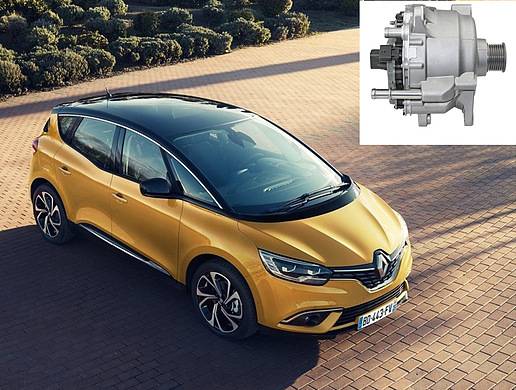 據了解,大陸的48V系統將作為一種標配,同時登陸汽油和柴油版雷諾風景混合動力MPV(Scenic Hybrid Assist)。ISG單元位于內燃發動機前端輔機驅動的所謂的“P0 [零]”位置,其中包括一款5kW·h的鋰離子電池。
 大陸集團北美混合動力工程主管Juergen Wiesenberger表示,該系統可在0.2秒內啟動車輛內燃機,幾乎比12V啟停系統快一倍,而且還能協助柴油車型將尾氣中的NOx排放降低最高10%。
 大陸集團混動業務執行副總裁Rudolf Stark認為,48V系統將成為混合電動和純電動汽車之間的“過渡技術”。