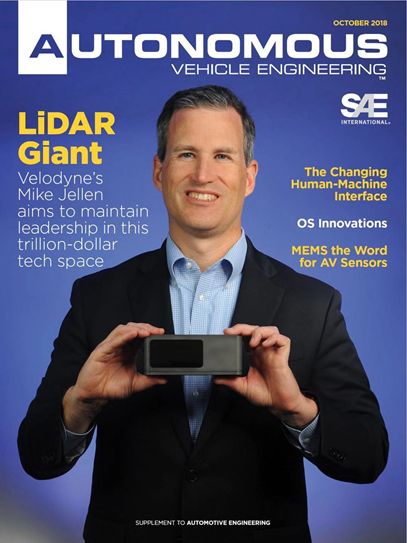
目前,激光雷達市場正處于高速發展之中,市場規模可達數萬億美元。盡管,這個市場中有超過100家競爭對手都在虎視眈眈,但行業領袖 Velodyne 公司總裁Mike Jellen 并不打算將領先優勢拱手讓人。
如果談起“激光雷達”,你腦海中浮現的第一家公司是哪家?可能很多人的第一反應都是Velodyne,畢竟這家硅谷公司的開創性激光雷達 HDL-64(64 通道、360° 視場)在 2007年 DARPA 無人駕駛汽車城市挑戰賽中“一戰成名”的表現太過讓人印象深刻。如今,Velodyne 繼續致力于 3D 激光探測與測距傳感器的研發,目前有 7 款激光雷達傳感器產品已正式上市,抵達成百上千家移動出行行業客戶,進行測試或有限商用。目前,Velodyne 公司圣何塞工廠的年產量已達數萬臺,但相比于未來市場對激光雷達產品的巨大需求,這仍然只不過是滄海一粟。
“通過一段時間的密集車隊測試,我們現在正在快速擴大汽車級激光雷達產品的量產規模,同時面向零售型 ADAS 系統和按需提供式移動出行服務車隊。”Velodyne 公司激光雷達業務總裁、首席商業官 Mike Jellen 解釋道,“目前,我們的產品大多供應給 SAE 4 級自動駕駛車輛,主要用于研發。然而,ADAS 安全系統也將在未來的新車活動中占據一定比例。我們認為,激光雷達產品的銷量將在 2019 到 2025 年間實現持續增長。”
對 Velodyne 而言,雖然激光雷達的高清 3D 繪圖能力也可以為公司創造收益,但自主和自動駕駛汽車仍是激光雷達產品的主要市場,一個價值數萬億美元的龐大市場。”Jellen 告訴SAE《自動駕駛汽車工程》雜志,“我們預計,世界上將有十億汽車裝配激光雷達,平均每輛車安裝 2 到 4 部,也就是說每輛車在傳感器方面的成本在 1,000 美元左右,那整個市場的規模可以輕松達到數萬億美元。”
事實上,Velodyne 的估計還算保守。Aptiv 公司已經在自己一款基于 BMW 的自動駕駛技術演示車上安裝了 9 部激光雷達。
為了為即將到來的淘金熱做好準備,Velodyne 一直在穩步擴充公司的研發、科學和技術力量。作為一家2006 年成立的公司,目前,Velodyne 在全球共有 5 個工廠和超過 500 名全職員工。
目前,Velodyne 已經拿到了多家投資者的投資,其中最引人注目的投資方包括美國福特(Ford)和中國百度公司。此外,Velodyne 與梅賽德斯奔馳(Mercedes)也有合作。
這家公司的核心知識產品資產包括嵌入式軟件和算法、探測器及 ASIC(專為移動出行級激光雷達定制的專用集成電路)技術。值得一提的是,Velodyne 公司的這些知識產品資產全部由公司內部研發。
提高分辨率、降低成本
2018 年 CES 拉斯維加斯消費電子展中,大量創新激光雷達產品都大放異彩,而且很多已經進入客戶評估階段,其中就包括Velodyne 公司的最新 VLS-128 激光雷達產品。Velodyne 公司激光雷達業務總裁 Jellen 稱 VLS-128 為“世界上最好的激光雷達傳感器”,這款產品現已從公司曾在 DARPA 挑戰賽中“一戰成名”的經典 HDL-64 激光雷達中接過大旗,登陸了多家廠商的自動駕駛原型車。據了解,VLS-128相較其之前型號,體積和重量均小了三分之一,激光通道數量卻增加了一倍,視場仍然為 360 度,據稱可以提供比之前高 10 倍的分辨率,物體識別和探測性能都有了顯著改善。
Velodyne 公司稱,VLS-128的探測距離高達 300 米(984 英尺),可直接用于車輛的目標探測,無需搭配額外的傳感器。此外,該產品專為自動組裝而設計,采用了專有的激光對準工藝。
除了 VLS-128之外,Velodyne 公司還推出了一款探測距離在 200 米(656 英尺)的固定式激光傳感器 Velarray。作為一款外形緊湊的激光雷達產品,Velarray 在汽車車身中的無縫集成將更加容易,同時適用于一些具備 ADAS 功能的 SAE 2 級部分自動駕駛汽車,以及 SAE 4 級或 SAE 5 級全自動駕駛汽車。除了顯著的集成優勢,Velarray 的價格也同樣具有吸引力,僅為“數百美元”。
Jellen 表示,公司還在同時研發將激光雷達與其他類型的傳感器(包括攝像頭)集成在一起的“集成傳感陣列”,同時迎合終端用戶的直接使用需求和其他公司的內部研發需求。
Velodyne 計劃采用分布式全球生產戰略,公司的生產設施分布在北美、中國和歐洲等地區,可直接支持當地客戶的需求,并提供多款汽車激光雷達產品,滿足不同市場的多樣化使用場景。
“在全自動駕駛汽車方面,一些行業巨頭肯定會先自己來做整合工作,其他公司則更有可能通過一些一級供應商合作伙伴,獲得 Velodyne 的支持。”Jellen 表示,“對于 ADAS 安全市場,我們可以通過一級供應商合作伙伴提供支持,也可以直接提供面向終端用戶的完整解決方案。因此,我們將采用一種一級/二級供應商混合交叉合作的策略,如今的情況就是這樣。“
SAE 4級自動駕駛汽車市場:普及率將達到 100%
目前,激光雷達市場正處于高速發展之中,市場規模可達數萬億美元,Velodyne 占據絕對優勢。但與此同時,該市場中還有超過100 家蠢蠢欲動地競爭對手,其中也包括一些 Velodyne 前員工創立的公司。在這樣一個高速增長的市場中,這種“摘櫻桃”(Cherry-picking)現象非常常見。
“這是一個潛力巨大的行業,一定會有大量公司前仆后繼地沖入這個領域,這并不令人驚奇。”Jellen表示,“不同公司在不同時段會采用不同的解決方案,盡管其中有些可能已經有 30 年或 40 年的歷史了。其中,一些公司正在借激光雷達的東風進行炒作,并希望從大量流入該領域的資金中分一杯羹。”
自動駕駛汽車工程師普遍認為,激光雷達對于 SAE 4 級和 5 級全自動駕駛汽車絕對必不可少,在 SAE 3 級自動駕駛汽車中也具有很高的價值。激光雷達可以利用脈沖激光測量動態距離,創建并更新 3D 地圖,讓 3 厘米級別的車輛定位成為可能,還可以作為一種安全失效冗余系統。
高清地圖允許車載處理器“不間斷地進行比較,感知固定和移動物體的位置,并獲得車輛在空間中的確切位置,無關于車輛的 GPS 或 IMU 慣性測量單元的性能。”Jellen 表示“這極大地簡化了車輛的實時感知挑戰。”
Jellen 是一名電氣和軟件工程師,他在 2015 年加入 Velodyne 公司,擁有 20 年的機器人和自動化行業經驗。Jellen 認為,激光雷達的真正商業應用將首先出現在自動駕駛穿梭巴士等在地理圍欄中行駛的運輸車輛。目前,試點車隊的測試正在順利進行中。
Jellen 表示,“未來,Navya、EsayMile 和百度Apollo (最近剛剛在中國公布的穿梭巴士項目)等自動駕駛穿梭大巴公司將繼續取得季度增長。”
Jellen 預計,在零售汽車市場中,激光雷達在 SAE 4 級自動駕駛汽車中將逐步實現 100% 的普及。他斷言,“我認為,除了激光雷達,沒有其他任何類型的傳感器可以滿足 SAE 4 級自動駕駛汽車的需求。”此外,一些提供“真正 SAE 3 級自動駕駛系統”(即高速公路下的放手/放松系統)的公司也開始為旗下產品增加激光雷達系統,從而提供一些 SAE 4 級自動駕駛功能,而不是依賴于駕駛員充當系統的“后備隊員”。
成本、尺寸、功耗
目前,激光雷達市場中的初創公司數量正在以爆發性速度增長,通常可以按照特定的傳感器類型對相關公司進行分類,例如固態激光雷達公司。Jellen 表示,除了現有產品外,公司還在研究數十種采用不同激光光束控制方法(包括固態傳感器)和不同視場范圍的激光雷達產品,從而更好地滿足不同使用場景的要求。Jellen 解釋到,“我們希望為特定應用場景選擇最合適地特定產品。”
通常來說,激光雷達的視場范圍可以分為兩類:窄視場和寬視場。窄視場激光雷達的視場范圍通常為 120 度或更小;寬視場激光雷達的視場則為 180° 或更大。 對于車輛安裝的固定式傳感器來說,清晰、寬廣的180 度視線范圍有助于車輛應對一些更令人生畏的駕駛場景,例如在高速接近丁字路口時,及時識別道路中的黑色輪胎碎片。
車輛研發工程師告訴《自動駕駛汽車工程》,2018 年,降低單位成本和提升包裝效率(將激光雷達“無痕”集成至車輛外殼內)是激光雷達領域需要解決的兩大挑戰。Jellen 表示,提高激光雷達的成本效益離不開兩件事:提高產量、借助 ASIC 技術。目前,Velodyne 公司的“基本款”16 通道 VLP-16 Puck 激光雷達的探測距離為 100 米,2018 年的小批量訂單價格約為 4,000 美元,而且可以為采購量大的汽車用戶提供更有競爭力的價格,而較早型號 HDL-64 的售價則高達 70,000 美元。
Jellen 預計,車輛安裝 4 部激光雷達的成本大約在 1,000 美元,這實際反映了 Velodyne 公司激進的降低成本計劃。事實上,除了提升產品性能、提高封裝效率外,Velarray 傳感器(采用 ASIC 技術)的另一項主要任務就是降低成本。第一代 Velarray 激光雷達的尺寸為 125 x 50 x 55 mm(大約 5 x 2 x 2 英寸),對于 OEM 設計師和車輛集成團隊來說,將這種尺寸的激光雷達集成至車輛外殼種會更容易。
一位車身結構工程師告訴《自動駕駛汽車工程》:“郵政車或自動駕駛出租車完全可以將激光雷達封裝在車身四周的突起中,但私家車卻不行。”Jellen 解釋說,“傳感器安裝地越高,你的視線就更高、可靠性也更高。對于一些具備自動緊急制動和 SAE 2 級以上自動駕駛功能的零售車輛來說,可以考慮將傳感器安裝在車輛保險杠中。”
但是,為了實現真正的 SAE 3 級自動駕駛功能(放手/放松駕駛,也就是駕駛員既不需要操作,也不需要操心),“你必須把傳感器至少安裝在駕駛員視線的高度才能讓傳感器有效‘觀察’周邊環境。”
Velodyne 的 ASIC 技術還有助工程師更好地管理“耗電大戶 ADAS 傳感器陣列”。“ASIC技術可以實現實時邏輯與‘智能’,且功耗非常低。”Jellen 解釋道,“未來,Velodyne 的傳感器將變得更加智能化,可以分擔如今自動駕駛汽車主機系統的部分工作。我們都知道,主機系統的耗電量一直很大,如果我們的傳感器可以分擔部分工作,則主機的功耗也能降下來一些。”
為了實現這一目標,Jellen 稱 Velodyne激光雷達可以實現“同時定位與制圖”且耗電量甚至不到 1 瓦。介紹一下,“同時定位和制圖”是指傳感器在感知周邊環境時,同時將周邊環境的結構繪制下來,這時一項非常了不起的成就。
Jellen 表示,“這有助于降低功耗,及集成復雜系統的成本。很顯然,這非常符合行業的要求和目標。”
關鍵任務技術
目前,為了在公司快速增長的團隊中增加研發力量,Velodyne 正在積極開展校園招聘和社會招聘活動。Jellen 表示,“我們正在尋找各個領域中的優秀工程師,包括電子電氣、嵌入式軟件、光學工程、包裝和質量等。”他同時承認,3D 激光雷達是一個非常新的專業,因此“我們也在尋找一些具有激光和光學行業經驗的人才。”
隨著 Velodyne 公司不斷發展,公司管理層認為,保持公司創始人David Hall 不斷創新的企業家精神和靈活機動的公司戰略非常重要。當然,說起來總比做起來容易。
“據報道稱,美國每 5 秒中就發生一起車禍,中國每天有 500 人在車禍中喪生,這太瘋狂了。”Jellen 表示,“我們必須團結一致,盡快讓傳感器在新車中發揮作用,讓這項可以挽救生命的技術盡快造福于大眾。”
100 competitors want to eat his lunch, but Velodyne president Mike Jellen aims to maintain leadership in this fast-moving, trillion-dollar technology space.
In a word-association game that begins with “lidar companies,” the first response is likely to be “Velodyne.” The Silicon Valley-based pioneer in 3D light-detection-and-ranging sensors, whose groundbreaking 64-laser, 360° field-of-view technology famously helped win the 2007 DARPA Urban Challenge for self-driving vehicles, is currently shipping seven sensor models to hundreds of mobility-industry customers for testing and for limited commercial use. The annual production rate from the company’s San Jose plant today, in tens-of-thousands of units, is just the tip of an impending tidal wave.
“We’re moving fast through a period of intense fleet testing into the initial ramp-ups for true auto-motive-scale, high-volume production—both for the retail ADAS as well as for on-demand mobility fleets,” explains Mike Jellen, Velodyne Lidar’s president and chief commercial officer. “Most current volume goes into [SAE] Level 4 developments. A significant portion of new-vehicle activity is on ADAS safety systems. We see an opportunity for sustained unit-volume growth occurring 2019 through 2025.”
While lidar’s high-definition 3D mapping capability represents a separate market for Velodyne, automated and autonomous vehicles (AVs) remain “the dominant force—a trillion-dollar market opportunity,” Jellen tells SAE’s Autonomous Vehicle Engineering. “We’d like each of the billion vehicles on the world’s roads to have two to four lidar sensors—maybe $1000 of sensors per vehicle—and see the trillion-dollar opportunity emerge.”
OEMs may bring suppliers even greater delight: Aptiv uses nine lidar units in its BMW-based AV demonstration vehicle.
To prepare for the gold rush, Velodyne Lidar has been steadily growing its engineering, scientific and technical resources. The company, founded by CEO David Hall in 2006 (see sidebar), now has over 500 full-time employees at five facilities around the world.
Ford and Baidu are among its high-profile investors, and the company also has a cooperation with Mercedes.
Velodyne’s core IP portfolio includes embedded software and algorithms, and detectors, as well as ASICs—application-specific integrated circuits that are custom engineered for mobility lidars. All are strategically developed in-house.
Higher resolution, lower cost
The latest fruits of this focus debuted at the 2018 CES and have been in customer evaluation. The VLS-128, which Jellen anointed “the best lidar sensor on the planet,” succeeds the company’s classic DARPA-winning HDL-64 seen spinning atop many proto-type AVs. Nearly one-third smaller and lighter than its predecessor, with twice the lasers (channels), the VLS-128 is claimed to deliver ten times better resolution. This greatly improves object identification and detection within a 360° field of view (FOV).
Velodyne claims the new lidar, with range up to 300 m (984 ft) can be used directly for object detection without additional sensor fusion. It was designed for automated assembly that includes a proprietary laser-alignment process.
Also appearing was the Velarray, a fixed-laser, solid-state sensor with 200-m (656-ft) range. Designed with a compact form factor for more natural integration into vehicle bodywork of both ADAS-enabled SAE Level 2 automated-driving vehicles, as well as SAE Level 4 and 5 autonomous vehicles, the Velarray’s target price—“in the hundreds of dollars” at automotive scale—was equally big news.
And according to Jellen, development also is underway on integrated arrays that combine lidar and other sensor modalities including camera—“both in direct fulfillment efforts to customers as well as internal R&D.”
Velodyne plans a regional approach to global lidar production, with manufacturing facilities to serve customers directly in North America, China and Europe. A range of vehicle-integration models depends on the vehicle market and use case.
“On the full-AV side, the leading companies will have in-house integration efforts,” Jellen said. “Others will rely on Tier-1 partners, through whom Velodyne will support directly. For the ADAS safety market, Velodyne will support both through Tier 1 partners as well as through direct full solutions. Therefore, we plan on a Tier 1/Tier 2 mix, as is the case today.”
100% Level 4 market penetration
Occasionally dubbed “the 800-pound gorilla” of the mobility-lidar market, Velodyne currently sits atop a burgeoning technology space that, by some counts, includes nearly 100 players of varying strengths and prospects. Some new competitors include ex-Velodyne staff—typical cherry-picking activity in a high-growth industry.
“Given the potential, it’s not surprising we see a large number of companies and approaches coming in to attempt to serve this vast opportunity,” he said. “Different companies are targeting different solutions at different times, though there has been a lot of repackaging of approaches that are 30, 40 years old. A number of these companies are taking advantage of the hype on lidar, and of the significant investment flowing into the space.”
AV engineers widely consider lidar to be an essential sensor (in combination with cameras and radars) for SAE Level 4 and 5 “full-autonomous” operation, and of high value in Level 3 automated driving. Employing a pulsed laser to measure variable distances, lidar is used for creating and updating 3D maps that enable real-time, 3-centimeter-level precision in vehicle location as well as providing fail-safe sensor redundancy.
The high-def maps allow the on-board processors to “continually compare and get a sense of static and dynamics and know exactly its position in space regardless of GPS or IMU [inertial measurement unit] performance,” Jellen said. “This greatly simplifies the real-time perception challenge.”
Jellen, an electrical and software engineer, joined Velodyne in 2015 with 20 years’ industry experience in robotics and automation. He expects the first major commercial lidar applications to be in autonomous shuttles and delivery vehicles running a geofenced route. Pilot-fleet use is well underway.
“You’ll continue to see quarter-over-quarter growth with [AV shuttle] companies such as Navya, EasyMile and Baidu Apollo,” whose new shuttle program in China was recently announced.
For the retail vehicle market, Jellen expects eventual 100% market penetration for lidar for SAE Level 4 driving. “I do not see another type of sensor that fills in for its capability,” he asserted. And companies choosing a “true Level 3” system—hands-off/mind-off highway operation—are including lidar to provide Level 4 functionality in that operating mode, rather than risk relying on the driver to be the backup.
Cost, size, power consumption
The explosion of lidar start-ups has tended to classify companies by a particular sensor approach, such as solid state. Velodyne is researching “dozens” of models beyond its current portfolio, Jellen said. The goal is to offer different beam-steering methodologies (including solid-state sensors), and both wide and narrow FOV types to serve various use cases. “The right tool with the right maturity for a given product line is how we do it,” he explained.
Narrow FOV is typically 120 degrees or less; wide is 180° or more. For one sensor placed on one location in the vehicle, being able to “see” a clear 180-degree sweep helps to solve some of the more daunting driving scenarios, such as identifying black tire-chunk debris in the road while approaching a ‘T’ intersection at speed.
Unit cost reduction and package efficiency—creating a form factor that can be integrated invisibly into a vehicle’s exterior skin—are the two greatest challenges related to lidar in 2018, vehicle development engineers tell AVE. According to Jellen, cost performance requires two things: volume, and ASICS. Velodyne’s “base” 16-channel unit, the VLP-16 Puck with 100-meter range, can be had for about $4000 for low-volume orders in 2018—far less than the $70,000 price tag of the old HDL-64 and has the ability to be priced competitively for high-volume automotive customers.
Jellen’s projection of $1000 for a four-unit vehicle array highlights Velodyne’s drive toward an aggressive unit-cost target, at volume. That is one of the missions, along with performance and package efficiency, of the new ASIC-enabled Velarray sensor. The first-gen Velarray unit measures 125 x 50 x 55 mm (roughly 5 x 2 x 2 in.), a dimension that OEM stylists and vehicle-integration teams will find easier to incorporate all around the vehicle.
“Having to package lidars inside aero-style blisters around the body may be acceptable for mail trucks or robo-taxis, but not for private vehicles,” a body-structures engineer tells AVE. Jellen explains that the challenge of perception is “you ‘see’ the environment much better, and with higher reliability, with a higher vertical sensor position within the vehicle. A retail vehicle that contemplates automatic emergency braking and limited Level 2-plus functionality may contemplate locating sensors in the bumpers.”
But in the quest for true Level 3 eyes-off, mind-off functionality, “you need the sensors to effectively ‘see’ at or above the human-eye [vertical height] level.”
Velodyne’s ASICs development also is helping engineers manage power-hungry ADAS sensor arrays. “They [ASICs] are enabling real-time logic and ‘intelligence’ at very low power consumption,” Jellen explained. “You’ll continue to see Velodyne sensors become more intelligent, with some ability to off-load the high-power host systems in the AVs today. As they off-load some of that responsibility, the power consumption required for the host will be reduced.”
Toward that goal, he cited demonstrations of ‘slamming’ within the Velodyne lidar using less than 1 watt of power. The term—simultaneous localization and mapping—refers to the algorithmic challenge of localizing (i.e. finding the position/orientation of) a sensor with respect to its surroundings, while simultaneously mapping the structure of that environment. A noteworthy achievement.
“It helps reduce power consumption and the integration costs of complex systems, which are clearly targets set by the industry,” Jellen said.
Mission-critical tech
Adding engineering muscle to the fast-expanding team, Velodyne has ongoing recruiting efforts at the major universities and within industry. “We’re looking for strong engineers across the various disciplines including electrical, embedded software, optical engineering, advanced packaging, and quality,” Jellen reports. The real 3D lidar discipline, he admits, is a fairly new space, “so we look for people with experience in the laser and optical industries.”
And as Velodyne diversifies, its leadership realizes the importance of maintaining the entrepreneurial spirit and flexibility created by founder Hall. That, of course, can be easier said than done.
“There is a police-reported vehicle accident in the U.S. every five seconds; 500 people are lost per day in China. These are crazy statistics,” Jellen says. “We need sensors that deliver true functionality into new vehicles as quickly as possible. We’re united under the mission of bringing life-saving technology to the masses.”
Author: Lindsay Brooke
Source: SAE Autonomous Vehicle Engineering Magazine

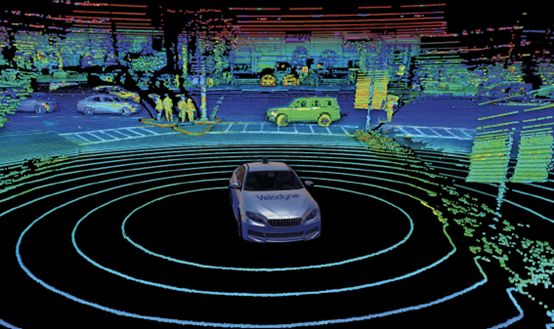 Velodyne 公司最高端的 3D 激光雷達傳感器VLS-128 發布于 2018 年,專為自動駕駛汽車設計,擁有128 個激光通道,可提供正負 0.1 度的水平/垂直分辨率,探測范圍 300 米,視場角度可達 360 度。圖為 VLS-128 生成的街景點云圖,速度達每秒 960 萬點。
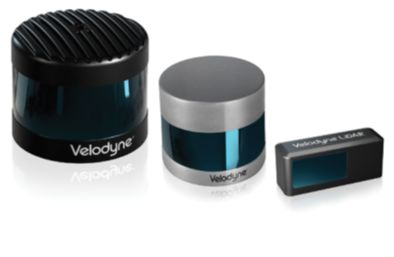 Velodyne 最新激光雷達產品的尺寸對比圖,從左到右分別為 VLS-128、32 通道的 Ultra Puck VLP-32C 及外形最為緊湊的固定式激光雷達陣列 Velarray。此外,在本期雜志封面上,Velodyne 公司激光雷達業務總裁 Mike Jellen 手中握著的正是一款 Velarray 。
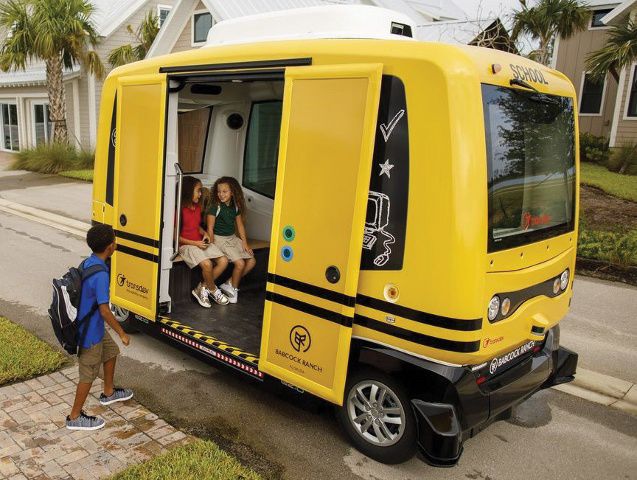 對于商用自動駕駛穿梭巴士(比如圖中來自 EasyShare 的EZ10)而言,激光雷達的集成“隱身”挑戰并不像私家車般顯著,但巴士運營商仍然希望激光雷達能夠無縫融入車輛,不影響其外觀。最近,法國自動駕駛汽車制造商EasyShare 在美國加州的部分公共路段推出了自動駕駛汽車穿梭巴士服務。
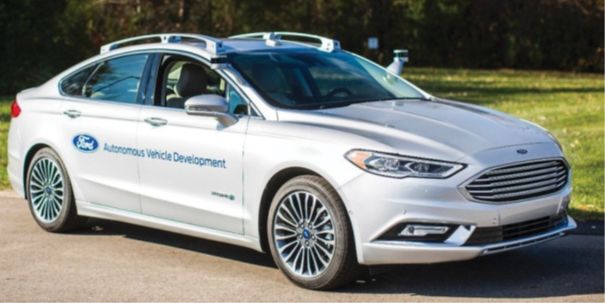 福特的 Fusion 自動駕駛演示車將傳感器陣列安裝在車輛頂部兩側的“支架”上,并在車輛A 柱上安裝了 Velodyne 的 Ultra Puck 激光雷達。