德爾福(Delphi)將在2017年美國拉斯維加斯國際消費類電子產品展覽會(CES 2017)的舞臺上,展示一款新型先進自動駕駛系統。作為一款“一站式”完整自動駕駛系統,該平臺預計將于2019年前送達各家汽車廠商,為車輛提供SAE 4級到5級的全自動駕駛功能的支持。
據了解,這款德爾福“中央傳感定位與規劃系統(CSLP)”采用了英特爾(Intel)的最新超級計算機微處理器芯片,以及以色列機器視覺專家Mobileye的全新傳感器融合處理器和三焦攝像頭硬件系統。
提到CLSP,除了德爾福公司賦予這個系統的強大微處理能力之外,最為獨特的地方也許正是由Mobileye開發的新型“道路體驗管理系統(Road ExperienceManagement,REM)”。REM系統可利用眾包信息為車輛提供一幅超高精度的實時地圖。Mobileye稱,“沒有地圖,就沒有安全的自動駕駛系統”。
2017年CES展的技術演示道路長約10.1公里,覆蓋了德爾福所稱的“自動駕駛公開演示以來,最為復雜的市內/高速綜合路段”。
在CES展之前舉行的CLSP系統背景信息媒體發布會上,德爾福公司服務副總裁Glen De Vos積極發聲稱,今年的CES展將見證德爾福、Mobileye和英特爾三家公司的史上首次聯合演示,我們非常激動。
“大家都希望在2019年前推出無人駕駛汽車,但在這場競賽中,有三個因素會讓真正杰出的產品脫穎而出,”De Vos表示,“一是攝像頭、雷達和激光雷達等感知傳感器;二是駕乘體驗;三是計算處理速度。”
De Vos向在場媒體表示,相較于其他系統常用的,成本更高的激光雷達傳感器,CLSP系統在生成周邊環境信息時大膽采用了先進視覺感知系統與軟件,因此成本相對更低。
De Vos表示,德爾福“一站式”CLSP系統的成本大約在5,000美元,而且這一數字預計還將隨著元件成本的下降與銷量的上升而大幅下降。他還表示,目前,德爾福系統尚未敲定任何“確定客戶”。
整合各路選手與技術
在未來的自動駕駛研發中,德爾福將繼續扮演自身一級技術整合商的角色,向無力或無意依靠自身力量進行自動駕駛研發的汽車廠商提供整合式系統,這也意味著在推廣初期,德爾福需要承當相應的責任。
2016年8月,德爾福宣布將與Mobileye進行傳感器融合方面的合作,助力高級別自動駕駛系統的發展。數月之后,公司證實已選擇英特爾為系統供應計算速度高達每秒萬億次的高級處理芯片。
2015年,德爾福收購了從卡內基梅隆大學研發實驗室中獨立出來的自動駕駛軟件工程專家公司Ottomatika。很大程度上來說,正是在Ottomatika駕駛軟件算法的幫助下,德爾福才能完成2015年的那場全自動汽車橫跨美國之旅。
目前,Mobileye已經與27家汽車廠商簽訂協議,為這些廠商提供高級駕駛員協助技術。但在與Delphi建立合作前不久,Mobileye曾直接卷入了迄今為止自動駕駛技術發展史上最大的挫折之中——一輛在自動駕駛模式下行駛的特斯拉電動車發生了事故,駕駛員不幸喪生,而這輛車正是采用了Mobileye的攝像頭視覺和軟件系統。
盡管如此,Mobileye的最新視覺傳感硬件和軟件系統仍是德爾福CLSP系統傳感器融合與軟件功能的核心,特別是基于EyeQ 4/5片上芯片微處理器的REM軟件。這樣一來,即使在沒有GPS信號的情況下,車輛的攝像頭視覺系統也能將車輛定位的誤差控制在10厘米以內。
公司高級副總裁、首席通信官Dan Galves在談及REM系統時表示,“這才是Mobileye對行業的真正貢獻。”
REM軟件目前“仍處于驗證階段,”Galves補充說,Mobileye已經開始向通用汽車(General Motors)、日產(Nissan)和大眾汽車(Volkswagen)供應REM軟件,支持這些公司采用的基于EyeQ芯片的視覺系統。
精度進一步提升
De Vos表示,利用REM系統實時理解“當地”環境信息是德爾福全新自動技術平臺“自動駕駛系統的關鍵元素”。他解釋說,公司最近在新加坡開展的“自動駕駛按需出行(AMOD)”試點項目,將采用基于REM的系統。德爾福還計劃在北美和歐洲城市(很大可能是匹茲堡和波士頓)開展類似的AMOD演示項目。
有意思的是,在Mobileye和英特爾的協助下,盡管德爾福的CLSP平臺擁有很大的計算處理容量,但REM軟件本身并不需要很大的存儲容量。系統僅需大約60GB的數據存儲空間,就可以記錄全美所有“本地化信息”所需的路測標志、建筑物,以及無數的其他固定道路標記。
但至少到目前為止,先進攝像頭系統和REM仍無法取代激光雷達傳感系統所提供的高精度車載地圖功能。德爾福的De Vos表示,為了增強車輛的視覺傳感功能,我們的CES演示車上安裝了6個機電激光傳感器,當然還有雷達系統。
德爾福認為,AMOD項目很有可能成為高級別(SAE 4級到5級)自動駕駛系統的首批采用者。De Vos稱,自動大巴、出行“小車”和私人駕乘分享汽車可能是高級別自動駕駛在推廣初期的最佳應用。
Delphi will use CES 2017 to demonstrate an advanced new automated-driving technology platform the company plans to make available to automakers by 2019 as a complete system to enable vehicles to operate with SAE Level 4-5 fully autonomous capability.
The Delphi technology platform, called Central Sensing Localization and Planning (CSLP), leverages the latest supercomputing microprocessor chip from Intel, as well as a new sensor-fusion processor and tri-focal camera hardware from Israel-based machine-vision specialist Mobileye.
But apart from the pure microprocessing power Delphi’s assembled for the CSLP system, perhaps its most unique advance is new, Mobileye-developed software called Road Experience Management. REM provides the vehicle with crowd-sourced information to create an ultra-precise, real-time map that Mobileye said “is a prerequisite for safe autonomous driving.”
The Las Vegas demonstration during CES 2017 is on a 6.3-mi (10.1-km) course comprised of public roads that Delphi claimed is “the most complex automated drive ever publicly demonstrated on an urban and highway combined route.”
At a media information background session prior to the CES unveiling of the CSLP system, Glen De Vos, vice-president of services for Delphi, enthused that the CES demonstration is “the first time we will showcase this (combined Delphi, Mobileye and Intel technology) together. We couldn’t be more excited.
“Three factors will separate the leader from the pack in the race to offer driverless vehicles by 2019,” De Vos continued in a release: “best-in-class perception sensors such as cameras, radar and LiDAR, automotive experience and computer processing speed.”
De Vos told the media the system, because of its advanced vision-sensing and software, will be less-expensive than others being developed that rely on still-costly LiDAR sensors to generate adequate data about the environment around the vehicle.
He said Delphi projects its turnkey system will cost on the order of $5,000, but that figure is of course expected to plummet as costs are reduced and sales volumes increase. He also said Delphi currently has no “committed customers” for the system.
Assembling the players and technologies
For autonomous-driving development, Delphi will continue its established role as a Tier 1 integrator of technology in order to sell a complete system to automakers, many of which either do have the resources to develop their own automated-driving system or are not inclined to do so, preferring for suppliers to make the investment—and, potentially, to shoulder the early-adoption liabilities.
In August 2016, Delphi announced its partnership with Mobileye to develop the sensor-fusion aspects required for high-level automated driving. A few months later, the company confirmed it had enlisted Intel to supply the advanced processing chipset that will enable trillions of calculations per second.
In 2015, Delphi acquired Ottomatika, an automated-driving software engineering specialist spun off from research at Carnegie Mellon University. It was Ottomatika driving-software algorithms that subsequently helped Delphi achieve a fully autonomous cross-country vehicle trip in 2015.
Not long before its partnership with Delphi, Mobileye, which has contracts with 27 automakers to supply some type of advanced driver-assistance technology, was on the front lines of autonomous driving development’s most notable setback to date: a Tesla car using Mobileye camera vision and software crashed while under autonomous control, killing the driver.
It is Mobileye’s latest vision-sensing hardware and software, however, that is at the center of the Delphi CLSP system’s sensor-fusion and software capabilities—particularly the REM software “overlay” on its EyeQ 4/5 System-on-a-Chip microprocessor. This enables the camera-vision capabilities alone to position the vehicle with a 10-cm (3.9 in) accuracy—even in the absence of a Global Positioning System (GPS) signal.
Dan Galves, senior vice-president and chief communications officer, said of REM, “This really is what Mobileye is offering to the industry.” He added that in internal development, a test vehicle was able to drive autonomously using only camera vision after just four circuits of a congested portion of I-75 near Detroit supplied the necessary visual data for REM.
The REM software is “really in the validation phase right now,” said Galves, who added that Mobileye also has supplied the REM software to EyeQ-based vision systems being used by GM, Nissan and Volkswagen.
Next-gen accuracy
Real-time understanding of the “local” environment with REM is “the key element of automated driving” using Delphi’s new autonomous-technology platform, said De Vos. He explained that the company’s recent automated mobility on demand (AMOD) pilot program in Singapore will adopt the REM-based system. Delphi also plans AMOD demonstration programs in North America and Europe (likely cities in the U.S.: Pittsburgh and Boston).
Ironically, despite the high-powered processing capacity Delphi is building into its CLSP platform with the help of Mobileye and Intel, the REM software itself does not require much memory capacity. The roadside signs, buildings and countless other fixed landmarks throughout the nation that the system employs for a large portion of its localization “knowledge” only needs about 60 GB of data storage.
But at least for now, advanced camera vision and REM isn’t replacing the highly accurate onboard mapping capability available from LiDAR sensing. Delphi’s De Vos said the CES demonstration vehicles will have six electromechanical LiDAR sensors, not to mention radar, to augment vision sensing.
Delphi sees AMOD projects as the likely first candidates for high-level (SAE Level 4-5) autonomous driving. De Vos noted that autonomous buses, mobility “pods” and individual ride-share passenger cars probably will be the best initial deployments for high-level autonomy.
Author: Bill Visnic
Source: SAE Automotive Engineering Magazine

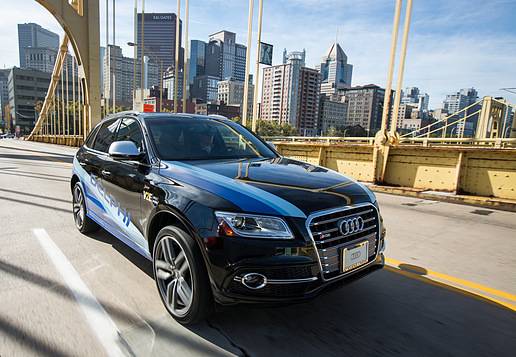 德爾福的演示車輛采用了公司的最新自動駕駛技術,目前正在美國匹茲堡市進行測試。據了解,匹茲堡也是德爾福Ottomatika駕駛軟件工程部的所在地。
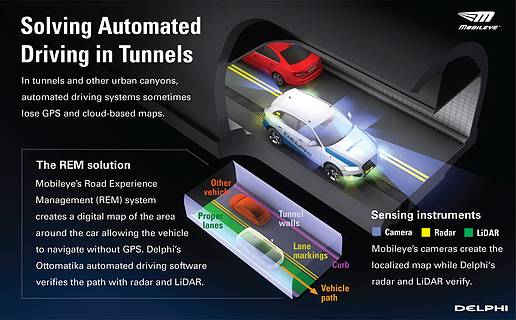 以色列機械視覺專家Mobileye公司開發的REM系統,是德爾福全新CSLP自動駕駛技術平臺的關鍵支持技術。
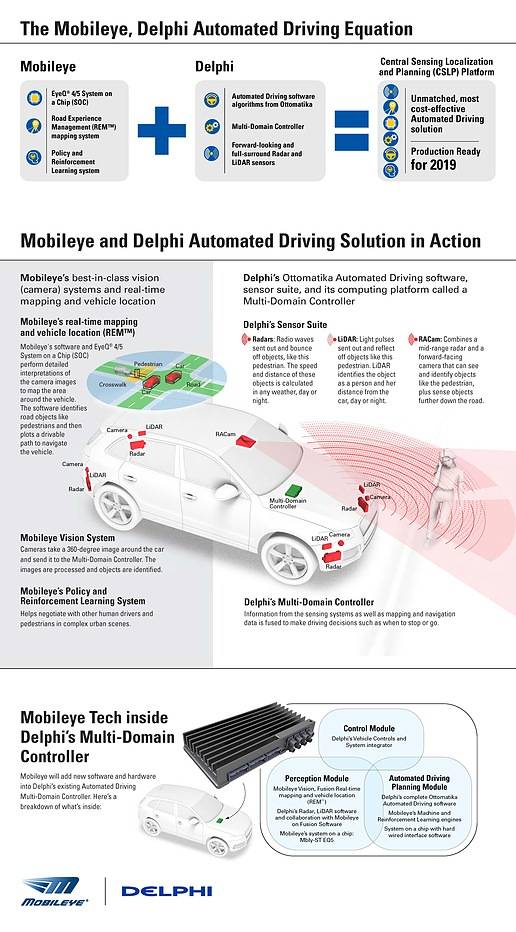 德爾福CSLP平臺的具體硬件和軟件技術簡介。據稱,該系統將在2019年做好上市準備。
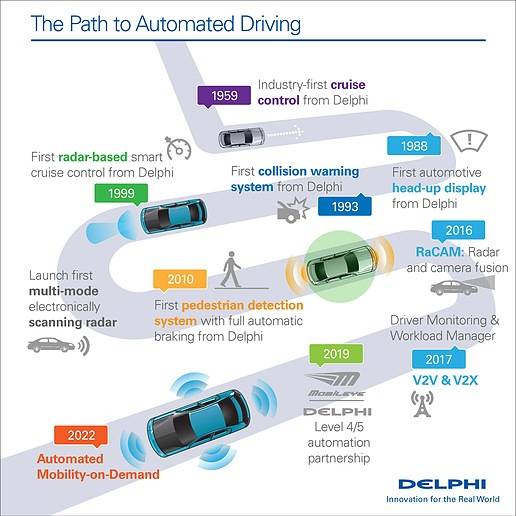 德爾福提出的高級別自動駕駛系統(SAE 4級到SAE 5級)開發規劃圖。這里主要指適用于量產車型的自動駕駛系統。