無論是可以指揮車輛在越野環境“上山下坡”的制動巡航控制系統,還是可以監測駕駛員視野以外危險道路用戶的傳感系統,這些都是大陸集團(Continental)的最新科技研發成果,目前基本均已做好量產準備,或已有量產計劃。
如果駕駛員視線受阻,行人、慢跑者和自行車等道路弱勢用戶都很容易暴露在車輛帶來的危險之中。車輛配備的攝像頭可以提醒駕駛員注意一些被其他車輛或障礙物遮擋的道路使用者,有時甚至可以更早發現潛在的風險。
大陸集團正在測試利用超寬頻帶傳感器,識別危險道路使用者。近日,《汽車工程》在大陸集團位于密歇根州的研發中心對這種傳感器進行了測試。具體來說,傳感器安裝在演示車的兩側后視鏡和副駕駛側的C柱上,但只有在特定距離內才能發揮作用,這與電子車鑰匙采用的傳感技術類似。另外,測試中還安排了一個裝備傳感器的安全測試假人,站在馬路中間充當行人。
通過綜合參考傳感器信號,演示車輛的通信網絡可以更快監測到安全測試假人“目標”,速度比傳統攝像頭監測系統快三到四秒。
大陸集團系統、技術及底盤與安全部北美總監Jeremy McClain表示,“這個演示讓我們開始思考,到底該如何避免事故發生,保護道路弱勢用戶,并拿出一個適合未來交通環境的解決方案。”
“巡航司機”系統(Cruising Chauffeur)
正如V2V和V2I通信一樣,了解道路用戶的確切位置有助于防止意外的發生。大陸軟件工程師Ganesh Adireddy說:“現在的重點就是如何獲取道路行人的信息,未來我們在實際應用中可能會利用行人的智能手機、智能手表或特殊應答器等裝置。”與GPS系統相比,短程通信技術的定位功能更加準確,也更加快速。
在自動駕駛場景中,能否獲知精確的位置信息至關重要。正因如此,大陸集團專門研發了“巡航司機(Cruising Chauffeur)”功能,從而提升車輛的傳感能力,輔助遠程和近程雷達攝像頭系統的工作。公司V2X團隊高級技術專家Eric Mertz表示,大陸的M2XPro算法可以綜合考慮GPS和車輛傳感器系統的數據輸入。
“在一些情況下,比如市內建筑物太多的時候,GPS信號就可能會反射在這些建筑物上。”Mertz指出,“這種情況可能會導致GPS系統給出錯誤的位置信息。”然而,通過綜合M2XPro和 “巡航司機”通信技術,大陸集團得以將定位誤差控制在1.5米以內。
大陸自動駕駛項目測試/驗證工程師SteffenHartmann表示,最近,公司還給“巡航司機”演示車增加了自動變道和車道跟隨功能。當采用“巡航司機”系統的車輛進入自動駕駛模式時,如果駕駛員發出變道指示,車輛就會在安全時自動進行變道。另外,如果前方車輛減速,“巡航司機”系統就會通過人機界面提示駕駛員可以變道。
目前,大陸集團位于美國、墨西哥、德國、日本和中國的研發團隊均在進行“巡航司機”的研發。Hartmann表示,“我們將不斷取得越來越多進步,直至最終實現SAE 4級自動駕駛的水平。”大陸官員預測,高級別自動駕駛技術將在2020年成型,而全自動駕駛技術則將在2025年成型。
“安靜”的越野功能
大陸集團的MK C1電子制動系統支持越野巡航控制(OCC)功能,目前已經做好量產準備。最近,MK C1系統剛剛登陸歐洲版阿爾法羅密歐Giulia轎車。
這款創新MK C1系統集成了制動促動、制動升壓和控制模塊,重約13磅(6公斤),比傳統制動系統輕大約4.4到6.6磅(2到3公斤)。大陸電子制動系統部汽車測試工程師Tim Buchert表示,電動-液壓式MKC1制動系統采用了線性促動器,而非傳統制動系統的雙活塞或六活塞泵。
在演示中,一輛配備了MK C1電子制動系統的吉普大切諾基(Jeep Grand Cherokee)將OCC模塊設定為1.2 mph(1.9 km/h)。此時,駕駛員僅用控制方向盤即可,車輛不僅可以爬上30º的巖石坡,在掛倒擋時也能下到類似的坡度。
“系統在提升制動壓力時非常安靜,因此車輛在上山下坡時并不存在任何NVH或抖動問題。”Buchert解釋道,“在混合動力汽車中,你可以踩剎車向電機發送減速命令,汽車將首先通過電機減速,而后慢慢進入常規制動過程。”
A braking and cruise-control system that can move a vehicle up and down steep off-road hills. Vehicles that can detect at-risk road users not in the driver’s field of vision. These production-ready and production-intent technologies are in Continental’s product pipeline.
Pedestrians, joggers and bicyclists are vulnerable to a vehicle impact when hidden from a driver’s sight. While a camera-equipped vehicle can alert its driver to someone partially concealed by a parked car or other obstruction, even earlier detection is possible.
Continental is testing the use of ultra-wide-band sensors to identify at-risk road users. These proximity-based sensors, like those used in key fobs, are located on the side mirrors and on the passenger-side C-pillar of a demonstrator car tested by Automotive Engineering recently at the supplier's Brimley, MI, Development Center. A sensor-equipped safety dummy stands in for a wandering pedestrian.
By triangulating the sensor signals, the sedan’s communication network detects the safety dummy "target" three to four seconds earlier than a vehicle using cameras.
“This demonstration is a thought-starter. We have to start thinking about how to avoid accidents with vulnerable road users in order to have a solution in the future,” said Jeremy McClain, Continental’s North American Director of Systems and Technology, Chassis & Safety Division.
The 'Cruising Chauffeur'
Like V2V and V2I communications, knowing the precise location of a road user can help prevent an accident. Said software engineer Ganesh Adireddy, “It’s all about sharing information from the pedestrian road user, who in actual use likely would have a smart phone, a smart watch, or a special transponder.” Short-range communication can identify a person’s position more accurately and do so more quickly than GPS.
Precise location information is critically relevant in autonomous driving scenarios, which is why Continental’s "Cruising Chauffeur" feature is designed to add another layer of sensing capability to compliment long- and short-range radars and cameras. According to Eric Mertz, senior staff technical specialist for the V2X team, Continental’s M2XPro algorithm fuses GPS and vehicle sensor data.
“There are situations, like an urban canyon, where a GPS signal reflects off buildings," Mertz noted. "And when that happens, it gives a false indication of where you’re at in the city.” By incorporating M2XPro with the Cruising Chauffeur’s existing communication technology, positioning accuracy below 1.5 m (5 ft) is expected, he said.
Automated lane change and lane-change recommendation capabilities were added recently to the Cruising Chauffeur demo vehicles, according to Steffen Hartmann, test and validation engineer involved with the automated driving project. When a Cruising Chauffeur vehicle is in automated driving mode, a driver’s turn signal movement tells the car to make a lane change if it’s safe to do so. A lane change recommendation occurs via the HMI interface if a vehicle in front of the Cruising Chauffeur slows down.
Engineering teams in the U.S., Mexico, Germany, Japan, and Shanghai are working on the Cruising Chauffeur. “We’re making more and more steps toward our final SAE Level 4 automated driving vehicle,” said Hartmann. Continental officials expect technology for highly automated driving to be ready by 2020 and fully automated driving technology to be ready by 2025.
Tip-toeing off road
Continental is production-ready with its MK C1 electronic brake system with Off-Road Cruise Control (OCC). The MK C1 portion of the system recently debuted on the European-market Alfa Romeo Giulia.
The innovative MK C1 unit integrates brake actuation, brake booster, and control systems. It weighs 13 lb (6 kg), about 4.4-6.6 lb (2-3 kg) less than a traditional system. According to Tim Buchert, a vehicle test engineer with the electronic braking systems group, the electro-hydraulic MK C1 uses a linear actuator instead of the two- or six-piston pump that’s in conventional braking systems.
During a demonstration, a Jeep Grand Cherokee equipped with the MK C1 only required the driver to steer the SUV after the OCC was set at 1.2 mph (1.9 km/h). The vehicle climbed a rocky 30º grade. It also moved itself down, and up, a similarly steep grade while in reverse gear.
“The system is silent when building up brake pressure, so there isn’t any NVH or pulsating as the vehicle climbs or descends the hill," Buchert explained. "In a hybrid driving application, you can hit the brake pedal to send a deceleration request to the electric motors. The vehicle will slow down using the electric motors and over time slowly fade-in conventional braking.”
Author: Kami Buchholz
Source: SAE Automotive Engineering Magazine
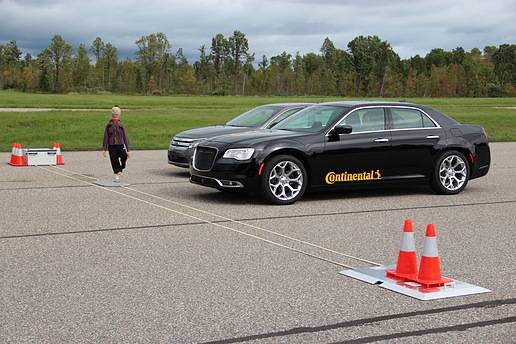 別撞到過馬路的假人了!大陸集團的全新超寬頻帶傳感器系統正在公司位于密歇根州的研發中心進行演示。
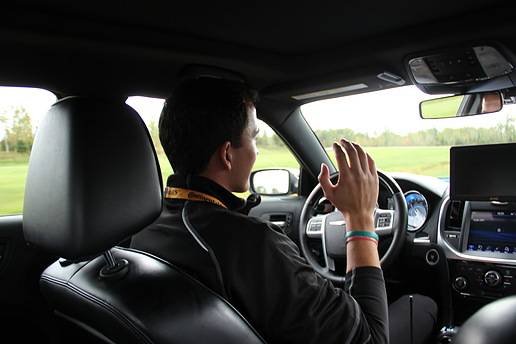 大陸集團工程師Steffen Hartmann坐在大陸“巡航司機”演示車中,雙手并沒有握著方向盤,即使此時車輛正在進行高速行駛。
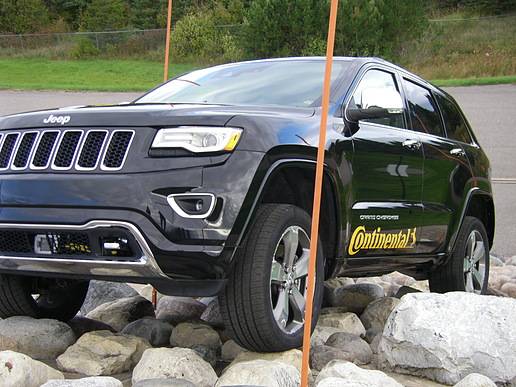 一輛配備大陸系統的吉普大切諾基正在爬30o的巖石坡。
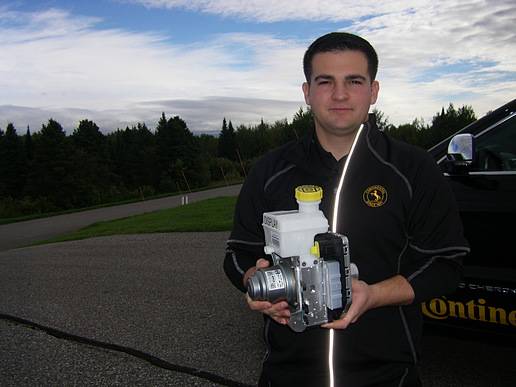 大陸集團的Tim Buchert手握MKC1制動系統。