前克萊斯勒公司在2011年推出Pentastar 3.6升汽油發動機,目標是為了取代七款現行V6發動機,以及3.0升發動機(中國使用)和3.2升發動機。現在,這一目標已完全達成。然而,盡管2011款Pentastar發動機設計較為靈活,但相對來說仍比較簡單,它保留了進氣口燃油噴射技術,無廢氣再循環系統(EGR)。并且,在渦輪增壓技術盛行的當時,這款發動機采用的是自然吸氣技術。
這種方法可以降低成本。目前,菲亞特克萊斯勒汽車公司(FCA)正在為2016款車型逐步進行Pentastar發動機的升級工作,目的也是為了控制成本。進行升級非常重要,因為對幾乎所有FCA北美車型來說,包括Ram皮卡在內,V6發動機都很有價值。FCA北美發動機、傳動和電氣推進部門副總裁Bob Lee表示,改良的V6發動機在美國聯邦綜合測試循環中,燃油經濟性提高了6%,最大輸出功率提高5.0 hp/3.7 kW(達到295 hp/220 kW),3000 rpm轉速下的扭矩提高了15%。
改良的V6發動機仍采用自然吸氣技術和進氣口噴射技術,而現在,還能夠向直接燃油噴射技術和渦輪增壓技術過度,這兩項技術正在位于美國密歇根州的奧本山公司總部進行研發,污染物顆粒捕集器也在此進行研發,以滿足未來的法規要求。
可變氣門升程系統
二階式可變升程進氣門系統也添加到了發動機中,系統由電磁閥控制油壓啟動,每個氣缸蓋都具備兩個電磁閥。一個電磁閥在前端,用于控制第一個氣缸進氣門;另一個電磁閥在后端,用于控制第二個和第三個進氣門。每個凸輪滾軸從動件都裝有一個由彈簧負載鎖銷固定的旋轉大升程部件;大升程模式(10.3毫米/0.41英寸)設定為默認模式。
在加速狀態下,一個電磁閥打開,油壓推動鎖銷釋放大升程從動部件。升程從動部件沿著套管向下旋轉,滾軸從動部件配合低閥門升程(5.75毫米/0.23英寸)凸輪軸工作,在轉速小于2800 rpm的切換值下,發動機都是如此運轉。Lee解釋說這種切換可以降低油泵能量消耗,有助于優化燃燒過程,其結果是馬力增大,燃油經濟性提高2.7%。
Pentastar發動機具備降低燃燒爆震的技術,因此燃氣壓縮比從10.2:1提高到了11.3:1。據稱,在結合了新型八孔噴油嘴(之前為四孔),以及繞流進氣道和高能(100兆焦)點火線圈之后,燃油經濟性可以提高1%。
發動機的可變進氣排氣門正時系統(VVT)的開啟相位已從之前的50度增加到了70度。老款發動機的VVT是控制系統的一部分,無需使用EGR。2016款Pentastar發動機的VVT結合了基于發動機扭矩的凸輪定相技術,減少了氣缸泵氣損失。優化的凸輪定相也在最大程度上降低了熱啟動時發動機的敲缸現象,從而提高燃氣壓縮比。
此外,VVT經過了特別校驗,目的是為了結合重新設計的進氣歧管上的加長進氣通路,有助于提高低檔扭矩。系統也擴展了怠速啟停系統的操作范圍,實現了雙贏效果,這不僅提升了實際操作的燃油經濟性,也為FCA贏得了出眾的公司平均燃油經濟性數據(CAFE credit)。
液冷式廢氣再循環系統
長期以來,Pentastar發動機都沒有裝備EGR。而這次,工程師們為發動機添加了一個液冷系統,該系統通常只為許多重型貨車配備。Lee向《汽車工程》雜志透露,該系統可以將尾氣溫度從650°C降到130°C(1202°F/266°F)。更低的氣體溫度有助于抑制高負載下的敲缸現象,從而提高燃氣壓縮比。EGR系統本身增加了0.8%的燃油經濟性,降低了氮氧化物排放。高繞流進氣通道和覆緣閥進一步增強了燃油、空氣和廢氣的混合程度。
Pentastar發動機的高產量(迄今為止超過500萬臺)凸顯了其高價值含量。Lee表示,直接燃油噴射技術(DI)已在發動機設計之中,但目前尚未應用。
Pentastar首席工程師Steve Gorgas表示,只有在更高負荷時,尤其是應用于增壓發動機和渦輪發動機時,或者受益于高燃氣壓縮比時,DI才有積極作用。他也補充道,DI硬件系統包括裝在發動機上的高壓燃油泵和燃油通道,這也增加了重量和成本。并且,DI也應用了更為昂貴的燃油噴嘴,每個動力沖程發出5到7次脈沖,需要非常精準的燃油噴霧分布控制顆粒生成。
Lee表示,到2018年,顆粒物標準將更加嚴格,增加污染物微粒捕集器的潛在需求也需要納入考量之中,雖然汽油進氣通道噴射系統能效較低,但燃料在進氣門背面霧化的時間得以延長,這會最大化降低顆粒物的生成量。
Gorgas說,渦輪增壓并非完全的自由動力源。盡管總體效果很好,但在2000 rmp轉速下,會產生更多附加損失。所以對于Pentastar發動機來說,渦輪增壓機并不適用。但是,與DI相同,渦輪增壓機僅在設計階段,尚未開始實際應用。
輕量化,減小摩擦
升級所涉及的各部件總共為發動機增重13磅(6公斤),其中EGR和可變升程系統重量超過7.5磅(3.4公斤)。Gorgas的研發團隊嘗試了各種方法減輕重量,氣缸蓋、機殼前罩采用了薄壁鑄造工藝。在全系列裝備中,升級版V6發動機的整備重量在326-332磅(148-151公斤)之間,比老款Pentastar發動機平均降低了4磅(1.8公斤)。
除越野道路評級的吉普車型外,油底殼尺寸都有所減小,機油容量從6夸脫減小到5夸脫(5.7到4.8升),節省了約2磅(0.9公斤)的重量。發動機機體有所改進,目的是維持結構強度,并減小一部分加強肋板的尺寸。空氣泵的結構區域從未使用,已被去除。整體而言,機體重量降低了近2磅(0.9公斤)。主軸承蓋以球墨鑄鐵為原材料,而之前是粉末鑄鐵。Gorgas說,雖然球墨鑄鐵成本更高,但其可以成形性能更好,因而能減輕0.8磅(0.4公斤)的整體重量。
為加長氣道長度,進氣歧管進行了重新設計,由之前的三階式設計改為兩階式,降低了0.7磅(0.3公斤)的重量。有兩處前端可見的明顯改動:曲軸阻尼器固定螺栓頭凹陷下去,減重43克(1.5盎司);水泵皮帶輪正面鉆了一些孔,減重近110克(4盎司)。
很多改進降低了阻力,以此提升1%的燃油經濟性,其中主要改進是曲軸軸頸寬度(從72毫米下降到68毫米),以及曲柄稍長度(從59毫米下降到54毫米)。圓角滾壓有所增加,從而保證曲軸強度;經證實,整體的重新設計也維持了之前的NVH特征。正時鏈條導板采用了一種具有超低摩擦系數的HDR-1塑料.
最后,氣門機構也進行了超級拋光處理,氣門彈簧負載得以降低,兩沖程的機油泵也有所改良,從而減小了附加損失。
作者:Paul Weissler
來源:SAE《汽車工程雜志》
翻譯:SAE 上海辦公室
2016 Pentastar V6 adds new VVT, cooled EGR
When the former Chrysler Corp. introduced the Pentastar 3.6-L gasoline V6 in the 2011 model year, it was engineered to replace seven incumbent V6 engines, and along with 3.0-L (for China) and 3.2-L variants. It has done exactly that. However, despite all the flexibility built into it, the Pentastar remained relatively uncomplicated—port fuel injection, no exhaust gas recirculation (EGR), and it was naturally-aspirated at a time when turbochargers were proliferating elsewhere.
This approach kept costs down, and for 2016 Fiat Chrysler Automobiles is phasing in a Pentastar update in the same cost-conscious vein—important because the V6 serves as a value offering in virtually all FCA's North American nameplates, including the Ram pickup. The revamped V6 delivers a 6% increase in fuel economy on the combined U.S. Federal Test Cycle, along with a 5.0 hp/3.7 kW bump (to 295 hp/220 kW) and 15% more torque under 3000 rpm, according to Bob Lee, FCA North America Vice President of engine, powertrain and electrified propulsion.
Still naturally aspirated and port injected, the upgraded V6 also is now capable of transitioning to direct fuel injection and turbocharging—both technologies are "on the shelf" in Auburn Hills—as well as particulate traps, should future regulations require them.
Variable valve lift
A two-step variable-lift intake valve system (https://youtu.be/YZtqCq9TXZg) was added, activated by oil pressure under control by solenoid valves—two for each cylinder head. One solenoid is in front, for the first cylinder intake valve; the other is at the rear, for the second and third intakes. Each roller cam follower incorporates a pivotable high-lift section held in place by a spring-loaded lockpin; the high-lift mode (10.3 mm/0.41 in) is the default.
On acceleration, a solenoid valve opens and oil pressure pushes the lockpin, releasing the high-lift follower section. It pivots down on a bushing, and the roller follower runs on low-valve-lift (5.75 mm/0.23 in) cam lobes, in which the engine stays through to the 2800-rpm switchover point. Lee explained that this switchover reduces pumping power draw and contributes to improved combustion, which delivers both the modest increase in horsepower and boosts fuel economy by 2.7%.
Thanks to steps taken to reduce combustion knock, the Pentastar compression ratio was raised from 10.2 to 11.3:1. Combined with new eight-hole injectors (vs. the previous four-hole), tumble intake ports and high-energy (100 mJ) ignition coils, the result is a claimed 1% fuel economy improvement.
The engine's variable intake and exhaust valve timing (VVT) authority has been increased to a range of 70°, vs. 50° previously. VVT on the old engine was part of the control system that eliminated the need for EGR. On the 2016 Pentastar, VVT incorporates an engine-torque-based cam phasing strategy, which reduces cylinder pumping losses. The enhanced cam phasing also is one contributor to the compression ratio boost by minimizing engine knock during hot starts.
In addition, the VVT was specifically calibrated to combine with longer intake runners in a redesigned intake manifold, contributing to the improved low-range torque. And the system expands the operating range of the idle stop/restart system, a carryover feature that not only improves fuel economy in real-world operation but also gives FCA a substantial CAFE credit.
Liquid-cooled EGR
After the long period without EGR, engineers added a liquid-cooled system that has normally been a design feature only on many heavy-duty trucks. It reduces temperature of the exhaust gases from 650°C to 130°C.(1202°F/266°F), Lee toldAutomotive Engineering. The reduced gas temperature helps enable the higher compression ratio by suppressing knock at higher loads. And the EGR in itself delivers a 0.8% improvement in fuel economy and low NOx emissions. High-tumble intake ports and shrouded valves further enhance fuel, air and exhaust mixing.
The Pentastar's high production volume (over 5 million units to date) puts an exclamation point on the value factor. Direct fuel injection (DI) was engineered into the engine design but it remains "on the shelf," said Lee.
DI is a positive addition only where loads are higher, particularly in applications with supercharged and turbocharged engines and when it also can be justified by the benefit of a higher compression ratio, noted Steve Gorgas, the Pentastar Chief Engineer. He added that a DI hardware package includes an engine-mounted high-pressure fuel pump and rail, which adds both weight and cost. Further, DI also uses more expensive fuel injectors that deliver 5-7 pulses per power stroke and requires very precise distribution of the fuel sprays to control formation of particulates.
Lee explained that as particulate standards tighten by 2018, the potential need to add particulate traps also has to be considered. Gasoline port-injection systems have lower efficiency, he admitted, but they also provide some additional time for the fuel to atomize on the back of the intake valves, which minimizes particulates.
Turbocharging, Gorgas said, isn't all free power. Although the overall result is a plus, there is greater parasitic loss at under 2000 rpm. So for the Pentastar, a turbo doesn't fit yet. However, like DI, a turbo was engineered in and is "on the shelf."
Weight, friction reductions
The various upgrades added 13 lb (6kg) to the engine's overall mass, with the EGR and variable lift system accounting for over 7.5 lb/3.4 kg. Gorgas' development team used a "look everywhere" approach to weight reduction, and employed thin-wall castings for the heads, windage tray and front cover. Across the range of installations, the upgraded V6 weighs about 326-332 lb/148-151 kg fully dressed, an average of 4.0 lb/1.8 kg less than the previous generation Pentastar.
Except for trail-rated Jeep applications, the oil pan is smaller, and oil capacity drops from six to five quarts (5.7 to 4.8 L), saving about 2.0 lb/0.9 kg. The block was modified to maintain structural strength while thinning out some of reinforcement ribs. The structural provision for an air pump, which has never been used, was eliminated. Overall, block weight was pared by almost 2.0 lb (0.9 kg). The main bearing caps are nodular cast iron, vs. the previous powdered cast iron. Nodular iron costs more, Gorgas noted, but it permits a level of contouring that saved 0.8 lb (0.4 kg) overall.
The intake manifold, as part of the redesign that lengthened the runners, is now a two-piece design, vs. the previous three section, for a 0.7 lb/0.3 kg reduction. There's a pair of visually obvious frontal modifications: the crankshaft damper retaining bolt has a recess in the head, saving 43 g/1.5 oz and the water pump pulley has drilled holes in the front face, saving almost 110 g/4.0 oz.
Many improvements reduced friction to improve fuel economy 1%, led by reductions in crankshaft journal width (from 72 to 68 mm) and crankpins (from 59 to 54 mm). Fillet rolling was increased to maintain strength and the overall redesign was verified to maintain the previous NVH characteristics. The timing chain guide is faced with HDR-1, an ultra-low- friction plastic.
Finally, the valve train was given a super-polish treatment, valve spring loading was reduced, and the two-stage oil pump was refined to reduce parasitic loss.
Author: Paul Weissler
Source: SAE Automotive Engineering Magazine
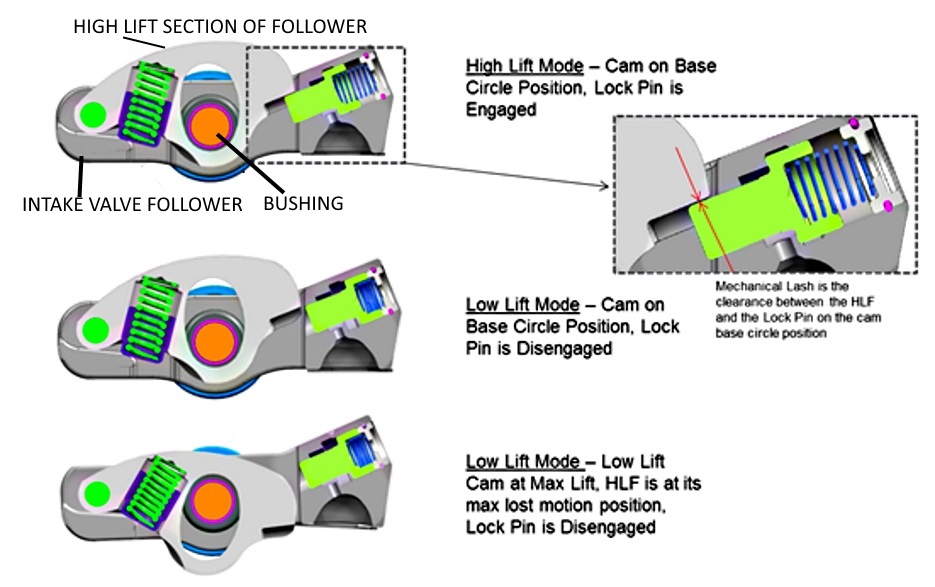 Pentastar發動機的新型二階式可變升程進氣門系統由每個氣缸蓋的兩個電磁閥控制油壓啟動。圖為系統的進氣滾軸從動件的操作演示。
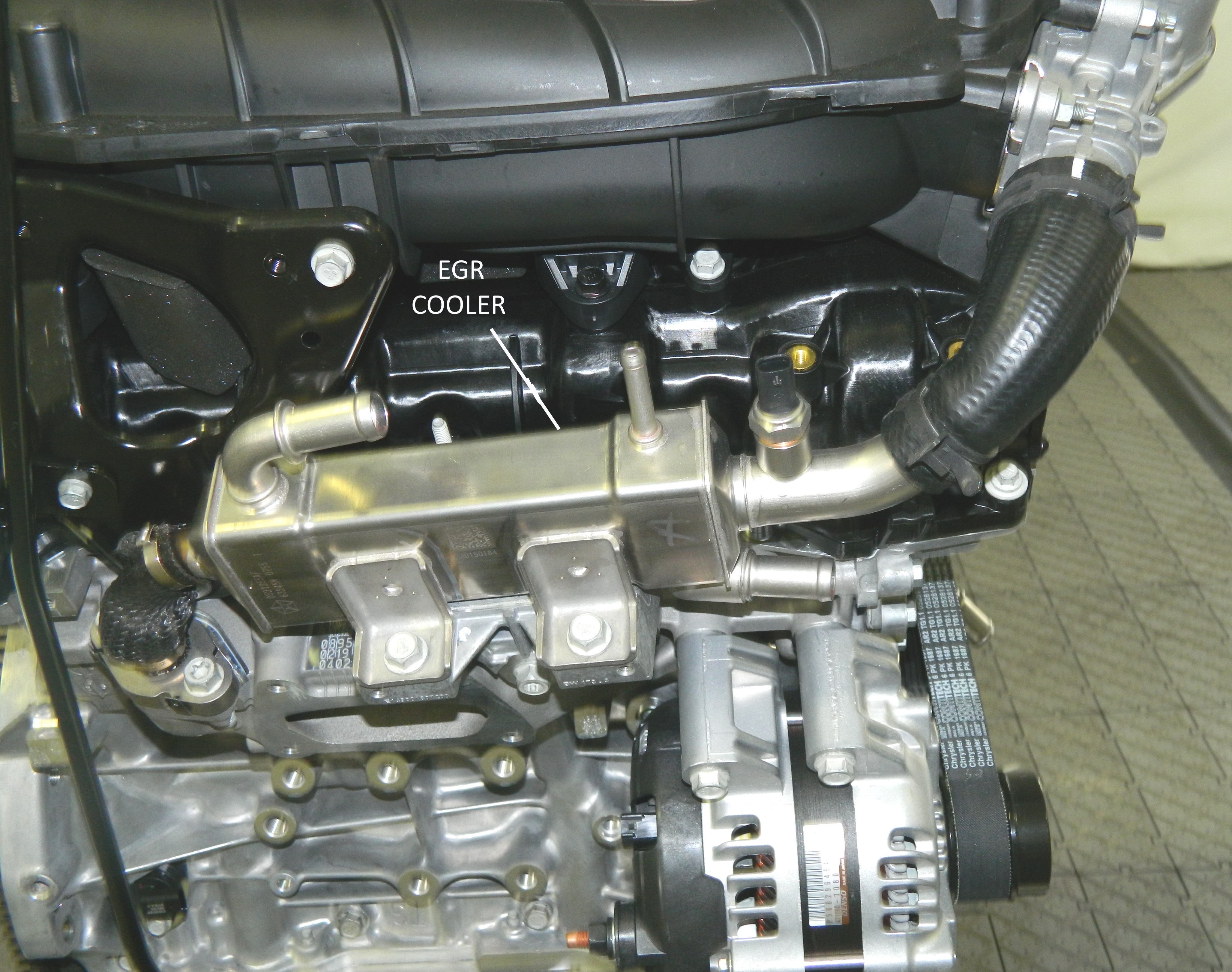 液冷EGR是一項重型柴油技術,FCA為經過重要改良的3.6升Pentastar V6汽油發動機采用了該技術。該技術可以提升燃油經濟性,降低排放,但此前極少用于輕型發動機。
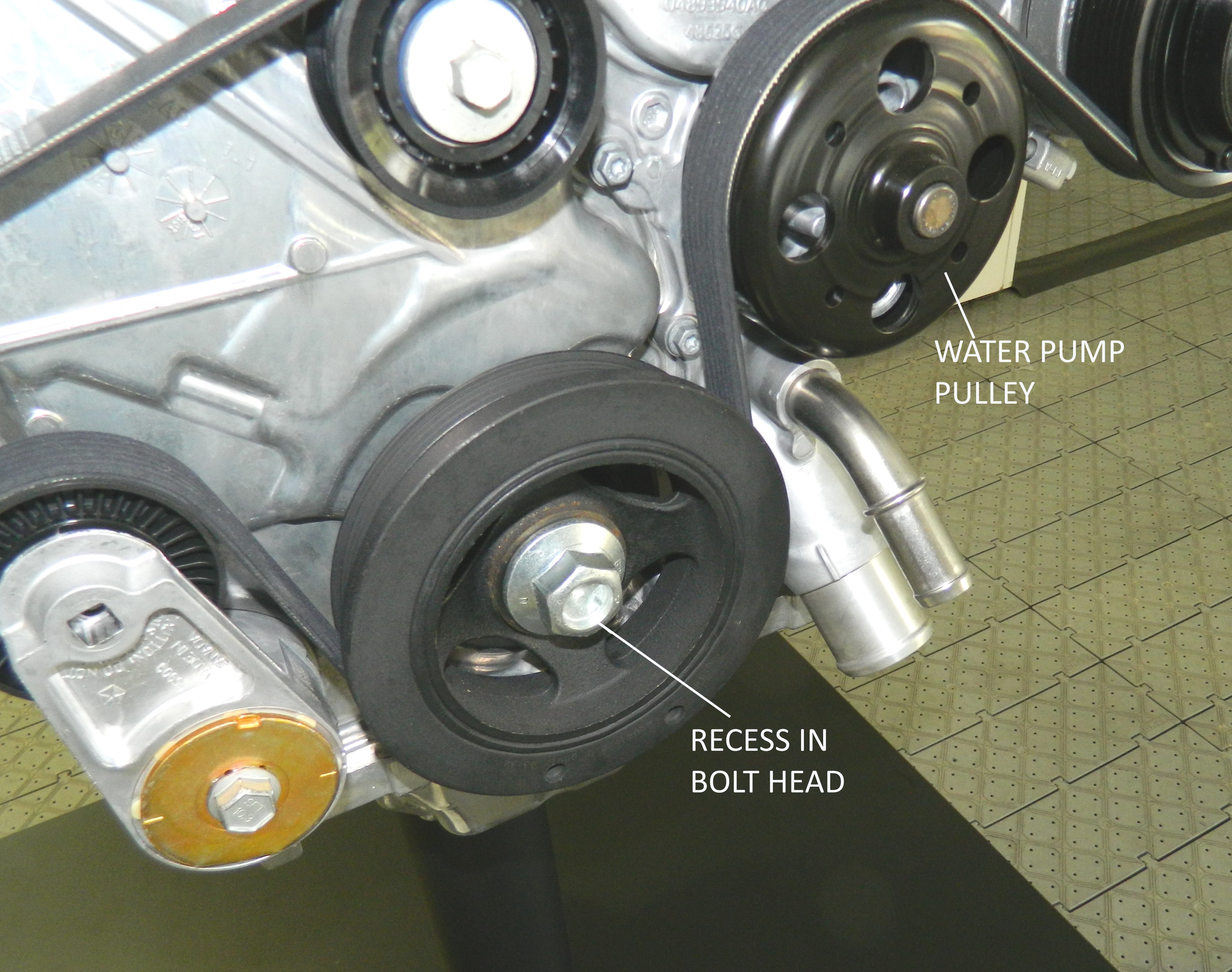 新型Pentastar V6發動機的曲軸皮帶輪螺栓頭凹陷和水泵皮帶輪鉆孔都屬于“采用一切方式”來試圖減重的方法。