目前,英國(guó) Millbrook 試驗(yàn)場(chǎng)已經(jīng)正式啟動(dòng)了 AutoAir 自動(dòng)駕駛汽車聯(lián)盟的 5G 蜂窩測(cè)試基礎(chǔ)設(shè)施,用于自動(dòng)駕駛車輛的開(kāi)發(fā)與測(cè)試。這套新設(shè)施可以為自動(dòng)駕駛汽車開(kāi)發(fā)商提供一套低延時(shí)的廣域無(wú)線設(shè)備,據(jù)稱可無(wú)縫覆蓋位于倫敦以北 50 英里(80 公里)的整個(gè)場(chǎng)區(qū)。
Millbrook 試驗(yàn)場(chǎng)表示,“5G通信能力對(duì) SAE L3 級(jí)到 L5 級(jí)自動(dòng)駕駛汽車測(cè)試至關(guān)重要,只有具備這種高速實(shí)時(shí)連接,自動(dòng)駕駛汽車才能將現(xiàn)實(shí)世界與模擬決策的結(jié)果進(jìn)行比較。”
開(kāi)發(fā)人員將能夠模擬弱信號(hào)和強(qiáng)信號(hào),并借助試驗(yàn)場(chǎng)中的丘陵等地貌理解各類地形對(duì)信號(hào)的影響,而且還能同時(shí)訪問(wèn)測(cè)試期間生成的所有數(shù)據(jù)。AutoAir 自動(dòng)駕駛汽車聯(lián)盟由 Airspan Networks 公司啟倡,允許自動(dòng)駕駛汽車開(kāi)發(fā)人員使用增強(qiáng)和虛擬現(xiàn)實(shí)技術(shù),為車輛創(chuàng)建虛擬事件,從而在安全環(huán)境下完成多種測(cè)試,甚至包括一些危險(xiǎn)的邊緣場(chǎng)景。
Millbrook 試驗(yàn)場(chǎng) AutoAir項(xiàng)目所采用的技術(shù)基于運(yùn)行于“中性宿主(neutral host)”的 4G和5G 小型蜂窩網(wǎng)絡(luò)單元。Airspan Networks 公司首席戰(zhàn)略官 Paul Senior 表示,“AutoAir 項(xiàng)目是世界上最雄心勃勃的 5G 測(cè)試平臺(tái)和站點(diǎn)之一,現(xiàn)已完成超密集小型蜂窩網(wǎng)絡(luò)的部署,可以提供超高網(wǎng)絡(luò)容量,幫助開(kāi)發(fā)人員輕松探索豐富的 CAV 使用場(chǎng)景。”
Millbrook 試驗(yàn)場(chǎng)圍繞園區(qū)高速公路共建設(shè)了 77 個(gè)小基站(使用 2.3 GHz 和 3.7 GHz 頻段)和 22 個(gè)毫米波接入點(diǎn)(即 30 GHz 到 300 GHz 頻段),安裝了 59 根天線桿(38 根用于小基站、11根用于毫米波接入點(diǎn)、10 根用于沿山公路的毫米波網(wǎng)狀回程網(wǎng)),共使用電纜 19 公里(11.8 英里)。
支持時(shí)速 160 mph 所需的蜂窩網(wǎng)絡(luò)覆蓋
Millbrook 試驗(yàn)場(chǎng)的全新通信系統(tǒng)可以提供:高達(dá) 1 Gbps的實(shí)時(shí)連接;“碗型”道路周圍在車速 256 km/h (160 mph) 時(shí)仍可保證高速網(wǎng)絡(luò)連接;使用 4G 長(zhǎng)期評(píng)估訪問(wèn)(一旦商用設(shè)備到位,該網(wǎng)絡(luò)還可支持 5G NR 通信);及多接入邊緣計(jì)算能力(MEC),并確保所有數(shù)據(jù)均不會(huì)流出試驗(yàn)場(chǎng)。
Millbrook 試驗(yàn)場(chǎng)還可以為開(kāi)發(fā)人員提供開(kāi)源參考車輛。這些參考車輛經(jīng)過(guò)編程可模擬多種車輛以協(xié)助自動(dòng)駕駛軟件的開(kāi)發(fā),還可以模擬一系列“軟目標(biāo)”從而更好地反映自動(dòng)駕駛汽車的真實(shí)工作環(huán)境。此外,試驗(yàn)場(chǎng)還可以為園區(qū)內(nèi)的測(cè)試車道提供精度高達(dá) 1 mm 的精密數(shù)字模型,以及同時(shí)適用于真實(shí)環(huán)境和虛擬環(huán)境開(kāi)發(fā)的模擬器。
網(wǎng)絡(luò)安全一直是自動(dòng)駕駛汽車研發(fā)的重點(diǎn)問(wèn)題,5G 測(cè)試平臺(tái)可模擬移動(dòng)網(wǎng)絡(luò)中斷的情況,以測(cè)試軟件、車輛和基礎(chǔ)設(shè)施的抗干擾能力。此外,這種開(kāi)放接入網(wǎng)絡(luò)還可以通過(guò)“切片”允許用戶在單個(gè)網(wǎng)絡(luò)基礎(chǔ)設(shè)施上工作,幫助測(cè)試各種網(wǎng)絡(luò)中斷和連接問(wèn)題。
除了 Airspan Networks 公司,AutoAir 聯(lián)盟的其他成員還包括邁凱倫應(yīng)用技術(shù)公司(McLaren AppliedTechnologies)、Blu Wireless Technology、薩里大學(xué) 5G 創(chuàng)新中心、Dense Air、Quortus及 Celestia Technologies Group。
歐洲另一試驗(yàn)場(chǎng)瑞典 AstaZero 中心已成為歐洲 NCAP 認(rèn)證的主動(dòng)安全和自動(dòng)駕駛系統(tǒng)測(cè)試場(chǎng)地,目前由瑞典研究所(RISE)和查爾莫斯理工大學(xué)共同所有。
Millbrook Proving Ground in the U.K. has officially launched the AutoAir consortium’s 5G cellular testing infrastructure for autonomous vehicle (AV) development. The new facility at Millbrook provides AV developers access to a low-latency, wide-area wireless infrastructure billed to work seamlessly across the entire sprawling test facility 50 miles (80 km) north of London.
Millbrook said, “This capability is crucial for the validation and testing of SAE Level 3 to Level 5 autonomous vehicles, which require high-speed real-time connectivity to compare real-world outcomes with decision-making simulation.”
Developers will be able to simulate weak and strong cell signals and understand the impact of hills and other terrain—all within Millbrook’s grounds—while having access to all data generated during testing. The AutoAir consortium is led by Airspan Networks and enables AV developers to create virtual events using augmented and virtual reality for vehicles on track, to test in safety scenarios right up to edge cases.
The technology used at Millbrook is based on 4G and 5G small cells that operate on a “neutral host” basis. “AutoAir at Millbrook is one of the most ambitious 5G testbeds and trials sites in the world. The project has now completed the deployment of a hyper-dense small cell network that delivers ultra-high capacities which enables a range of new CAV use cases to be explored,” said Paul Senior, chief strategy officer at Airspan Networks.
The Millbrook mobile network facility comprises 77 small-cell base stations (using 2.3 GHz and 3.7 GHz spectrum) and 22 millimeter-wave access points (millimeter-wave is the spectrum from 30 GHz to 300 GHz) around Millbrook’s banked, high-speed road circuit. There are 59 masts, 38 for the small cell base stations and 11 for the millimeter-wave access points, plus 10 for the millimeter-wave mesh backhaul along a hill route. Some 19 km (11.8 miles) of fiber-optic cable is installed.
Cellular coverage at 160 mph
The site’s new communications systems provide up to 1 Gbps real-time connectivity; up to 256 km/h (160 mph) continuous coverage capability around the high-speed bowl; access using 4g long-term evaluation—the network capable of supporting 5G New Radio (NR) when commercial devices become available—and secure Multi-access Edge Computing (MEC) with the assurance that data does not leave Millbrook’s environs.
The Millbrook facility offers access to open-source reference vehicles that can be programmed to emulate a range of vehicles for AV software development, and “soft targets” for real-world AV requirements. It also can provide a digital model of the facility’s test tracks with 1 mm surface accuracy for vehicle simulation, as well as a simulator suite for both physical and virtual development.
With cybersecurity a continuing concern for AVs, the 5G testbed can be used to simulate mobile-network disruption and connectivity to test software, vehicle and infrastructure resilience to interference. And an open-access network, with slicing to enable users to work on a single network infrastructure, facilitates testing involving various network disruption and connectivity situations.
Together with Airspan Networks, the AutoAir consortium includes McLaren Applied Technologies; Blu Wireless Technology; The 5G Innovation Center, University of Surrey; Dense Air; Quortus and Celestia Technologies Group.
Another proving grounds in Europe, the Swedish test facility AstaZero, now is accredited by Euro NCAP to perform tests of active safety systems and automated driving. It is owned by Research Institutes of Sweden, (RISE) and Chalmers University of Technology.
Author: Stuart Birch
Source: Autonomous Vehicle Engineering

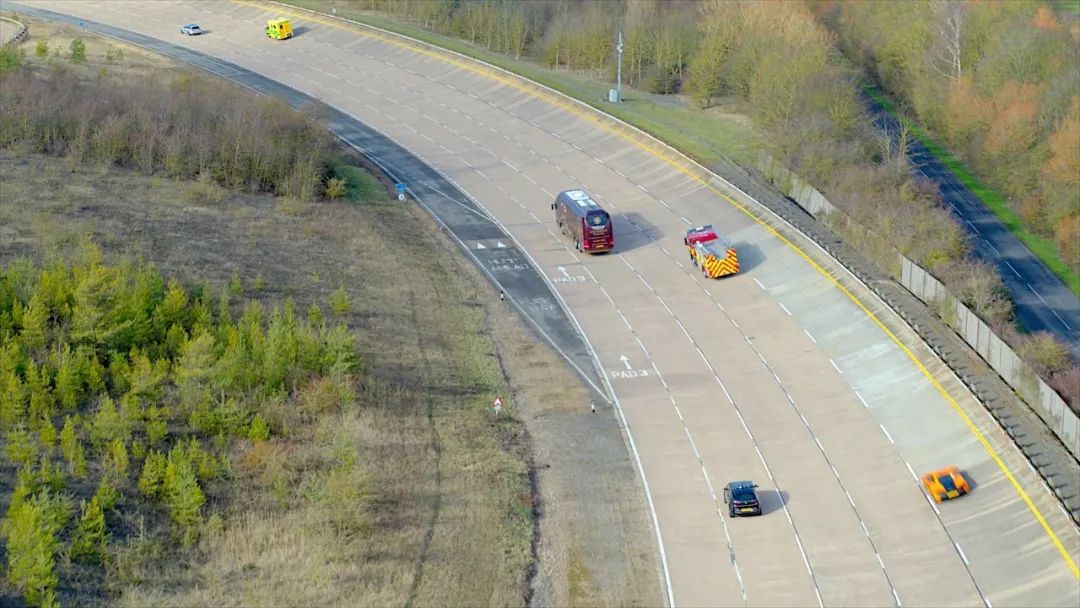 英國(guó) Millbrook 試驗(yàn)場(chǎng)的“碗”型高速道路是 5G 技術(shù)開(kāi)發(fā)的重要特征。(圖片來(lái)源:Millbrook 試驗(yàn)場(chǎng))
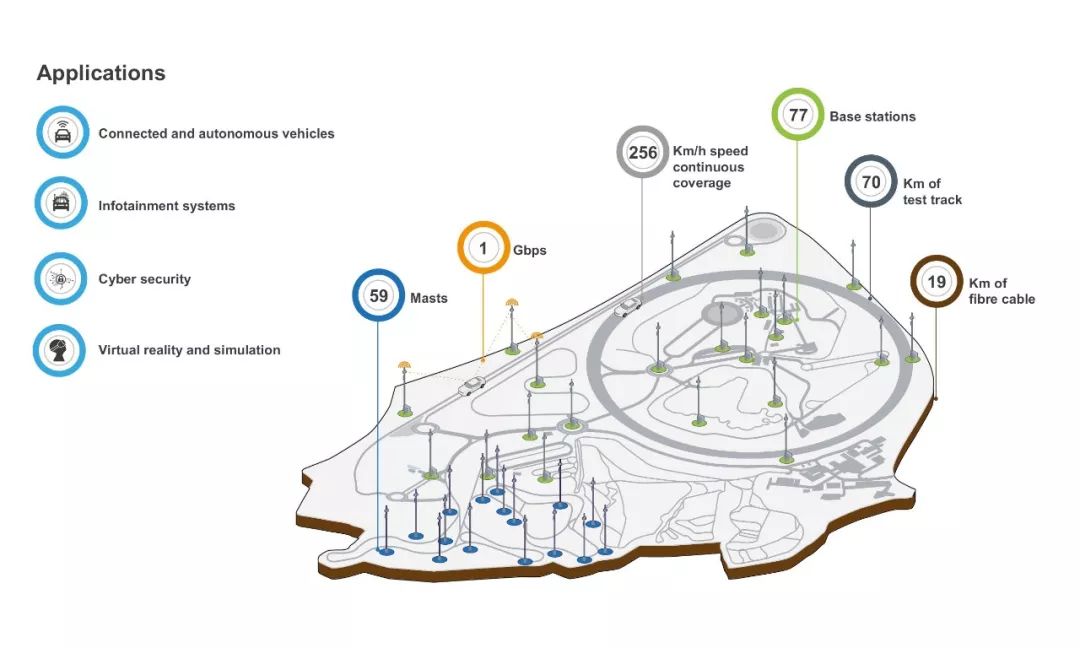 英國(guó) Millbrook 試驗(yàn)場(chǎng)的AutoAir 項(xiàng)目將為 5G 通信技術(shù)登陸自動(dòng)駕駛汽車做出重大貢獻(xiàn)。(圖片來(lái)源:Millbrook 試驗(yàn)場(chǎng))