奧迪旗下的第一款純電動車型e-tron即將投產,其性能亦是不負眾望的一流卓越。
By Bill Visnic
今年9月17號,大眾奧迪推出了旗下第一款純電動車型e-tron,而就在一周之前,奧迪的主要競爭對手奔馳發布了EQC純電動車。另一家車企—捷豹更是捷足先登,早在幾個月之前就推出了i-Pace純電動車。如此緊鑼密鼓的產品亮相,似乎是在宣示純電動車時代已然到來。除了主打純電動以外,奧迪、奔馳、捷豹推出的新車還體現了當下純電動車熱潮的另一特征——它們都是跨界車。
三年前,奧迪發布了e-tron的概念車型,那也是e-tron的首次亮相。時隔三年后,在舊金山華麗的全球發布會上,奧迪終于揭開了e-tron量產車型的神秘面紗。目前,e-tron已經在位于比利時布魯塞爾的奧迪工廠投產,奧迪計劃在年底之前在歐洲交付。而美國的開售時間定在了2019年第二季度,這也是奧迪反復斟酌后做的決定。價格方面,e-tron不算親民。科技感十足的Prestige標配版起價74,800美元。奧迪還將限量發布999輛First Edition版,定價也是三款車型中最高的— —86,700美元,
車型優勢
盡管特斯拉是高端電動汽車的標桿,奧迪e-tron的一大優勢在于它的車型— —跨界車,這點和奔馳EQC和捷豹i-Pace一樣。相較之下,特斯拉只傾心于轎車。奧迪美國產品經理Matt Mostafaei表示,美國消費者非常看重車型,“e-tron的第一大賣點是中型SUV,第二大賣點才是純電動。”
五座的e-tron誕生于大眾 MLB前置橫向發動機動力總成通用化平臺,大小適中,介于奧迪的中型Q5和全尺寸3排Q8跨界車之間。e-tron長193 英寸(4902毫米),寬86.3英寸(2192毫米),軸距為115.1英寸(2924毫米)。和Q5相比,軸距加長了4英寸(102毫米),總體車身則加長了10英寸(253毫米)。
在舊金山亮相的e-tron看上去除了尺寸大以外,重量也不輕。盡管奧迪的宣傳材料中并沒有揭示歐版和美版的整備質量,但根據一位奧迪的內部人士透露,e-tron重達2490千克(5490磅)。不過,考慮到車上搭載了凈重為700千克(1543磅)的電池包,這個重量也就不足為奇了。
電池大,充電快
e-tron搭載的95千瓦時的鋰電池包由432塊袋裝電池組成,共有36個模塊。電池由韓國LG化學公司負責生產。電池盒由奧迪內部負責設計制造,以堅固的鋁材為主,能有效保護電池抵抗沖擊。此外,為改善熱管理,電池包還設有特殊設計的冷卻液環路。
e-tron系列項目負責人Jens van Eikels告訴《汽車工程》雜志, e-tron的四條冷卻液環路是e-tron中最復雜的系統之一。除了密切管理電池包的溫度以外,電池包的冷卻液還會流向前后車橋的驅動電機,也會流入調節座艙溫度的熱泵。VanEikels表示,e-tron的熱泵比傳統汽車的效率要高15%。和驅動電機相連的冷卻液特殊管路可以非常有效地降低電機和整合式單速行星變速箱的溫度,沒有必要再冷卻變速箱油,因此不用安裝油泵。
e-tron還有一個別出心裁的冷卻設計:冷卻液管道采用網格狀結構,不會和電池模塊發生直接接觸,電池模塊上涂覆的特殊凝膠會將熱量轉移到冷卻液管道中。
奧迪之所以如此重視電池熱管理,也是因為這會影響到e-tron的充電速度和電池容量。美版e-tron搭載了一個9.6千瓦的充電器,奧迪聲稱這是市面上所有純電動車型中功率最高的充電器。如果使用240伏(即40安倍)的家用電源,容量為95千瓦時的電池包在約8.5小時內即可充滿80%。
如果使用標準SAE-J1772規格的組合式充電系統(CCS),e-tron的最高充電速率可達150千瓦。如此一來,電池包可在不到30分鐘內充滿80%。如果是在公共充電站充電,按照50千瓦的速率,充電時間大概為80分鐘。
不過,如果使用目前標準的120伏家庭用電,充滿80%需要大約90小時。想必多e-tron車主定會更傾心于240伏電路。為此,奧迪也和亞馬遜簽訂了一項協議,未來將由亞馬遜家庭服務公司為車主安裝240伏電路。但是,在奧迪看來,最佳充電功率應該是350千瓦。大眾集團旗下的子公司ElectrifyAmerica 已經開始著手安裝350千瓦的充電樁,如果使用這種充電樁,e-tron的充電時間將不到12分鐘。
然而,e-tron最重要的電池性能參數還有待觀察。奧迪聲稱目前還不能確定e-tron的續航里程。截止到全球首發之前,最可靠的數字是e-tron的全球輕型車測試規程(WLTP)的測試結果:400公里(249英里)。這個數字應該非常接近美國監管部門的測試結果。
新的轉折:電動四驅
據e-tron動力總成工程師Joachim Dorr博士介紹,e-tron的標配是前后車橋上驅動四輪的交流異步牽引電機,其精準度更是達到了前所未有的水平。Dorr博士說,e-tron的電動四驅系統“打開了奧迪四驅技術的新篇章”。
Dorr博士說,“在我看來,e-tron擁有奧迪最出色的四驅技術。”
盡管奧迪聲稱美版e-tron的配置參數尚未最終確定,根據發布會我們可以預測,后橋異步電機負責在普通工況下輸出主要的牽引扭矩,功率大概為140千瓦(188馬力)。前橋電機的功率為125千瓦(168馬力)。兩臺電機加起來的輸出扭矩最高可達413磅·英尺(561 牛·米)。
奧迪還透露,sport模式下,踩住油門可以激活特殊增壓技術,電機的功率最高可達300千瓦(402馬力),最高輸出扭矩為490磅·英寸(664牛·米),百公里加速僅為5.5秒,這也是e-tron系列的最快速度。有評論人士指出,e-tron的加速性能之所以不是非常驚艷,很可能還是因為e-tron的重量。不過,e-tron瞄準的是高端SUV中端市場,極致的性能并不是它的主要目標。話雖如此,奧迪還是可能在以后推出性能不同的e-tron車型。
e-tron項目負責人van Eikels表示,電動四驅的調校速度非常快,可以在較為輕松的工況下,將后橋的扭矩矢量的轉化為制動力,分配給四輪,傳遞扭矩矢量效應。
驅動電機將在位于匈牙利杰爾的歷史悠久的奧迪內燃機工廠投產。轉子將不使用稀土元素,轉子和定子都是由奧迪內部設計制造。其它的零部件將由外部供應商提供。具體是哪些供應商,奧迪還沒有透露。奧迪計劃在年底之前,通過采用新型模塊化生產系統實現400臺的電機日產量。屆時每個電機將不使用流水線工藝,而是由自動小車運送到各個組裝工位。
e-tron的驅動系統當然也包含了制動能量回收技術,回收比例可由駕駛員自行選擇。奧迪美國總裁Scott Keogh聲稱,這是迄今為止效率最高的電池能量回收系統,可以將e-tron的續航里程提高30% 。
浪潮的前奏
Keogh表示,e-tron是奧迪進軍電動化的序曲。到2025年前,奧迪計劃在全球推出12款純電動車型,電動車將占到銷量的三分之一。
繼今年9月之后,奧迪將在明年推出e-tron的Sportback版,然后再在11月的洛杉磯車展上發布一款主打運動性能的GT轎跑概念車型。
The first-ever electric vehicle from Audi, the e-tron, is production-ready. As expected, it's impressively engineered.
By Bill Visnic
It seems safe to say the global shift to battery-electric vehicles is now in full swing, with the Volkswagen Group's Audi brand unveiling on September 17 its first electric vehicle (EV), the e-tron, barely a week after chief rival Mercedes-Benz revealed its EQC and mere months after Jaguar launched its i-Pace. An additional sign of the times: all three new luxury EVs are crossovers.
In a glitzy global reveal event in San Francisco, Audi finally pulled the sheet off the production version of the e-tron, some three years after it was first shown as a concept. Production already is underway in Brussels, Belgium, with Audi intent on delivering the first customer vehicle in Europe by the end of this year. The company is cautiously pegging the start of U.S. sales for the second quarter of 2019 and the e-tron will not be inexpensive, with the heavily-equipped Prestige “base model starting at $74,800 and moving to $86,700 for First Edition (limited to a run of 999 units), which tops the three-trim e-tron lineup.
Bodystyle jackpot
Although Tesla is the obvious target for any new luxury-brand EV, Audi's advantage (as well as for the Mercedes-Benz EQC and Jaguar i-Pace) is that the e-tron is a crossover, while Tesla remains oriented towards sedan body styles. It's a critical point for U.S. consumers, said Audi of America's Matt Mostafaei: “The e-tron is a midsize SUV first and an electric car second.”
Derived from the VW Group's essentially powertrain-agnostic MLB (front longitudinal-engine) platform, the 5-seat e-tron is sized conveniently between Audi's midsize Q5 and the fullsize, 3-row Q8 crossovers: the e-tron is 193 in (4902 mm) long and 86.3 in (2192 mm) wide, with a wheelbase of 115.1 in (2924 mm), making it 4 in (102 mm) longer in wheelbase and nearly 10 in (254 mm) longer in overall length than the Q5.
Seen at its San Francisco revealing, the e-tron has an ample footprint— and weight to match. Although the company's press material did not reveal a curb weight for the crossover in either European or U.S. configuration, one Audi source pegged the e-tron at a stupendous 2490 kg (5490 lb)—not an unimaginable figure considering the battery pack alone weighs a claimed 700 kg (1543 lb).
Big battery, big charging ability
The 95 kWh lithium-ion battery pack is comprised of 432 pouch-type cells grouped in 36 modules; the cells are made by Korea's LG Chem. Audi designed and builds the clever battery enclosure, incorporating exceptional protection from crash intrusion via a robust, largely-aluminum structure that also was specially conceived to facilitate thermal management with incorporated cooling circuits throughout the battery pack.
The e-tron's four coolant circuits are “one of the most complex systems of the car,” Jens van Eikels project leader of e-tron car line, told Automotive Engineering. In addition to closely managing the temperature of the battery pack, coolant also flows to a drive motor at each axle, as well as to the heat pump that provides cabin climate control. The heat pump is some 15% more efficient than a conventional HVAC system, van Eikels said, while the special coolant “spears” designed into the drive motors are so effective in drawing heat from the motors and integrated single-speed planetary transmission that there is no need to cool the transmission oil, also eliminating the need for an oil pump.
Another cooling innovation: the coolant lines do not directly contact the battery modules, instead running in a grid-like pattern in the structure itself; heat transfer is accomplished via a special gel that surrounds the modules.
Audi makes much of the built-in charging capability of the e-tron and the thermal-management performance also plays a role in the speed and capacity at which charging can take place. Onboard for U.S. models is a 9.6-kW charger that Audi said is the highest capacity of any currently-available EV. It means a household 240-volt/40-amp circuit can provide an 80% recharge of the 95-kWh battery pack in about 8.5 hours.
The e-tron can be charged at up to 150kW, however, through its standard SAE J1772-spec Combined Charging System (CCS) connector. At the 150-kW rate,
the battery pack can be recharged from 80% depletion in less than 30 m. At the 50-kW rate currently available at some public charging stations, an 80% recharge will require about 80 m.
Those without the requisite household 240V circuit surely will want to install one, however, as charging on standard 120V current would require some 90 hours! To that end, Audi has entered an agreement with Amazon Home Services to broker installation of a 240V circuit. Audi sees the charging end game, however, at a 350-kW rate—now starting to be installed by the VW Group's Electrify America subsidiary—that would recharge the e-tron in less than 12 m.
But perhaps the most-important aspect of battery performance remains unaddressed for now: Audi said it does not have official driving-range figures for the e-tron. The best-available figure at the time of the e-tron's global unveiling was the 400-km (249-mile) rating from Europe's new Worldwide Light-vehicle Test Procedure (WLTP), which may be reasonably close to what U.S. regulators will derive.
New twist: Electric Quattro
Standard for every e-tron is an AC asynchronous traction motor at each axle that imparts all-wheel-drive capability with a new level of precision, said Dr. Joachim Dorr, a powertrain engineer for the e-tron, who called the electric-drive quattro system “the next chapter in Audi all-wheel-drive technology.
“In my personal opinion,” he added, “the e-tron has the best quattro drive we've ever made.”
Although Audi said U.S.-specification output figures are yet to be finalized, information at the crossover's press reveal indicated the asynchronous motor at the rear axle (which under normal driving is designed to deliver the majority of tractive torque) is rated at approximately 140 kW (188 hp). The front-axle motor generates approximately 125 kW (168 hp) and the combined torque output is a maximum of 413 lb.ft (561 N. m).
A special “boost” mode—engaged by pinning the accelerator pedal whenever the drive control is in “sport” mode—will command a maximum of about 300 kW (402 hp) and 490 lb.ft (664 N.m). Using this function delivers the e-tron's best 0-60 mph (0-97 km/h) acceleration time of 5.5 s, Audi said. Early critics noted the acceleration performance is not particularly impressive and likely is related to the e-tron's not-inconsiderable weight. The e-tron also seems targeted at the middle of the luxury utility-vehicle market, where extreme performance is not a high priority; Audi might be expected to in the future offer performance variants of the e-tron.
Project leader van Eikels said the all-electronic quattro “tuning” is particularly fast-acting and also allows for a certain degree of torque vectoring at the rear axle and accompanies braking at individual wheels to impart a torque-vectoring effect in less-strenuous driving situations.
The drive motors are built by Audi at its longstanding IC engine plant in Gyor, Hungary. The rotors use no rare-earth elements and the stators are Audi-designed and built, with other motor components coming from external suppliers Audi did not detail. By the end of the year, the company intends to make about 400 motors daily under a new modular production system that sees each motor travel to assembly stations on automated carts rather than an installed conveyor line.
The e-tron's drive system of course incorporates driver-selectable degrees of regenerative braking effect. Audi of America president Scott Keogh called the system “the most-efficient battery recuperation to date,” adding that it can contribute up to 30% of the e-tron's total driving range.
Start of the wave
The e-tron is the beginning of Audi's push to electrification, Keogh said. By 2025, Audi intends to have 12 EVs in its global product portfolio and sees one-third of sales comprised of electrified models.
Following the e-tron is a “Sportback” version next year, while a sport-oriented GT concept coupe is slated to be revealed at the Los Angeles auto show in November.
Author: Bill Visnic
Source: SAE Automotive Engineering Magazine

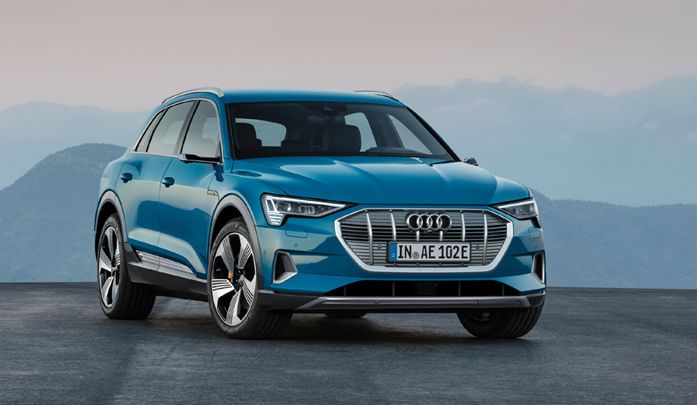 e-tron - 車型名稱以全小寫組成,美國市場將于2019年第二季度上市。
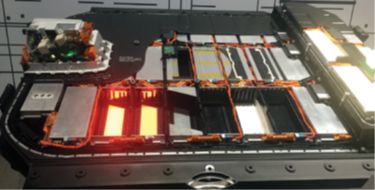 e-tron 95千瓦時鋰離子電池組的剖面展示,展示了電池的外形尺寸,防撞布局和結構。
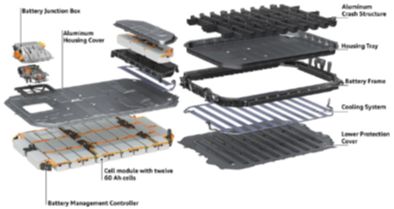 解視圖展示了獨特的電池組設計,便于液體冷卻,增強了耐撞性。
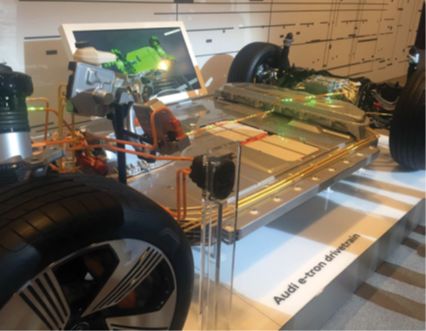 奧迪e-tron的Rolling Chassis(移動底盤)展示前后軸的標準空氣懸架和驅動電機,電池組包括幾乎整個結構的平坦地板
 Jens van Eikels, e-tron車型及rolling chassis(移動底盤)的項目負責人