法國納米材料公司NAWA Technologies打算對汽車行業使用的“混動”一詞增添一層新涵義,它希望將基于碳納米技術的高效超級電容器與鋰離子電池結合起來,為大體積電動汽車提供雙重電源。
NAWA聲稱,這個名為超快碳電池(UltraFast Carbon Battery)的技術已進入試投產階段,其功率和能源密度比現有的超級電容器高3-5倍。
NAWA表示,其長期目標是將混合超級電容器電池的充電速度和壽命提升至,甚至超過當前(或更高級的)鋰離子電池。
公司CEO Ulrik Grape表示,基于公司的研發成果,他有充分理由相信一種徹底的儲能系統的量產可以解決目前的許多問題,有助于改變公眾對電動汽車電池功率的認知。
“我們的超快碳電池的獨特之處在于我們自主研發的垂直排列特殊涂層納米管,該技術可以提升碳納米管或基礎電容器的能量密度,”Ulrik Grape告訴《汽車工程》雜志。
“我們能夠以超快的速度接收并釋放電荷,這個高功率技術可以幫助汽車行業實現越來越高的能源密度目標。”Grape于2017年加入NAWA,此前他是加州固態鋰離子電池創業公司SEEO的管理人員,后者最近被博世收購。
NAWA聲稱,其新一代能量回收電池可“在幾秒內充放電100萬次循環”,非常適用于無人駕駛汽車,尤其是共享汽車。由于該電池是基于碳制作的,因此不會出現傳統儲能電池的各種高溫問題。此外,它與氫燃料電池的技術也十分匹配。
回收制動能量
NAWA是“用納米技術對抗全球變暖(NAno technology to fight against global WArming)”這句公司創立宗旨的關鍵字縮寫,它是法國原子能與替代能源組織(CEA)的衍生企業,于2013年成立。其創立者堅信可以將電池的儲能容量提升至現有電池的五倍,而這將在電動汽車的發展中扮演重要角色。
NAWA電池的一個重要特征就是均勻涂覆聚合物的納米管。為什么納米管的垂直排列如此重要?Grape表示:“這樣做可以對電子和離子加以管束,使它們沿著整齊的路線,而非隨機的路線運動,就像是牙刷上排列整齊的刷毛一樣!”
超快碳電池能夠以極高的速度釋放電量(與傳統電池相比較,極小的電池可在幾秒或幾毫秒內釋放,而且對溫度的依賴也更少),以滿足突然加速的要求。更為重要的是,這種功能還有助于充分回收制動能量。Grape認為汽車行業尚未對這一點給予足夠重視,但他表示OEM和供應商對新技術的態度的確變得越來越開放了。
“歐洲企業對我們的新電池表現出濃厚的興趣,”他表示。“在一個48V或容量更大的系統中,我們可以回收90%以上的制動能量。”NAWA的研發工作包括一款電動方程式汽車的混動電池的模擬,該電池由鋰離子電池和NAWA的超級電容器組成。該項目看似有點跑題,但Grape認為它非常重要。“我們研究了多場比賽的參數,發現在僅使用鋰離子電池的情況下,轉彎處的制動能量回收率僅為20%左右”。
減重與成本
Grape認為,借助超級電容器和鋰離子電池還能實現顯著的車身減重。“最初階段可以將車身重量從300公斤減至200公斤,之后再想減100公斤就必須對整個電氣系統進行優化了。但是目前我們的電容器容量還不及鋰離子電池,因此不能聲稱可以取代它們。我們的系統可以和鋰離子電池聯合運行。儲能是通過整個系統實現的,而不只是依靠我們的技術。”
還有一點重要的是,整個系統的使用壽命會比僅有鋰離子電池的系統更長,因為超級電容器和鋰電池可以分工合作,前者擔任負重任務,后者負責自動駕駛。
使用高效超級電容和能量回收技術有可能延長汽車的行駛里程,但Grape對這個話題較為謹慎。
“根據我們和汽車行業對整個生產系統的討論,我們估計里程的延長可高達40-50%,但目前說這些還太早了,”他表示。
汽車行業中任何新技術的誕生都繞不開成本話題。Grape認為其電池的成本會比現有的超級電容器“低幾個數量級”,但具體數字還等待進一步的確認。
超快碳電池的核心技術和生產工藝與光伏電池“非常相似”,但是針對汽車應用的大規模生產還需要投入全新的工藝。
光伏電池的生產工藝通常是在電池外部涂覆一層由幾十種粉末、添加劑和粘合劑組成的混合物,而NAWA的工藝則不同。它們首先注射一種包含大量碳原子的液體,然后將其汽化,使一層均勻、堅固、柔軟的垂直排列納米管“地毯”自動生長。
NAWA的試投產在其位于法國普羅旺斯地區艾克斯的胡賽研發工廠進行。第二批試投產線預計于2019年建設完畢并開展生產。電池的最初應用預計為動力工具,接著會與汽車行業開展合作,這也是汽車行業引進新技術的慣常做法。Grape表示,公司計劃在未來4-5年內實現首批汽車應用,接著實現大規模量產。
NAWA的創始人兼首席運營官PascalBoulanger補充道:“最讓人激動人心的是超級電容器的巨大潛力。通過超快碳電池,我們成功地將納米技術和最好的清潔技術結合了起來。”
French nanomaterials specialist NAWA Technologies is aiming to bring a new dimension to the automotive industry’s use of the word “hybrid.” It is aiming to link high efficiency new technology carbon nano-based ultracapacitors with lithium-ion batteries, to create a dual energy source for high volume electric vehicles.
NAWA claims its Ultra Fast Carbon Battery technology now in pilot production, can deliver between three and five times higher power and energy density than existing ultracapacitors.
The company has stated that in the “long term” its technology will enable it to develop hybrid ultracapacitor cells with performance levels approaching or surpassing current (or even advanced) lithium batteries in terms of fast charging and lifecycle.
The result of its R&D work, said CEO Ulrik Grape, is confidence that high volume manufacture of a radical energy storage system will help overcome many of the frustrations that continue to dog the wholesale public acceptance of automotive electric motive power.
“The unique aspect of the technology of our Ultra Fast Carbon Battery is our successful development of vertically aligned specially coated nanotubes, allowing us to increase the energy density of the carbon nanotubes or basic capacitor," he told Automotive Engineering.
“We can accept the charge and release it exceptionally fast," he explained. "This is a high power technology that can assist the automotive sector’s requirement to achieve ever greater energy density.” Grape joined NAWA in 2017, having been part of the management team at California solid-state lithium-ion battery start-up SEEO, recently acquired by Bosch.
NAWA’s claim is that its new generation of energy-recouping batteries could be recharged “in seconds for up to a million cycles,” ideal for autonomous vehicles, notably shared cars. Carbon-based, the new Ultra Fast Battery configuration is said by the company not to suffer the thermal issues of conventional storage systems. It could also fit technologically with hydrogen fuel cells.
Regen braking benefits
NAWA (NAno technology to fight against global WArming) Technologies, a 2013 spin-out business from the French Atomic and Alternative Energies’ Organization (CEA), states that the battery is capable of storing up to five times more energy than existing capacitors, would play a key part in electrified vehicle development.
A significant aspect of the NAWA battery involves the use of the uniformly applied polymer coating of the nanotubes. But why is vertical alignment of nanotubes so important? Said Grape: “It’s about regimenting electrons and ions, smoothing their path instead of their taking a random route. It’s rather like the perfectly ordered bristles of a toothbrush!”
Benefits of the Ultra Fast Carbon Battery include the capability of very high speed delivery of a charge (compared to conventional batteries, typically in a few seconds or milliseconds for very small cell sizes and with less dependence on temperature) to meet sudden acceleration requirements. Also, and possibly more importantly, to harvest as much braking energy as possible. Grape believes the industry has not paid sufficient attention to this, although he accepts that OEMs and suppliers are becoming ever less conservative in adopting new technology.
“European companies in particular are showing strong interest in our new battery," he stated. "In a 48V or larger system we could perhaps recoup up to 90%-plus of available braking energy.”
NAWA development work has included the simulation of a Formula E hybrid battery featuring lithium-ion batteries and its own ultracapacitors. This may be regarded as the exotic end of the auto industry but Grape believes it is a relevant program. “We looked at performance on several race circuits and received information from drive cycles which showed only about 20% of energy recovery when braking for turns using only lithium-ion batteries,” he noted.
Mass reduction, cost
Grape believes very significant overall weight reduction could be achieved using the hybrid ultracapacitor and lithium-ion system. “Initially it could typically be reduced from 300 kg to 200 kg," he said. "Further savings of another 100 kg could be possible through optimization of the overall electrical system. But we are not storing as much energy as lithium-ion batteries and are not professing to replace them. Our system would work in conjunction with lithium-ion; storage would need to involve the performance of the whole system not just our technology."
Significantly, the overall system is expected to have a longer in-service life than stand-alone lithium-ion batteries, as the ultracapacitors handle the heavy loads and the lithium-ion address the autonomy.
Grape is cautious on the emotional subject of range enhancement potential via the use of its more efficient ultracapacitor technology and resultant energy harvesting.
“Depending on the outcome of discussions with the auto industry regarding all aspects of a production system, it could be as high as 40% to 50%, but it is too early to be specific,” he said.
Likely cost is inevitably the major issue when new technology looms on the automotive horizon. Grape sees this as being “orders of magnitude less" than that of super- or ultracapacitors currently available,” adding that precise figures are still to be refined.
Core technology and manufacture of the Ultra Fast Carbon Battery are claimed to be “very comparable” to those of the photovoltaic industry in general, although for application to high volume automotive production, a unique process would be applied.
Instead of coating a mixture of dozens of powders, additives and binders—very fragile when charging and discharging, NAWA's approach is different. A liquid containing a high content of carbon atoms is injected then vaporized, which allows the growth of a uniform, robust and flexible "carpet" of the vertically aligned nanotubes.
NAWA’s pilot production unit is at its French R&D facility at Rousset, Aix-en-Provence. The second generation of the pilot line is scheduled to be up and running in 2019. Initial applications are likely to be for power tools. The automotive qualification process— working together with the industry—is expected to follow. Grape said the aim is for initial production for automotive to begin in four to five years, then ramping up to high volumes.
NAWA founder and COO, Pascal Boulanger, added: “What is really exciting is the sheer potential of ultracapacitors. With the Ultra Fast Carbon Battery, we have combined the best nanotechnology with the best clean technology.”
Author: Stuart Birch
Source: SAE Automotive Engineering Magazine
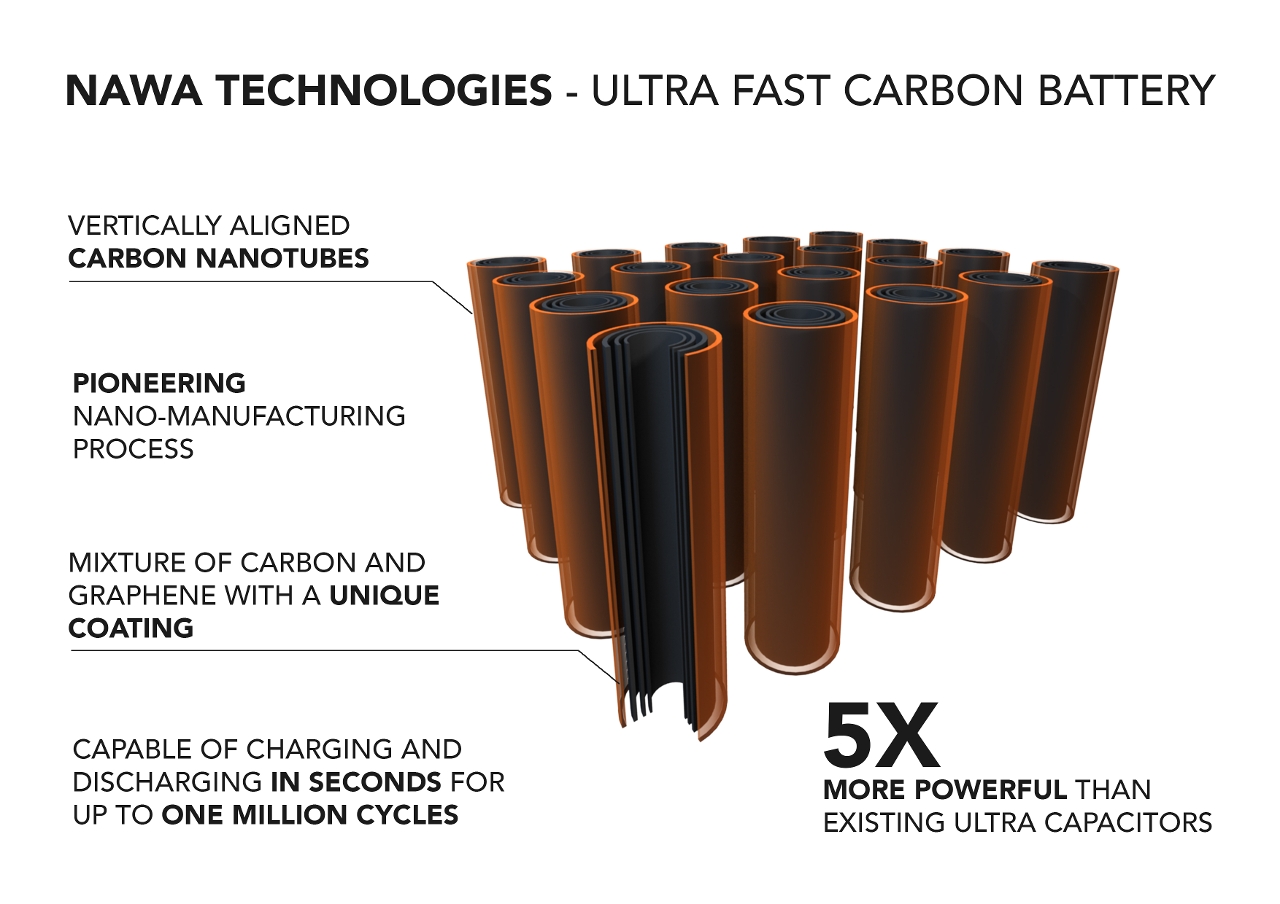 這就是NAWA的新技術,目前正在該公司位于法國南部的工廠中開展試生產。(圖片來源:NAWA)