美國阿凱提斯動力公司(Achates Power)打造的2沖程對置活塞壓燃式發動機已正式計劃投入市場。據阿凱提斯稱,同標準的4沖程發動機相比,該款發動機能夠大大提升燃油能效。而就像2017年2月號的《汽車工程》(Automotive Engineering)有關這款發動機的封面報道中曾提到的,要讓這個有100多年歷史的動力技術概念在本世紀付諸實踐,還有很多實際問題有待解決。
毫無疑問,技術細節需要更詳盡完備。為此,阿凱提斯研發團隊運用先進的CAE模擬仿真技術(CAE simulations),在造價更低、運算更快的現代計算機上模擬仿真運行,以使細節方面更趨精準。
阿凱提斯的首席執行官David Johnson說,“1990年我剛加入福特時,公司有一臺克雷超級計算機(Cray Supercomputer)。這在當時絕對是個寶貝,只有很少的工程師能用到它。而如今,阿凱提斯給每名工程師都配備了與之性能相當的計算機設備,公司有1/3的工程師每天都會用到。”
對于這個領域的工程師而言,阿凱提斯的這一大膽構思絕對讓人激動無比,尤其是那些在較小公司工作的同行。而要弄清楚這一設計為何如此令人興奮,我們還得先簡單了解一下相關背景。
模擬仿真軟件和基本原理
燃燒模型建模的復雜和困難程度遠超想象,工程師需要十分精確地了解燃燒在哪個部位,什么時間發生,如何膨脹,以及熱量如何釋放,其精確程度需要達到毫米級別,且以微秒為時間單位。
所有現代CAE模擬仿真采用的都是離散技術。一個計算機輔助設計模型(CAD model)被分成若干個計算元細胞,再使用有限元(finite-element)或有限體積(finite-volume)法模擬出液體流動、熱量釋放、自動點火(爆震)、氮氧化物、煙炱以及未燃燒的碳氫化合物等狀態,然后在元細胞中或元細胞之間解出“簡化后”的方程。而對于阿凱提斯這樣的對置活塞發動機而言,要了解技術細節,將元細胞準確定義到亞毫米級至關重要。而最終得到的則是數百萬的元細胞和方程,這些數據必須在逾千步的分析中實現同步處理。
而在每個亞毫米級的元細胞內,要做出燃燒模型則需要模擬出一套復雜的化學動力學反應。由于其太過復雜,大多數的發動機廠商都會采用相對簡單的燃料模擬物來代替真的燃料。畢竟,真的燃料中所包含的化學復合物多達數百種,而燃料模擬物中的化合物則只有幾十種。
舉例而言,我們從阿凱提斯技術開發副總裁Fabien Redon處獲悉,在設計9.8升柴油發動機的模型時,阿凱提斯使用的燃料模擬物由35種物質混合而成,需要77個反應步驟。阿凱提斯的軟件供應商ANSYS和Convergent Science都會為其提供燃料模擬物的數據庫和詳盡的化學動力反應模型。比如,ANSYS會提供汽油、柴油、航空煤油及其他燃料、天然氣或合成燃氣、生物燃料以及燃油添加劑等模擬物的相關數據,客戶根據其具體需求合理選用。而隨著時間的推移,這些數據庫也將不斷擴充。
但這些還不是CAE模擬的全部。由于燃料在每個時間點上的燃燒情況不盡相同,燃燒時,燃料和空氣的混合物會在發動機氣缸內位移和膨脹。這就需要將三維的流體力學計算代碼(即CFD)和化學動力編碼配對后,進行三維的燃燒分析。拿上例來說,每個元細胞需要在渦輪模型下計算77道反應步驟和配對后獨立的納維—斯托克斯方程(Navier-Stokes equations)。這也就難怪克雷超級計算機一度如此搶手了。
適應性強的智能軟件
盡管如今計算機的能力已經能夠逐漸滿足CAE日益增長的需求,軟件開發者仍需設法降低其復雜度。不過,建立能夠一直運行的固定模型已經是相對容易的部分了。如今CAE軟件公司已開發出了自動網格生成、多部件燃料蒸發模型、元細胞分組(用以化學動力計算)以及網格自適應改良(adaptive mesh refinement)等技術。
網格自適應改良技術可將體積小的元細胞置于溫度或燃燒等變量對結果影響明顯的區域,而將體積大的元細胞置于影響不明顯的區域,以便進一步減輕計算的負荷。
Redon指出,網格自適應改良技術在每個時間步長都會進行運算,這一點對阿凱提斯研發團隊而言尤其有幫助,因為燃燒區域處在對置的活塞之間。基于用戶自定義的網絡控制參數,Converge Science公司的代碼會在運行環境下進行自適應改良,減少了對腳本或模板的依賴。其他代碼也會進行類似操作。
盡管優質詳盡的模型對于理解氣缸內的燃燒動態十分重要,然而研發者最終想看到的還是發動機在各種負荷和速度狀況下的表現。據Redon稱,由于對置活塞發動機使用氣缸掃氣技術替代提升閥,測試的預估是否足夠精確,完全取決于對空氣、燃料以及氣門關閉時未排出氣體的建模。
此外,有些進出氣缸的氣流和燃燒無關。若要將這一因素考慮在內,就要涉及到Redon所說的三維開放式循環分析(3D Open Cycle Analysis)。這一情況下,開發人員就需要對已提交的代碼做重大調整,而這通常是需要CAE公司提供支持的部分。
阿凱提斯還建了一個摩擦模型,來預估動力氣缸、變速箱、曲軸軸承、發動機附件以及密封件等所帶來的主要摩擦損失。Redon解釋道,“用來計算動力氣缸和曲軸軸承摩損的是曲軸角解算模型。這一模型的特點是在計算這些部件的摩擦時,囊括了氣缸壓力長期變化的影響。”
系統模型和最優化技術
要建立一個完全可行的發動機模型,阿凱提斯就要將其變成一維或系統模型。阿凱提斯的做法是把Gamma Technologies公司的GT Power技術運用到發動機上。這類一維代碼并非是要從空間上模擬仿真氣缸內的情況,而是對理解其熱力學方面的狀況大有幫助,并能提供指示扭矩和熱效率數據。再將其和三維的流體力學計算代碼,以及經Converge Science公司改進過的三維開放式循環分析相結合,就能生成一個三部分構成的三階段迭代循環(參見圖表)模型,來預估發動機的表現。
這一模型的另一特點是迭代循環內還嵌入了實驗設計(DoE)。這種統計工具可用來進行氣門傾角的幾何計算,從而估計氣門的方位和渦流。Redon稱,從已有實驗結果的長期相關性表現中可以看出,模型有足夠的精確度。這在近年SAE的技術論文中多有體現。
除了精確計算燃燒和液體流動的各項數值,如今的軟件還能優化氣缸的幾何形態和各部件的組合,以使整個系統更趨完美。設計優化的發展非常激動人心,越來越多的多領域優化、形狀優化以及拓撲優化技術已得到運用,這些都有助于工程師拿出更好的設計。
“我們正在將優化技術運用到我們的燃燒CFD上,以找到活塞碗形狀、燃燒時氣流運動和噴油器噴霧模式之間的最佳組合。”Redon指出,“根據具體的應用和參數設計空間等不同情況,我們可以采用相應的遺傳算法和實驗方案進行最優化處理。”
展望CAE軟件的未來,值得關注的一點是,其中大多數工具都能通過平行計算輕而易舉地提高運算速度,像CFD或化學動力學編碼皆是如此。如今,很多臺式計算機都是四核或八核處理器,以后甚至會更多。因此使用CAE會變得越來越容易,從而對既有的理念和技術提出新的挑戰,而這正是阿凱提斯動力如今正在進行的變革。
The Achates Power opposed-piston, two-stroke compression-ignition engine is making its way to market, boasting significantly improved fuel efficiency versus today’s standard four-stroke units. As explained in the February 2017 Automotive Engineering cover story on the engine, many practical challenges had to be overcome before the 100-year-old power concept was ready for duty in the 21st century.
A highly detailed level of engineering was needed. The Achates development team exploited the advanced CAE simulations running on today’s cheap, fast computers to get those details precisely right.
“When I joined Ford in 1990, the company had a Cray Supercomputer that was a special thing; only a few engineers got to use it. Today, we have that same capability accessible to any of our engineers and about a third of them are using it every day at Achates,” stated company CEO David Johnson.
There is an exciting lesson here from Achates for all engineers, especially those working at smaller companies. And to fully grasp their enthusiasm, a bit of background is required.
Software simulation tools and fundamentals
Modeling combustion is exceedingly complex. Engineers need to know minute details down to millimeters of where and when combustion occurs, how it expands and how heat is released, measured in microseconds.
All modern CAE simulations use discrete techniques. They divide a CAD model into a mesh of computational cells and then solve ‘simplified’ equations in and between the cells, usually with finite-element or finite-volume mathematics to simulate fluid flow, heat release, autoignition (knock), NOx, soot and unburned hydrocarbons. For an engine like the opposed-piston Achates, specifying cells in sub-millimeters is crucial in understanding the details. The result is millions of cells and equations that must be solved simultaneously over thousands of time steps.
Within each sub-millimeter cell, modeling combustion requires a complex chemical kinetics simulation. It is so complex that most engine OEMs use less complex fuel models that represent real fuels. The chemical compounds that comprise real fuels contain hundreds of species, a model fuel surrogate a few dozen.
For example, in modeling a 9.8L diesel engine, Achates used a fuel surrogate with 35 species and 77 reaction steps, according to Fabien Redon, the Vice President of Technology Development. Software suppliers to Achates such as ANSYS and Convergent Science offer model fuel libraries along with their detailed chemical kinetics models. For example, ANSYS offers fuel models for gasoline, diesel, jet fuel, FT fuels, natural or synthetic gas, biofuels and additives, for use with its Forte code, according to the company. These libraries are expected to continue to grow.
But there's more. As the fuel is combusting differently at each point, the fuel/air mixture will move and expand in the cylinder while it is combusting. The spray of the fuel into the chamber requires its own modeling technique. This requires coupling a 3D computational fluid dynamics code, or CFD, to the chemical kinetics code for 3D combustion analysis. So, in the example above, each cell needs to compute 77 reaction steps as well as the coupled discrete Navier-Stokes equations, with a turbulence model. No wonder Crays were once needed!
Smart, adaptable software
Despite the power of today’s computers that is vital to the growth of CAE, software developers still need to help tame complexity. It is still easy to create models that will run forever. Today, CAE software companies offer automatic mesh generation, multi-component fuel vaporization models, methods to group cells for chemical kinetics computing and adaptive mesh refinement.
Adaptive mesh refinement creates small cells in places where there are steep gradients in effects, like temperature or combustion, and big cells where not much is happening, further reducing computation.
Redon notes that adaptive mesh refinement calculated at each time-step is particularly useful for his Achates team because their combustion area is squeezed between the opposed pistons. The Converge code does this at runtime based on a few user-defined grid control parameters, eliminating the need for scripts or templates, according to Convergent Sciences. Other codes perform similar operations.
While finely-detailed models are essential to understanding in-cylinder combustion dynamics, what is required at the end of the day is the specific performance of the engine at any load and speed. According to Redon, because opposed-piston engines use a scavenging process rather than poppet valves, accurate predictions depend on modeling of the air, fuel and exhaust trapped at the instant of port closing.
Also, there are flows into and out of the cylinder that do not involve combustion, what Redon refers to as 3D Open Cycle Analysis. This required them to make important adaptations to the codes as-delivered, a task usually facilitated by the CAE companies.
Achates also created a friction model, to model the important losses from the power cylinder, gearbox, crank bearings, engine auxiliaries and seals. “The power cylinder and crank-bearing friction was calculated using a crank angle resolved model which allows for impact of the cylinder pressure history to be included in assessing the friction for these components,” explained Redon.
System models and optimization
To create a fully functional engine model required Achates to turn to a 1D or system model. They adapted Gamma Technologies' GT Power to their engine. Such 1D codes do not attempt to model in-cylinder spatially, but are useful in understanding thermodynamic conditions and provide indicated torque and thermal efficiencies. Combining this with a 3D Combustion CFD code with the 3D Open Cycle adapted from CONVERGE, they created a three-part, three-step iterative loop (see figure) to predict engine performance.
Embedded in the iterative loop is a Design of Experiment, or DoE, computation to calculate the geometry of the port angle to estimate port orientation and swirl. Ongoing correlation to experimental results shows the accuracy of the models, according to Redon, such as in SAE Technical Papers presented in recent years (see SAE paper 2017-01-0638).
Beyond computing the minute details of combustion and fluid flow, today's software can also be used to optimize the best geometry of pistons and combinations of components for a system. Design Optimization is a particularly exciting field, where multidomain optimization, shape optimization and topology optimization techniques are increasingly being used to help engineers design.
“We’re applying optimization techniques in our combustion CFD all the time to identify the best combination of piston bowl shapes, charge motion during combustion and injector nozzle spray pattern,” noted Redon. “We have used genetic algorithms as well as design of experiment schemes, depending on the application and the design space of the parameters to optimize.”
A key point about the future of CAE software is that most of it, such as CFD and chemical kinetics codes, are easily speeded up through parallel computing. Many desktop computers today offer four and eight processors, and more are on the way. Using CAE is only going to get easier, enabling others to challenge the establishment and its incumbent technologies, just as Achates Power has done.
Author: Bruce Morey
Source: SAE Automotive Engineering Magazine

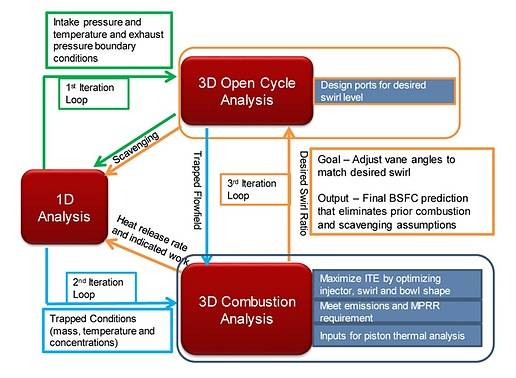 阿凱提斯動力的工程師構建了一個由三部分構成、三重迭代的計算模型,可謂前所未有。該模型采用優化實驗設計的方法來測算氣缸渦流,是CONVERGE CFD和GT-Power的改良版模型。(圖表來源:阿凱提斯動力)
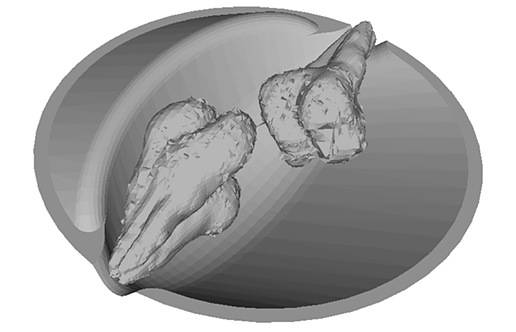 模擬仿真阿凱提斯燃燒系統從邊側噴油器產生的噴射氣流。(圖片來源:阿凱提斯動力)
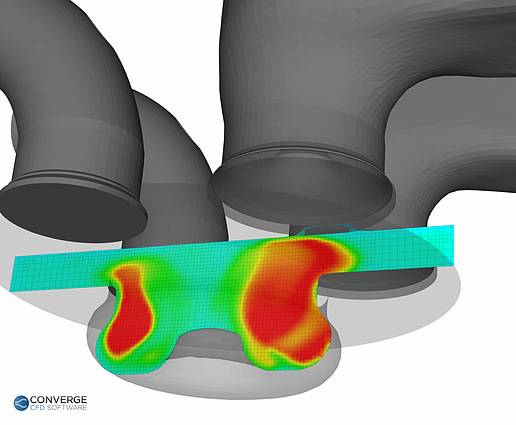 要減輕大計算量模擬仿真工具的工作負荷,涉及不少技術,其中就包括自適應網格系統,可以進一步提高模擬仿真工具的效用。(圖片來源:Convergent Science)
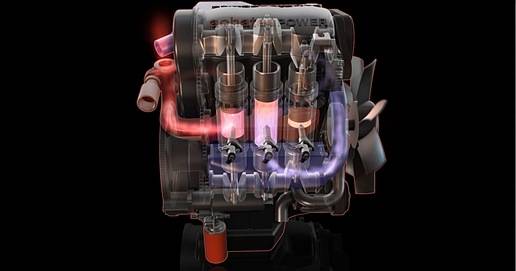 掌握了CAE工具以及相關的創新技術后,阿凱提斯的工程師就能克服多項對置活塞發動機設計所固有的技術難題。(圖片來源:阿凱提斯動力)