在我們準備給全新2017款本田ClarityFuel Cell燃料電池汽車以10,153psi (700巴)的壓強加氫時,讓我們感到一絲小興奮、小激動,最起碼有點小冒險的感覺。
但事實上,我們所處的加氫站上方籠罩著一個有型的半透明遮陽天棚,整體造型非常符合本田的期望:那就是與加油站難以分辨。現階段來說,南加州共有26個投入使用的公共加氫站。
Clarity燃料電池汽車的加氫時長甚至都與汽車加油很接近,加滿141L(37.3 gal)的雙儲氫罐大約需要5到6分鐘時間。這也就是說,只需五分鐘,你就可以駕駛著這輛寬敞、舒適的新能源轎車飛馳366英里(589公里)左右。我們高速行駛在加州的高速公路,又伴著微風穿過彎彎曲曲的鄉村道路,周圍的一切是如此安靜,如果我們閉上眼睛,肯定會以為乘坐的是本田已量產多年的雅閣(Accord)全電動汽車。根據美國環保署(EPA)估計,Clarity Fuel Cell的綜合燃料經濟性為68 mpg(3.5 L/100 km)。
那么,燃料電池汽車還能有什么讓人們不喜歡的地方呢?
技術難題已經解決
2017款Clarity Fuel Cell的首席工程師與開發主管Kiyoshi Shimizu自1997年即開始領導本田燃料電池動力開發部門的工作。他堅信,全新Clarity完全可以勝任“日常用車”的角色,根本不需要任何理由。從1998年僅能乘坐“1個半人”的小貨車(他羞澀地稱為“輪子上的化學工廠”)到今天成功將整個動力系統(包括燃料電池堆棧、驅動單元及所有相關動力、控制元件)完美封裝進發動機艙的Clarity Fuel Cell,本田對燃料電池技術的研發追求已經持續了幾十年。值得一提的是,與本田3.5L V6發動機相比,Clarity完整推進系統所需的安裝空間甚至還會更小。
本田稱,Clarity的整潔封裝技術為世界首創。目前,世界上唯一一款量產的燃料電池轎車為豐田(Toyota)Mirai,而Mirai是將燃料電池堆棧安裝在乘客艙的地板下方,這點與Clarity Fuel Cell的前款,即1998年推出的FCX Clarity相同。此外,另外一款已經公開發售的燃料電池汽車是現代汽車(Hyundai)的Tucson 燃料電池汽車。不過,現代最近發布了一款采用第四代燃料電池技術的概念跨界車,并許諾將作為一款2018年車型公開上市,為用戶提供800km (497 mi)的續航里程。
正如Clarity Fuel Cell幾乎不可思議的封裝所展示的一樣,本田新一代燃料電池汽車幾乎在各個方面都較前款有顯著的提升。
從封裝方面來看,通過多個方面的努力配合與進步,Clarity所采用的新動力系統的電機高度縮小34%,更重要的是電池單體的數量減少了30%。此外,新電池單體自身的厚度也降低了20%。在這樣的支持之下,新的電池系統得以水平安裝,而非一定要垂直安裝了。
盡管電池數量有所減少,但每個電池單體的輸出均增加了1.5倍,總功率達103kW,按照每個堆棧33L的容量,也就是所每個堆棧的功率密度為3.1kW。很顯然,電池的輸出電壓更高,牽引電機可以使用的功率就越大。
動力傳動系統:更高功率、更低噪聲
盡管工程師希望可以提高系統的功率和效率,但他們也同樣希望降低噪音,無論是燃料電池的“進氣口”部分,還是驅動單元本身。
首先,氧氣的供應至關重要的,充足的氧氣才能保證燃料電池堆棧的正常運行;Clarity還采用了一款新型電驅動兩級空氣壓縮器為燃料電池堆棧提供輸送氧氣,無論技術還是NVH性能方面均有較大提升。所搭載的ICE型渦輪增壓器的噪聲更低,同時一款更簡單的消音器能夠消除更高頻率的噪聲(相較于之前的羅茨壓縮器),而且還可以輸送1.7倍空氣。此外,壓縮機的體積也縮小了40%左右。
盡管如此,我們必須說明的是,這款安靜、強大的電動渦輪增壓器需要消耗大量能量。首席工程師Shimizu告訴《汽車工程》,這款增壓器的功率需求通常在1-2kW之間。但由于新型燃料電池堆棧的能量密度更高,可以為電機提供所需的功率,這是本田與一家供應商的聯合開發成果。不過,Shimizu微笑著拒絕向我們透露這家供應商的具體信息。
此外,Clarity 燃料電汽車的動力系統還同時采用了一款“燃料電池電壓控制單元”,這是一部大約4英寸厚的增壓器(也是打開引擎蓋時第一個看到的組件),可以通過一種碳化硅功率半導體材料將燃料電池的功率輸出提高至500V,從而極大地提高開關頻率,且可以采用一個體積更小的散熱器,而非傳統的純硅材料半導體散熱器。
之前,FCX Clarity燃料電池堆棧最高可向交流同步電機輸出為330V電壓,而升級后的輸出高達500V,這意味著電機的功率輸出將提升30%達到174hp,而扭矩也從之前的189lb·ft (256 N·m)提高至 221 lb·ft (300 N·m)。此外,電機的最高轉速也從之前的12,500轉提高至13,000轉,最高時速則從4mph上升至103mph(166km/h)。
這款電機本身也經過了一系列精細調整,以減少噪音。目前,電機轉子已經被分為四部分,而非之前的兩部分。本田表示,這種設計可以降低轉矩波動,而經過優化的定子則可以減少震動,電機外殼也增加了結構性支撐條的數量。根據本田的計算,車輛加速度為0.2g時,電機傳送至車廂的噪聲可降低25%。
安靜電機與電動渦輪增壓器設計的完美配合仍需面臨一個困擾大多數燃料電池汽車的NVH問題:壓縮機噪音和電機“嗚咽”。《國際汽車工程》記者在啟動Clarity時(車內信息娛樂系統已經關閉的情況下)還是可以聽到一陣小聲的尖聲“嗚咽”傳入車艙。另外,在高速公路上將油門踩到底全速飛馳時的情況也一樣。
新的基礎、大量優化創新
2017款Clarity燃料電池汽車的尖端動力傳動系統離不開本田的一個全新平臺。這個平臺似乎沒有特別的名字,但采用了“直線型車架”結構,可以最大化車艙空間、減少重量并為這款燃料電池汽車提供更加優化的行駛動力表現(純電動/混合電動Calrity系列產品,尚待定)。與現行版混動雅閣相比,這款全新平臺的重心降低了4 in (10 cm) ,經過專門設計,可以支撐鋁制內襯碳纖維/玻璃纖維儲氫罐(世界第一)的重量。
此外,車輛的四輪獨立懸架系統采用了幾種巧妙的輕量化技術:系統的前支柱采用了鍛造鋁材料的下懸掛臂,重量較常用的壓制鋼材料輕30%,而且可以減少10%的轉向節。車輛后方的多連桿均采用了全鋁材料(與鋼材相比重量降低40%),橫拉桿則采用了本田口中的世界首創高強度鍛造鋁材料,成功為該部件減重20%。
Clarity Fuel Cell還有另一項世界首創:一款空心的壓鑄鋁材前副車架。這種設計可以減少需要焊接的部位數量,并降低20%的重量;此外,這種借鑒于摩托車的車架設計還能同時為車輛提供一個異常強勁的剛性結構。
還想要更多世界第一嗎?來看看ClarityFuel Cell的車身吧!本田為新款Clarity搭配了一款世界首創玻璃纖維增強塑料(GFRP)后保險杠,并將前部的鋼制隔板也替換為一款“混合”塑料組件。本田表示,該汽車平臺40%的組件均采用了超高張力鋼材,且Clarity也是980 MPa級高成型鋼首次登陸汽車應用。由于采用了鋁質車身板等其他先進輕質材料,據稱Clarity Fuel Cell的結構要比傳統的中型轎車更強,但卻更輕15%。
在尺寸和重量方面,Clarity Fuel Cell的軸距108.3-in (2750-mm),(雅閣為109.3-in),總長度為192.7 in (4895 mm) ,幾乎與雅閣相同,而且從尺寸上也與豐田的Mirai很相似,但Carity為5座車,而Mirai為4座車。這款本田燃料電池轎車內部空間為102立方英尺(2.88立方米),而最寬敞的雅閣則最大可以為車上人員提供103.2立方英尺(2.92立方米)的空間。這款Clarity Fuel Cell重約4,134 lb (1,875 kg),比自動檔雅閣要重700 lb (318 kg) 。
從體積和功能來看,2017款Clarity Fuel Cell一點也不輸給任何一款傳統的中尺寸轎車(好吧,也許后備箱空間的確小了一些)。但倡導環保的加州又給有意愿購買Clarity的車主更多福利。本田Clarity Fuel Cell的“租售”條件為$2,500元首付、$369月租(合同期限36個月),但考慮到加州提供的$5000立即返款和本田提供的價值$15000的加料卡,相當于用戶每月出不了多少錢。許多加州經銷商都有客戶訂購了這款車型。本田相關人士透露,Clarity Fuel Cell目前在日本櫪木生產,但最終的量產可能在今年早些時候交給其他工廠進行(可能會是一家美國工廠?)。
啊,燃料和基礎設施怎么樣了?
事實上,大家都氫燃料電池汽車環保型的觀點可能非常矛盾。批評人士表示,氫燃料的生產及后續的壓縮過程均非常消耗能量,而這會擴大氫燃料的碳足跡,但也有主流研究認為,氫燃料(天然氣制成)電池汽車的“油井到車輪”排放僅為汽油車型的一半。Clarity的首席工程師Shimizu告訴我們氫燃料(天然氣制成)的“油井到車輪”能源效率優于混合電動汽車,并強調了燃料電池汽車不會產生任何尾氣排放的事實。
有關二氧化碳排放的爭論可能還將繼續,但幾乎沒人可以否認燃料電池汽車加料網絡缺乏的現實。目前,加氫站僅僅在加州的進行了部署,并“遵從了”加州的游戲規則。本田的替代燃料實現方面的老員工Stephen Ellis表示,快速的加氫時間、Clarity的長續航里程、以及不斷完善“氫高速公路”網絡都將讓氫燃料汽車成為一種切合可行的汽車選擇。Ellis表示,我們可能很快就會等到有關在美國東北部建設加氫網絡的消息,這些州都已經采用了加州的排放標準。
在經過一整天對2017款Clarity Fuel Cell的了解與體驗后,我想很少有人會質疑這款燃料電池汽車為主流所接受的潛力。本田和其他燃料電池汽車的支持者并沒有說錯燃料電池汽車相較于純電動汽車的優勢。如果氫燃料的供給變得更加普及,Clarity Fuel Cell應該大可以和其他電池電動汽車好好比拼一下。
We expected some pop and sizzle–at least something vaguely adventurous—to mark the occasion of refueling Honda’s all-new 2017 Clarity Fuel Cell sedan with compressed hydrogen pumped in at a heady 10,153 psi (700 bar).
Instead, standing under the stylish translucent sunshade protecting this hydrogen refueling station—one of about 26 such public facilities currently operating in Southern California—the overwhelming experience is exactly how Honda and hydrogen-fuel interests want it to be: nearly indistinguishable from the gas station a stone’s throw away.
Even the time to fully fill the Clarity Fuel Cell is about the same, maybe five or six minutes to fully replenish the fuel-cell car’s two-tank capacity of 141 liters (37.3 gal). Five minutes and you’re on your way in this large and comfortable sedan for another maximum of 366 miles (589 km). We cruise the California freeways and breeze through snaky backroads in utter silence and with an unassailable refinement that, if we shut our eyes, convinces us the Clarity Fuel Cell could be an all-electric Accord that Honda’s had in production for years. The EPA-estimates this all happens at a combined fuel-economy rating of 68 mpg (3.5 L/100 km).
So what’s not to like about these fuel-cell cars, anyway?
Technical challenges resolved
Kiyoshi Shimizu, chief engineer and development leader for the 2017 Clarity Fuel Cell, has led Honda’s FCV Powertrain Development Dept. since 1997. He seems almost the personification of why the new Clarity Fuel Cell need make no excuses as a fully viable “everyday” vehicle. The company’s dogged decades of R&D have progressed fuel-cell technology from 1998’s “one-and-a-half-passenger” minivan he almost sheepishly describes as a “chemical plant on wheels” to today’s Clarity that packages the entire powertrain—fuel-cell stack, drive unit and all associated power and control electronics—neatly under the hood. The entire propulsion system requires less physical space than Honda’s 3.5L V-6.
Honda claims that tidy packaging is a world-first. And considering arch-rival Toyota’s Mirai is the only other production FCV sedan on the road. Mirai locates the fuel-cell stack under the passenger-compartment floor, much like the Clarity Fuel Cell’s predecessor, the FCX Clarity, launched in 1998. The only other series-production FCV offered for sale to the public is Hyundai’s Tucson Fuel Cell, although Hyundai recently revealed a concept crossover model using fourth-generation fuel-cell technology that the company promises will impart a 2018 production version with 800 km (497 mi) of driving range.
As the Clarity Fuel Cell’s almost miraculous packaging demonstrates, the eight years between fuel-cell generations has delivered demonstrable advance in almost every sense.
The powertrain’s packaging advance—including a 34% cut in motor height—comes from several development areas, chief being a 30% reduction in the number of cells in the stack. The new cells themselves are 20% thinner. And thanks to the new stack design, the unit now can be situated horizontally rather than vertically.
Despite the decrease in the number of cells, each now has 1.5 times more electrical output, for a total of 103 kW, or a power density of 3.1 kW for each of the stack’s 33L of volume. More voltage from the stack means more power available to the traction motor.
Drivetrain: more power, less noise
But while engineers aimed to improve system power and efficiency, they were similarly bent on cutting noise, both from the “intake” portion of the fuel cell and the drive unit itself.
First, oxygen supply is critical to allow the more power-dense fuel-cell stack to do its job; a considerable advance—both technically and in terms of NVH—comes from the adoption of a new, electrically-driven two-stage air compressor to shove air into the stack. Not only does this ICE-type turbocharger produce less sound, and of a higher frequency that can be muffled by a simpler silencer than the former Roots-style compressor—but it pushes 1.7 times the air volume. The compressor body is about 40% smaller, too.
The quiet and more-powerful electric turbocharger is an energy-hungry devil, though: chief engineer Shimizu told Automotive Engineering it typically might draw between 1-2 kW of power. But the heightened energy density of the new fuel-cell stack allowed for the draw attributable to the electric turbo that is the result of a joint development between Honda and “a supplier” Shimizu smilingly would not name.
Also new to the Clarity Fuel Cell’s powertrain is a “fuel cell voltage control unit,” a 4-inch-thick booster (and the uppermost component one sees when lifting the hood), steps up power from the cell stack to a maximum of 500 volts via a silicon-carbide power semiconductor material that vastly improves switching frequency while necessitating a much-smaller heat sink than would a more-conventional silicon-only semiconductor.
The upgraded 500V input—the most power the previous FCX Clarity fuel-cell stack could deliver was 330V—to the AC synchronous electric motor means its power output is hiked by 30% to 174 hp, while torque climbs to a robust 221 lb·ft (300 N·m) compared to the previous 189 lb·ft (256 N·m). Maximum motor rpm also is increased slightly from 12,500 rpm to 13,000 rpm and top speed climbs 4 mph to 103 mph (166 km/h).
The motor itself enjoyed incisive development tweaks to cut noise. The rotor now is sliced into four sections instead of two, which Honda said reduces torque fluctuation, while the stator is optimized to reduce vibration and the motor housing has additional structural ribs. Honda calculates that motor noise transmitted to the cabin at 0.2 g of acceleration is reduced by 25%.
The quieted motor and the new electric turbocharger team to all but nullify one of the ongoing NVH bugaboos that has lingered for most FCVs: loud compressor noise and motor whine. Automotive Engineering’s hard standing-start acceleration could wring little more than a nearly inaudible high-pitched whine in the cabin with the entertainment system turned off. The same was true for floored-throttle roll-on acceleration at freeway speeds.
New underpinnings, mass-optimization innovations
The 2017 Clarity Fuel Cell’s cutting-edge driveline propels an all-new platform that Honda doesn’t seem to be calling anything in particular, but said its fundamental “straight frames” structure was designed to maximize cabin space, cut weight and deliver optimized driving dynamics for a fuel-cell vehicle (and the pending battery-electric and hybrid-electric Clarity-family variants). Designed specifically to handle the weight of the aluminum-lined carbon-fiber/fiberglass storage tank (said to be a world-first), the new platform’s center of gravity is some 4 in (10 cm) lower than an Accord Hybrid.
The four-wheel independent suspension uses a few clever lightweighting techniques: the front strut setup uses forged-aluminum lower arms that are 30% lighter than a common pressed-steel arm and hollowing the knuckle saves 10%. At the rear, the multilink arrangement’s arms all are aluminum (worth a 40% cut compared with steel) and the tie rods come from what Honda said is the world’s first high-strength aluminum forging, allowing the rods to be 20% lighter than a conventional aluminum forging.
Another world-first for the Clarity Fuel Cell: a hollow die-cast aluminum front subframe eliminates the welding of multiple pieces and saves 20% in weight; the technique, borrowed from motorcycle-frame development, also creates a seamless and exceptionally rigid structure.
Want some more claimed world-firsts? Look to the Clarity Fuel Cell’s body, where Honda has the first glass-fiber reinforced plastic (GFRP) rear bumper beam. Meanwhile, there’s a “hybrid” plastic bulkhead at the front that replaces steel and Honda said 40% of the vehicle’s platform is comprised of super-high-tensile steel and the company said the car marks the world’s first (again) use of high-formability 980 MPa-class steel for automotive application. Along with aluminum body panels and other lightweight advanced materials, the Clarity Fuel Cell’s structure is claimed to be stronger than that of a conventional midsize sedan yet is 15% lighter.
In terms of size and weight, the Clarity Fuel Cell has a 108.3-in (2750-mm) wheelbase (Honda’s Accord: 109.3) and is 192.7 in (4895 mm) in overall length, nearly the same as the Accord and also quite dimensionally similar to Toyota’s Mirai, although the Clarity seats five and the Mirai is a 4-seater. The Honda fuel-cell sedan’s interior volume is listed at 102 cubic feet and the most spacious Accord variant offers 103.2 cubic feet of passenger volume. The Clarity Fuel Cell weighs 4134 lb (1875 kg), while a typical automatic-transmission Accord is about 700 lb (318 kg) lighter.
In terms of size and utility, then, the 2017 Clarity Fuel Cell gives up nothing (okay, maybe some sheer trunk usability) to a conventional midsize sedan. But the green-oriented in California have further incentive: Honda’s opening “deal” for this FCV is compelling: a $369/month lease for 36 months with $2,500 down. But factor in a California HOV-lane sticker, the state’s instant $5000 rebate and Honda’s debit card for $15000 worth of fuel over the lease term and the monthly out-of-pocket outlay is almost laughably skimpy. Many California dealers have waiting lists for the car that for now is being built in Tochigi, Japan, but is moving to a mass-production plant somewhere (the U.S., perhaps?) early next year, said a Honda source.
Ah, that fuel, that infrastructure
You’ll find plenty of contradictory opinion about the environmental friendliness of hydrogen fuel. Critics say its production and subsequent compression is energy-intensive and balloons hydrogen’s carbon profile (one prominent study concluded, however, the well-to-wheels CO2 emissions of hydrogen produced from natural gas for an FCV is approximately half that of gasoline).Chief engineer Shimizu told us the well-to-wheels energy efficiency of hydrogen derived from natural gas is better than a hybrid-electric vehicle—and reminds that an FCV has zero tailpipe emissions.
The carbon-dioxide argument will continue, but few can argue the almost complete lack of a national refueling network makes FCVs, for now, strictly a California “compliance” play (see sidebar). Stephen Ellis, Honda’s veteran of alternative-fuel implementation, said fast refueling times, the Clarity Fuel Cell’s plump driving range and the expanding “hydrogen highway” of conveniently-located refueling stations make FCVs utterly practical in California. He then said to expect imminent news (likely at New York’s auto show in April) regarding the initiative to extend refueling strategies to the northeastern U.S., where many states have adopted California’s emissions standards.
After a full day’s sampling of the refinement and brisk performance of the 2017 Clarity Fuel Cell, few could question the car’s potential for mainstream acceptance. And Honda and other FCV proponents are correct in pointing out fuel-cell advantages over battery-electric vehicles. If and when hydrogen fuel becomes more widely available, the marvelously-developed Clarity Fuel Cell is proof the fuel-cell approach could give batteries a run for the money.

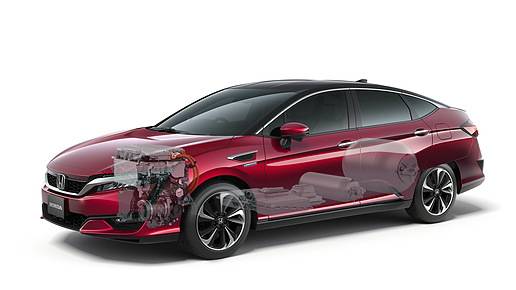 一個封裝的奇跡:本田表示,Clarity Fuel Cell是世界首款將燃料電池系統(包括燃料電池堆棧)完全封裝進發動機蓋下的轎車。
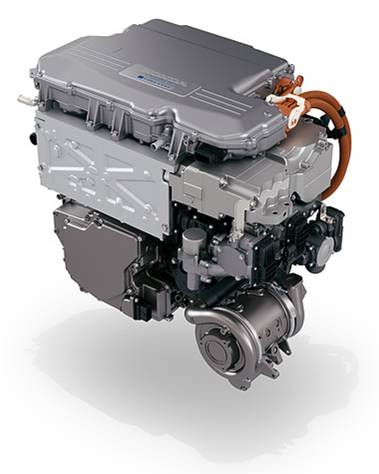 為了精簡動力系統的尺寸,2017款Clarity Fuel Cell燃料電池汽車采用了多項創新技術,主要集中在燃料電池堆棧和交流同步推進電機方面。
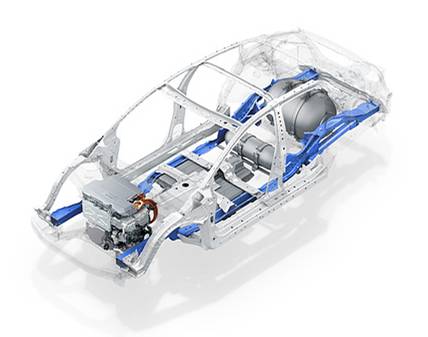 2017款Clarity基于本田全新專用電動汽車平臺設計,采用了車艙空間最大化的“直線型車架”配置,可以便利車輛的封裝,據稱還可以提供更好的碰撞性能。此外,本田的全新平臺還經過專門設計,配合Clarity的雙儲氫罐設計。
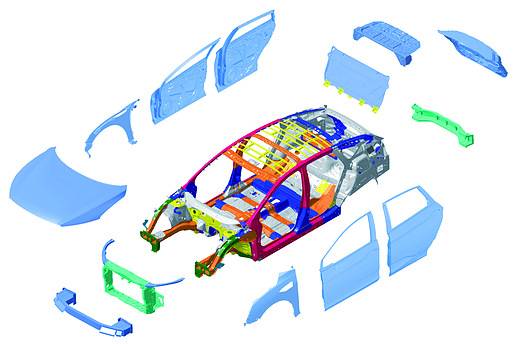 為了減輕懸掛、架構和車身的重量,2017款Clarity Fuel Cell采用了大量混合材料。根據介紹,上圖中的紅色和橘黃色部分分別代表高成型、高張力鋼,這也是這些材料在汽車領域的首次應用;綠色部分代表混合塑料材料;車輛的后保桿采用玻璃纖維增強塑料(GFRP),據稱這也是CFRP材料在高沖擊區的首次應用。
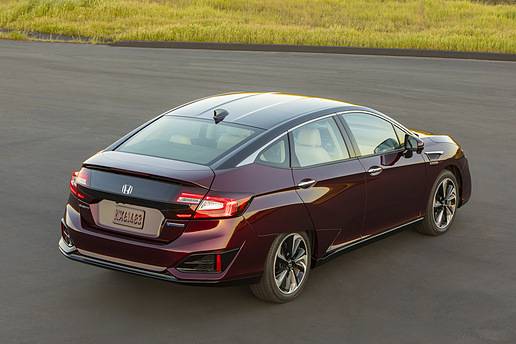 與同尺寸的本田雅閣(Honda's Accord)中型轎車和競爭對手豐田Mirai相比,Clarity Fuel Cell的內部空間更加寬敞、加速性能相當干脆,完全讓人感覺不到這款車整備重量達到了4134 lb。