2017年美國工程機(jī)械展(Conexpo2017)上,英國工程機(jī)械與農(nóng)業(yè)設(shè)備制造專業(yè)公司JCB表示,公司的入門級產(chǎn)品3.0L DieselMax柴油發(fā)動機(jī)將在2017年晚些時候搭載在一款工程機(jī)械上進(jìn)入美國市場。
JCB公司發(fā)動機(jī)部主管AlanTolley表示,這款DieselMax柴油發(fā)動機(jī)可以按照行業(yè)標(biāo)準(zhǔn)輸出74-hp (55-kW)功率并同時滿足美國EPA的Tier 4排放標(biāo)準(zhǔn),整個工作過程無需采用SCR選擇性催化還原系統(tǒng),可以有效降低設(shè)備的運(yùn)營成本和維護(hù)保養(yǎng)難度。
此前,JCB公司的4.4LEcoMax柴油發(fā)動機(jī)是公司排量最小的四階段(Tier 4)發(fā)動機(jī),而Dieselmax 4缸柴油發(fā)動機(jī)的尺寸比EcoMax還小25%。在展會期間的采訪中,Tolley告訴《卡車與非公路工程》雜志(Truck & Off-Highway Engineering),這款新型3L發(fā)動機(jī)的重量也比4.4L發(fā)動機(jī)大約輕30%,燃料經(jīng)濟(jì)性也要高8%左右。此外,盡管DieselMax的尺寸比EcoMax發(fā)動機(jī)小很多,但一樣可以輸出295 lb·ft (400 N·m)的扭矩。
“我們在這款發(fā)動機(jī)的設(shè)計(jì)中認(rèn)真考慮了一些重型設(shè)備的需求。”Tolley向記者介紹了這款發(fā)動機(jī)在耐用性和維護(hù)保養(yǎng)方面的設(shè)計(jì)優(yōu)勢。DieselMax的換油間隔可以延長至1,000小時,具體可配合燃料過濾器的更換周期;而發(fā)動機(jī)采用的液壓挺桿設(shè)計(jì)也意味著用戶無需周期性的進(jìn)行閥門調(diào)節(jié)。此外,發(fā)動機(jī)還配備了一個電控渦輪增壓廢氣門和多個預(yù)熱塞,可協(xié)助發(fā)動機(jī)快速達(dá)到理想工作溫度,確保流暢、安靜的運(yùn)行性能。
“DieselMax的燃耗更低、工作噪聲更小且保養(yǎng)間隔更長,能夠真正造福終端用戶。”Tolley表示,DieselMax發(fā)動機(jī)非常適合各類鏟斗機(jī)、裝載機(jī)、挖掘機(jī)等建筑設(shè)備。
高科技的“甜點(diǎn)”
Tolley表示,受到最新美國和歐洲排放要求的限制,目前市面上的發(fā)動機(jī)大多以最大功率55 kW的產(chǎn)品為主。
“55-kW發(fā)動機(jī)開始變得很受歡迎,”Tolley表示,“然而,你必須采用SCR系梳才能滿足美國的Tier 4或歐洲的Stage IIIB規(guī)定。”Tolley表示,一些地區(qū)和公司對SCR型發(fā)動機(jī)的態(tài)度有所退縮。他表示,不同地區(qū)對SCR系統(tǒng)的接受程度有所不同。此外,設(shè)備類型及工作占空比需求不同也會影響大家對這種系統(tǒng)的容忍度。比如,一些設(shè)備租賃公司就很反對氧化還原劑的使用,因?yàn)檫@會增加公司的維護(hù)成本。
此外,DieselMax還同時采用了冷卻廢氣循環(huán)(EGR)和共軌加油系統(tǒng),能夠滿足設(shè)備的啟停需求。Tolley表示,DieselMax發(fā)動機(jī)還可升級采用一款可變幾何形狀渦輪增壓器,但這對于這款發(fā)動機(jī)55 kW的輸出功率并沒有必要。Tolley表示,這款發(fā)動機(jī)還可以通過調(diào)整輸出更高功率,但這樣一來就必須借助加載SCR設(shè)備才能滿足相關(guān)規(guī)定,因此單純升級渦輪增壓器并沒有太大意義。
Tolley補(bǔ)充說,DieselMax完全可以為絕大多數(shù)目標(biāo)設(shè)備提供足夠的功率。目前,這款發(fā)動機(jī)可以在1,200-1,250轉(zhuǎn)時取得最大功率,幾乎在完整操作區(qū)間內(nèi)均能實(shí)現(xiàn)峰值扭矩。
按照計(jì)劃,新款DieselMax將由JCB公司位于英國的Darby裝配廠負(fù)責(zé)生產(chǎn)。
Off-highway powertrain and driveline specialist JCB said at Conexpo 2017 the company is starting production of its new entry-level engine, the 3.0-L DieselMax, with its first applications in OEM machines coming in the U.S. market later in 2017.
Alan Tolley, group director—engines at JCB Power Systems, said DieselMax’s key design feature is that it produces the industry-standard 74-hp (55-kW) rating while complying with U.S. EPA Tier 4 emissions standards without selective catalytic reduction (SCR) exhaust aftertreatment, a boon for reducing operating cost and maintenance complexity.
The Dieselmax 4-cylinder also is 25% smaller than JCB’s 4.4-L EcoMax diesel, until now the company’s smallest-displacement Tier 4-compliant engine. The new 3L also is roughly 30% lighter than the 4.4-L engine—and as much as 8% more fuel-efficient, Tolley told Truck & Off-Highway Engineering during an interview an Conexpo. And the DieselMax may be significantly smaller than the 4.4-L, but generates the same torque rating of 295 lb·ft (400 N·m).
“We’ve very much taken the (JCB) heavy-duty architecture into this design,” Tolley said in noting the new engine’s design priorities of durability and low service requirements. The oil-change interval can extend to 1000 hours, matching the fuel-filter change schedule and hydraulic tappets mean no periodic valve adjustments. There also is an electronically-controlled turbocharger wastegate and glowplugs for quickly achieving a temperature conducive to smooth operation, quiet operation.
“What the end user gets is less fuel consumption, low noise and longer service intervals,” Tolley said of the Dieselmax, which will be suitable for OEMs to specify for all manner of backhoes, loaders, excavators and other construction equipment.
High tech for the sweet spot
Tolley said engines with a maximum output of 55 kW now play a significant role in the market because of the latest emissions standards in the U.S. and Europe.
“55-kW is getting very popular,” he said. “Above that, you need SCR (for Tier 4 and Euro Stage IIIB emissions compliance).” He said there has been pushback in some regions or by some operators regarding engines that require SCR. There is a comfort level with SCR that varies by region, machine type and duty cycle, he said. Rental operations, for example, are averse to SCR because of maintenance concerns.
The DieselMax also has cooled EGR and common-rail fueling and is capable of accommodating stop-start operation. He said it would be possible to use a variable-geometry turbocharger, but it is not needed to achieve the 55 kW rating. Tolley said the engine could be tuned for more output, but since that would require fitment of SCR, there wouldn’t be much sense in using a more-sophisticated turbocharger.
He added that the engine’s operating characteristics provide more than enough power for most equipment that would use the engine. Maximum power is developed at 1200-1250 rpm and peak torque is available almost throughout the DieselMax’s operating range.
The new DieselMax is built by JCB at its assembly plant in Darby, United Kingdom.
Author: Bill Visnic
Source: SAE Truck & Off-highway Engineering Magazine
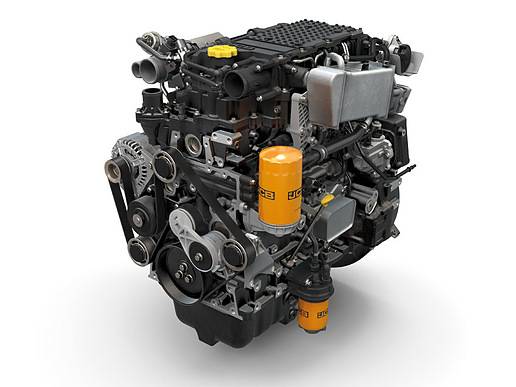 JCB全新3.0L 4缸柴油發(fā)動機(jī)DieselMax的功率輸出可達(dá)74hp,峰值扭矩達(dá)295 lb·ft (400 N·m),幾乎可以與同公司的4.4L柴油發(fā)動機(jī)持平。