作為記者,每當有機會率先試駕一款仍在研發之中,可能世上絕無僅有的技術演示車時,我總是精神高度集中,而如果這一切又發生在英國北部海岸泥濘的鄉村道路上,則又會給我的經歷平添了更多風味。
正是在這樣的環境之下,Torotrak公司向《汽車工程》雜志展示了公司旗下新款V-Charge增壓器的無窮潛力。具體來說,V-Charge是一款由傳統皮帶輪驅動的CVT控制機械傳動可變壓強增壓器,其壓縮器轉速不受發動機轉速的限制。此外,這款增壓器還經過專門設計,可提供低端扭矩并解決小型汽油發動機存在的渦輪滯后問題。
Torotrak公司選擇采用一款1.0L福特福克斯(Ford Focus)作為技術演示平臺(Torotrak正在與福特合作開展該項目),展示V-Charge增壓器的非凡潛力。據了解,目前這款技術演示車正在歐洲各地進行路演。
Torotrak集團業務開發經理RichardDunne表示,為了滿足歐VII排放標準的要求,多家公司均將目光轉向了米勒循環發動機,V-Charge也順應趨勢采用了小型化設計。目前,英國巴斯大學正在進行相關獨立測試。
Dunne解釋說,要“無中生有”一直都是工程師面臨的挑戰之一。V-Charge增壓器并不能減少常規1.0L發動機的燃耗,這并不是我們的首選計劃。但相比同樣常規的1.5L福特西格瑪(Sigma)系統,V-Charge預計最高可節省12%的燃料消耗,并同時降低相當比例的CO2排放。
V-Charge增壓器并不需要求助于48V輕混合動力技術,而是采用了一款現成的標準壓縮器。Dunne表示,與e-boost系統不同,V-Charge系統可以實現持續增壓。他說,“這并不復雜;這款可變壓縮比牽引驅動器就是一款微縮版的CVT變速器,而我們CVT技術已經得到了大家的認可。”據了解,V-Charge系統的重量約為6公斤(13.2磅)。
試駕
在本次試駕中,這款手動福克斯演示車由本文作者駕駛控制,而Dunne則使用筆記本控制開關,從而直觀地對比發動機在是否使用V-Charge系統時的性能差異。據了解,這款福克斯采用的渦輪增壓器比標準EcoBoost單元略大,可提供110kW(147hp)的輸出,比后者高18kW(24hp)。
經過試駕,V-Charge的性能在以下情況下體現最為明顯:首個陡坡、十字路口的起步、三檔下發動機轉速降至1000轉時的90°轉彎等。發動機的低轉速和高扭矩(相對)配合非常默契,一般不需要換到較低檔位。
對于一款輸出在92kW(123hp)的常規福特3缸發動機,其在1000轉時的基線額定扭矩為100Nm(74 lb·ft),1400轉時的基線額定扭矩為170Nm(125 lb·ft)。在使用V-Charge之后,以上兩個數據可分別提升至145 N·m (106 lb·ft)和240 N·m (177 lb·ft),輸出水平與1.5L的4缸發動機相仿。這種增壓器最合適重量在1289kg(2841lb)左右的C級或小型車。
Dunne解釋道,由于V-Charge的變速比為10,因此可將轉速在1100轉的發動機提升至10,000轉到100,000轉之間。該系統經過專門設計,可在發動機的較大轉速范圍(怠速到2500轉)內保持最高效率,具體可采用逐漸降低的方式避免過度增壓。據了解,V-Charge系統可在400ms內完成增壓。
此外,這款增壓器的工作過程非常安靜。Dunne表示,V-Charge的工作噪音比與同級別的羅茨式增壓器小97%,因此可以輕松安裝在發動機后方,無需專門采取降噪措施。
V-Charge增壓器通過一款電動促動器調整增壓比,而非液壓控制,因此可以在最大程度上減少寄生損失。CVT系統選用了性能有保證的牽引液,不存在金屬部件直接接觸的情況。V-Charge的增壓比范圍為0.28至2.82:1。當沒有增壓需求時,車輛可將V-Charge的增壓比可降至最低水平,并不需要斷開離合器。
這款V-Charge采用了一款非標準渦輪,以提升發動機的最大功率輸出,但Dunne并未透露渦輪供應商的名稱。通過試駕我們可以感受到,如果不使用V-Charge,福克斯演示車在較高檔位,發動機轉速較低時明顯動力較弱。
V-Charge增壓器經過專門設計,可提供高達17kW(23hp)的持續功率容量。
據稱,由于系統本身會增加發動機的負載(約100W),因此當采用V-Charge系統時,1.0L發動機的燃耗和排放均比采用V-Charge之前高2-5%,但1.5L發動機的燃耗和排放數據均降低12%左右。
成本與VGT可變截面渦輪增壓器相仿
由于Torotrak公司本身并不是制造商,因此可能會將V-Charge技術出售或許可給一級供應商使用。公司首席技術官Doug Cross表示,V-Charge的成本與VGT相仿。
“在確定成本效益比時,我們必須把所有成本都考慮在內。”Cross告訴《汽車工程》,“當你把一項技術賣給廠商時,消費者最終需要買單的價格很可能比你當初的技術轉讓價格高一倍。”但由于V-Charge可以提高發動機性能,因此一些廠商可以選擇用成本更低的3缸發動機替代4缸發動機,從而在不犧牲性能的情況下節約一些成本。
Cross認為,考慮到這些因素,事實上應用V-Charge增壓器可能僅會少量增加成本,甚至還有可能為廠商節約成本。
Cross曾效力于雷諾和豐田的F1車隊擔任發動機設計經理,也是KERS開發供應專家公司Flybrid(目前為Torotrak的一部分)的聯合創始人。
最近,福特宣布,公司計劃在2018年為旗下1.0L 3缸發動機配備氣缸鈍化功能。Cross認為,V-Charge可為氣缸鈍化技術提供有力補充。
可兼容米勒循環發動機
過去,只要提到CVT技術,人們總是會擔心系統中的牽引液在極端低溫下的表現。Cross解釋說,“我們已經通過大量研發工作,成功開發出了一種在零下30ºC時仍能保證泵送性能的牽引液產品。”
Cross表示,考慮到很多開發商都在進行米勒循環發動機(或類似產品)的研發,因此V-Charge一定要能夠與這種技術兼容。
雖然過去V-Charge的“用武之地”主要是汽油發動機,但事實上這種增壓器也同樣適用于渦輪增壓的柴油發動機,可在油門踩到底時克服瞬時載荷步帶來的負面影響。
為了滿足駕駛員的需求,廠商一般會減少對EGR(尾氣循環系統)的使用,從而導致車輛的NOx排放激增,或者通過額外給油推動渦輪的旋轉,從而造成燃料燃燒不充分而帶來的尾氣排放。
“因此,這就是在顆粒物和氮氧化物的排放之間進行權衡,”Cross表示,“對于柴油發動機來說,車輛大約40%的NOx排放均源自瞬間給油活動。但如果采用持續運行的V-Charge增壓器,系統可通過調整增壓比,輕松提供額外的增壓。這并不會影響對EGR系統的應用,而且無需增加燃料用量。”
截至目前,Torotrak尚未完成V-Charge系統在柴油發動機中的測試。但Cross相信,V-Charge一定可以有效解決柴油發動機的NOx排放激增問題。
Being the first journalist to test drive the only example of a new piece of technology still in development always concentrates the mind. Doing so in wet and windy weather battering rural roads close to England’s North Sea coast, brings an added dimension to the experience.
But that was how Torotrak demonstrated to Automotive Engineering the potential of its new, CVT-controlled V-Charge pressure charger—a mechanical, gearless, fully variable pressure charger driven by a conventional pulley. It allows compressor speed to vary independent of engine speed. It's designed to provide low-end torque and tackle the effects of turbo-lag on downsized gasoline engines.
Fitted to a 1.0-L Ford Focus as a technology demonstrator (Torotrak is partnering with Ford on this project), it is currently being shown to industry engineers and senior executives across Europe.
As well as general downsizing V-Charge is proving of particular interest to those companies working on Miller-cycle engine applications to meet Euro 7 emissions legislation, says Richard Dunne, Torotrak’s Group Business Development Manager. Independent testing has been conducted by the U.K.’s University of Bath.
Getting something for nothing has always been a problem for engineers. So V-Charge does not reduce fuel consumption of the regular 1.0-L; that is not Plan A, Dunne explained. But compared to the equally regular Ford Sigma 1.5-L it is claimed to lower consumption by up to 12%, with a comparable cut of CO2emissions.
It does this without recourse to 48-volt mild hybrid technology and uses a standard off-the-shelf (OTS) compressor. Unlike an e-boost system, this provides continuous boosting, asserted Dunne: “It is not complex; the variable ratio traction drive is a scaled down version of our established and proven toroidal CVT technology,.” he noted. System weight is 6 kg (13.2 lb).
The test drive
With the author behind the wheel of the manual-gearbox Focus demonstrator, Dunne used laptop control to switch the system in or out to give direct engine behavior comparisons. The development car uses a turbocharger slightly larger than that of the standard Ecoboost unit to give 110 kW (147 hp), an 18-kW/24-hp) increase.
The efficacy of the V-Charge was apparent on the first steep hill encountered; the initial step-off from an intersection; and a 90° bend tackled with engine speed dropping towards 1000 rpm in 3rd gear. Low engine speed and (relatively) high torque were smooth partners typically without the need for downshifting.
Baseline rated torque for a regular Ford 92-kW (123-hp) triple is 100 Nm (74 lb·ft) from 1000 rpm and 170 N·m (125 lb·ft) from 1400 rpm. With V-Charge the figures rise to 145 N·m (106 lb·ft) and 240 N·m (177 lb·ft) respectively, very similar to those for the 1.5-L 4-cylinder. It is perfectly amenable for C-segment or smaller cars with a curb weight of 1289 kg (2841 lb).
With a CVT ratio spread of 10, an 1100-rpm engine speed can be converted to anywhere between 10,000 and 100,000 rpm at the impeller without any traditional gearing, explained Dunne. The system is designed to provide greatest efficiency from idle to 2500 rpm, tapering off to avoid over-boosting. It provides a ratio change in a maximum 400 ms.
All this happens very quietly; Dunne said the system is 97% quieter than a comparable Roots-type supercharger. It is easily packaged at the rear of the engine. No noise attenuation is required, he claims.
An electric actuator is used to change ratios (there are no control hydraulics), so parasitic losses are minimized. There is no metal-to-metal contact in the CVT which uses traction fluid of proven performance. The ratio spread provides 0.28 to 2.82:1 gearing. When the charger is not needed, the ratio moves to its minimum and there is no need for a disconnect clutch.
Bearing in mind that a non-standard turbo—Dunne would not name the supplier—was fitted to increase maximum engine power, without the V-Charge the test Focus was distinctly lethargic at low revs in higher gears on the test drive.
The system is designed to provide a power capacity of up to 17 kW (23 hp) and can run at that level continuously.
Claimed fuel consumption and emissions for the 1.0-L with V-Charge are 2 - 5% higher than the standard engine due to the added load (about 100 W) caused by the system. However, the figures are estimated to be 12% lower than the 1.5-L's for similar or improved performance.
Cost similar to a VGT
Torotrak is not a manufacturer; it would sell or license V-Charge technology to a Tier 1 supplier. Doug Cross, Torotrak’s Chief Technical Officer, says the V-Charge would represent cost comparable to a variable geometry turbocharger.
“The complete on-cost needs to be considered to determine a cost:-benefit ratio," Cross told AE. "When you sell technology to an OEM, your transfer price is effectively doubled by the time it reaches the customer.” But offsets include cost saved by using a triple instead of a 4-cylinder engine without loss of performance.
It is possible, therefore, that by adding V-Charge only a modest cost penalty might be involved — and even a cost saving, Cross believes.
A former engine design manager for the Renault F1 team and before that with Toyota F1, Cross was co-founder of Flybrid, (now part of Torotrak), which became a specialist KERS (Kinetic Energy Recovery System) developer and supplier.
Ford recently announced that it plans to add cylinder de-activation capability to its 1.0-L triple for MY2018. Cross believes V-Charge could be used to complement that technology.
Miller-cycle compatible
One concern regarding use of any CVT was once the behavior of its traction fluid in extremely low temperatures, explains Cross: “We have done a huge amount of development and we now have a traction fluid that is liquid pumpable down to -30º C.”
With many OEMs involved in Miller-cycle engine development (or variations of it), Cross is confident that V-Charge would be compatible with the technology.
Although Torotrak has concentrated on gasoline engine applications for V-Charge, it would also be applicable to turbodiesels, overcoming the negative aspects of transient load steps when the accelerator is floored.
To meet the driver’s demand, either the amount of EGR is reduced, which can bring a NOx spike, or the injection of extra fuel is used to help spin up the turbo which results in unburned fuel in the exhaust.
“So it’s a trade-off between particulates and NOx,” said Cross. “These transient tip-in events are responsible for about 40% of the NOx emissions from a diesel engine. But a V-Charge, running constantly, just changes its ratio to provide added boost. The EGR is unchanged and no fuel is added.”
So far this has not been tested by Torotrak on a diesel engine. But Cross is confident that it would provide an effective solution to the problem of NOx spikes.
Author: Stuart Birch
Source: SAE Automotive Engineering Magazine

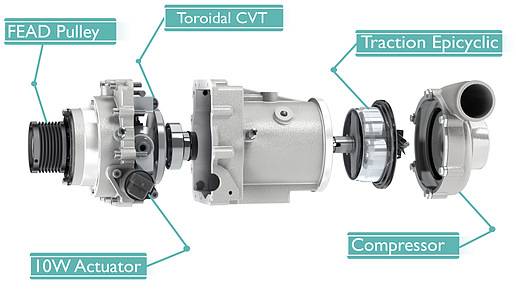 V-Charge增壓器的分解圖。我們可以看到,這款增壓器采用了環面CVT和現成的標準壓縮器。
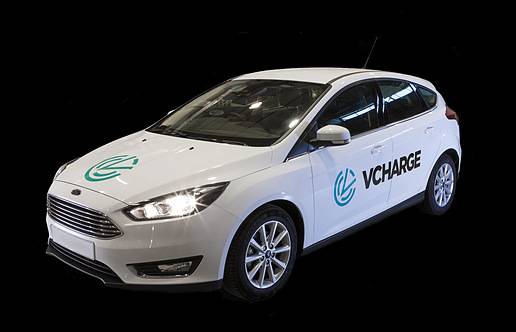 Torotrak公司選擇了一款福特福克斯(如圖)作為演示平臺,展示V-Charge技術的功能。
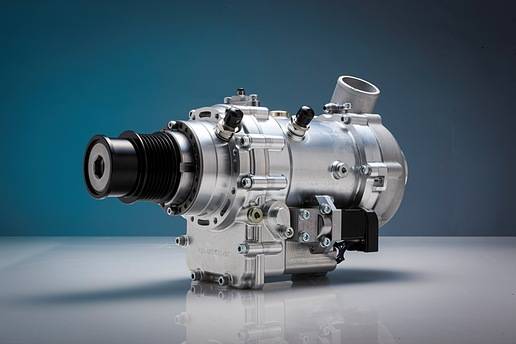 V-Charge增壓器的重量約為6kg。
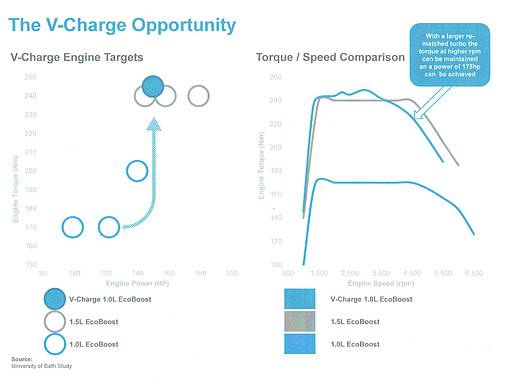 采用V-Charge增壓器的1.0L EcoBoost
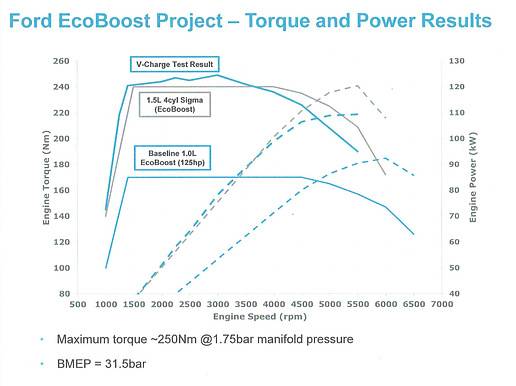 常規1.5L 4缸Ecoboost
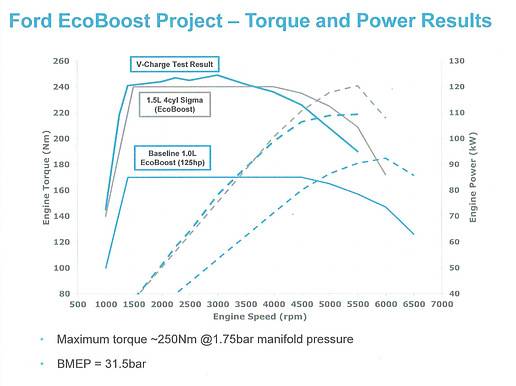 常規1.0L 3缸EcoBoost發動機
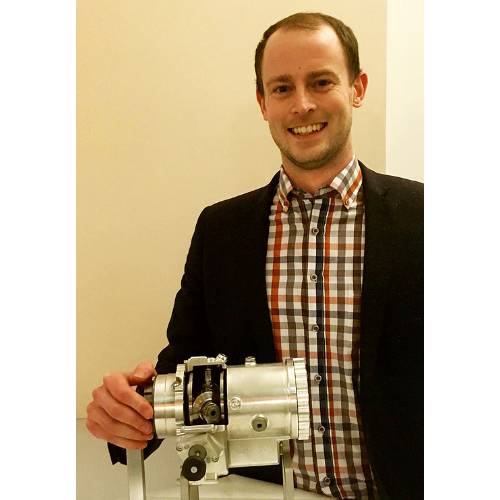 Richard Dunne表示,V-Charge并不需要求助于48V輕混合動力技術,而是采用了一種相對簡單的設計。