優化駕駛員的視野,是提升車輛安全性的重要課題。雖然如今的汽車已經開始越來越依賴立體照相機、激光雷達和紅外系統等電子系統,但從本質而言,優化視野的關鍵仍在于清潔的車窗,這樣駕駛員才能看清車外的情況。
如今,英國一所大學的研究人員推出了一種適用于建筑窗戶的“智能”玻璃解決方案,可能也同時適用于車輛車窗。這種玻璃采用了納米技術,不但可以實現自動清潔,而且還具有節能環保和防眩光的屬性。
“這是納米結構與感溫變色涂層的首次結合,”英國倫敦大學學院(University College London,下簡稱UCL大學)電子與電氣工程系Ioannis Papakonstantinou博士表示,“這種仿生納米結構可以增強玻璃涂層的感溫變色屬性,帶來一種能夠實現自動清潔的高性能智能窗戶。”
作為該高級專家團隊的項目主管,Papakonstantinou表示,這種納米結構的初步應用為摩天大樓的外窗,但目前他也認為,只要符合汽車行業的安全標準和其他規定,這種技術也完全可以用于道路汽車。
“我們應當將這種技術的應用范圍推廣至汽車領域,這很容易,只是涂一層1毫米左右的涂層而已。當然了,我們肯定還要建立一套測試項目,比如觀察水滴流下車窗玻璃的速度快慢,這點非常重要,特別是針對前擋風窗而言。”
UCL大學的研究工作得到了英國工程與自然科學研究理事會(Engineering and Physical Sciences Research Council)的資金支持。據稱,經過實驗證明,該結構確實可以表現出3種優良屬性。
具體來說,當雨水接觸到這種納米玻璃表面后會形成水珠,而后在流過玻璃的過程中帶走灰塵、泥土等污染物,這就是自動清潔功能的原理。Papakonstantinou解釋說:“這主要是由于玻璃上的納米結構具有像鉛筆尖一樣的圓錐形設計,可以存儲空氣,從而在很大程度上減少液體與玻璃表面的接觸。”
與這種新型玻璃不同的是,當雨滴落在常規玻璃上時,一般會在玻璃表面停留一段時間,而后才會滑落,并且還會留下印記。
為了達到節能效果,這種玻璃的表面還涂了一層5到10納米厚的二氧化釩(一種便宜豐富的材料)薄膜,這可以減少熱損耗,并在炎熱天氣中減少射入車內的太陽輻射。
“這種納米結構還具有防眩光的屬性,這種能力多見于蛾子或其他善于躲避捕食者的生物之中。”Papakonstantinou指出,“這種新玻璃可以將室內反射光線控制在5%之內,而其他二氧化釩膜節能窗戶的平均表現為20%-30%。”
他強調說,目前UCL大學的發現仍處于研究成果階段,下一步的主要任務是優化納米制造技術和二氧化釩涂層工藝,以支持規模化生產。目前,Papakonstantinou已經從歐洲研究委員會(European Research Council)敲定了180萬歐元的經費,用于實現這一目標。
此外,UCL大學的團隊成員還包括該校化學系教授Ivan Parkin,以及電子與電氣工程系研究員Alaric Taylor。
作者:Stuart Birch
來源:SAE《汽車工程雜志》
翻譯:SAE 上海辦公室
Nanotechnology may provide self-cleaning, energy-saving 'smart glass' for vehicles
Improving driver visibility is a major aspect of vehicle safety that is increasingly supported by stereo cameras, LiDAR, and infrared systems. But fundamental to visibility is being able to see clearly through clean glass windows, and front and rear windshields.
Now, researchers at a U.K. university have revealed a "smart" window solution for buildings that may also be applicable to vehicles. It uses nanotechnology to achieve not only self-cleaning but also delivers energy saving and anti-glare properties.
“This is the first time that a nanostructure has been combined with a thermochromic coating,” said Dr. Ioannis Papakonstantinou of the Department of Electronic and Electrical Engineering, University College London (UCL). “The bio-inspired nanostructure amplifies the thermochromic properties of the coating, and the net result is a self-cleaning, highly performing smart window.”
As project leader of a highly specialist team, Papakonstantinou said initial applications of nanostructures could be to skyscraper windows but at present he believes that in theory there was no reason why the system could not be extrapolated to road vehicles provided it met required safety standards and other legislation.
“It should, because it simply involves application of a coating of about one micron. But of course there would need to be a test program to establish—for example, how quickly water droplets would flow down automotive glass, particularly the windshield.”
The research work at UCL is being supported by the U.K.’s Engineering and Physical Sciences Research Council, and prototype examples of the technology are said to confirm that the three key benefits can be delivered.
The self-cleaning application sees rain hitting a glass surface to form spherical droplets that roll easily across that surface carrying away dust, dirt, and any other contaminants. Explained Papakonstantinou: “This is due to the pencil-like, conical design of nanostructures engraved onto the glass, trapping air and ensuring that only a tiny amount of water comes into contact with the surface.”
Regular glass typically sees raindrops clinging to the surface before sliding down, leaving marks.
To achieve energy saving, a glass surface is coated with a 5- to 10-nm (0.2- to 0.4-µin) film of vanadium dioxide (a cheap and abundant material), which prevents heat loss or, in hot climates, prevents solar IR entering the vehicle.
“The design of the nanostructures also gives the windows the same anti-reflective properties found in the eyes of moths and other creatures to hide them from predators!” noted Papakonstantinou. “It cuts the amount of light reflected internally in a room to less than 5% compared to 20-30% achieved by other prototype vanadium-dioxide-coated energy saving windows.”
He stressed that the UCL findings are the result of a research project and that the next big step would be to scale-up the nano manufacturing techniques and the vanadium-dioxide coating process used to create the prototypes. For this purpose, Papakonstantinou has secured a €1.8M grant from the European Research Council.
The UCL team also includes Prof. Ivan Parkin of the university’s Department of Chemistry, and researcher Alaric Taylor of the Department of Electronic and Electrical Engineering.
Author: Stuart Birch
Source: SAE Automotive Engineering Magazine
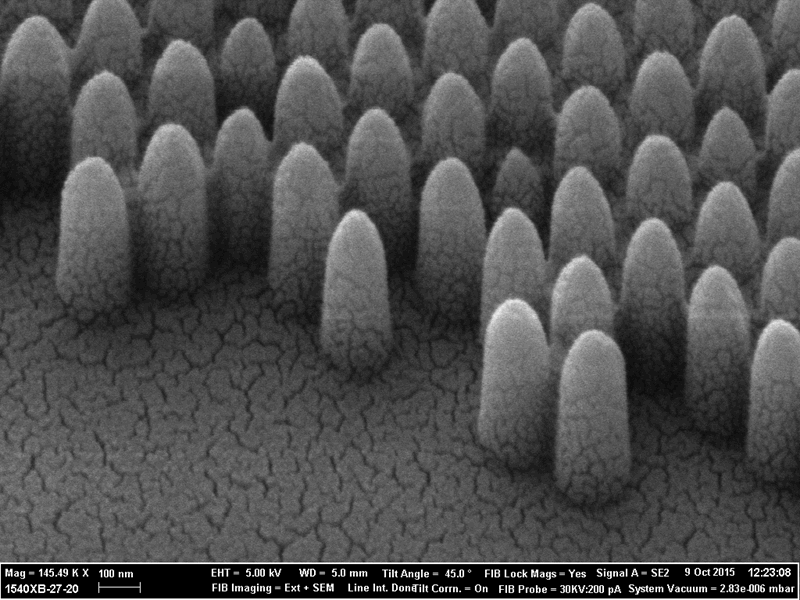 電子掃描顯微鏡下的玻璃納米層結構。從納米級別控制玻璃的表面形態,可以非常精確地控制玻璃與液體、光線間的互動。
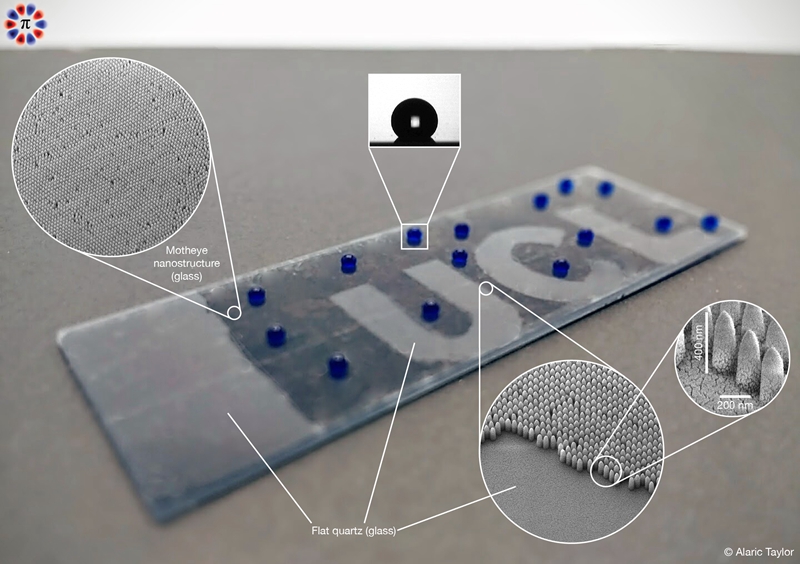 UCL大學“智能玻璃”解決方案原型。圖中較暗區域采用了納米結構,具有防水性,可以迫使水形成近似球形的水滴,快速流過玻璃。圖中UCL字樣的區域則并未經過特殊處理,我們可以注意到該區域的反射要強的多。
 UCL大學的Ioannis Papakonstantinou指出,這是納米結構與感溫變色涂層的首次結合。