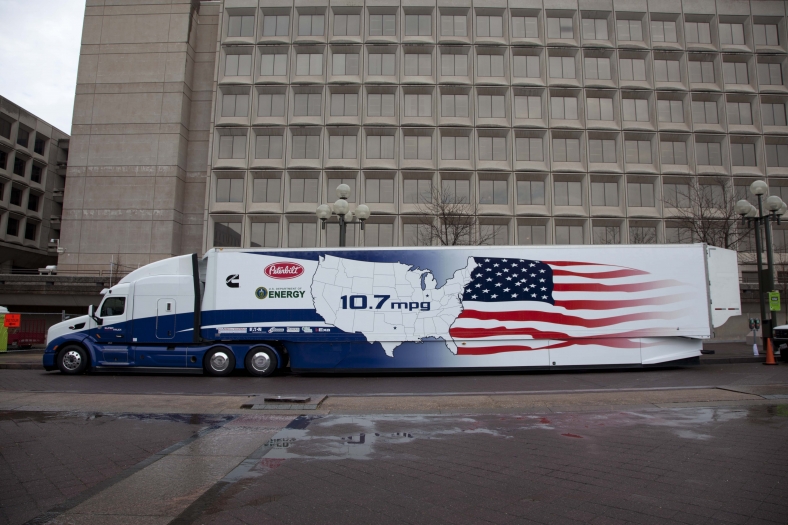
我們在美國高速公路上常看到的重型牽引卡車,其燃油經濟性非常低,油耗通常高達5.8mpg(40.5 L/100km)。一項由美國能源部支持的先進技術——康明斯-彼德比爾特超級卡車項目(Cummins – Peterbilt SuperTruck)卻在去年的測試中其油耗數值僅為10.7mpg (21.98L/100km)為常規車的一半。如果所有的重型卡車的油耗能向超級卡車靠攏,那全美每年可以節省近3億桶燃油,相當于節約150億美元,每輛8級貨卡每年可以節省1萬美元的燃油開支。
盡管半拖掛卡車僅占全美汽車總量的4%,但卻燒掉了大約20%的燃油,因此提卡車的燃油經濟性能夠顯著減少CO2的排放量。
該原型車是由康明斯-彼德比爾特公司為SuperTruck項目的開始,該項目為政府與行業間的合作項目,耗資7800萬美元研發周期長達4年,旨在研發下一代低油耗高效的柴油半拖掛卡車。美國能源部希望能進一步提升發動機系統的效能正著力推進后續項目。
Wayne Eckerle,自稱“燃燒小子”,康明斯集團研發科技副總裁表示,“SuperTruck項目融匯了我們將過去研究的數項先進發動機技術并得了可行性驗證,讓我們受益良多。”
SuperTruck的動力系統達到了美國能源部所設定的目標,發動機系統峰值制動熱效率達到50%。Eckerle表示:“達到50%相當不容易,現在的柴油機大約只能達到43%。”
作為全美唯一的獨立柴油發動機制造商,能源部將在2年內撥款450萬美元資助康明斯,希望將熱效率在現在基礎上再提升5個百分點至55%。Eckerle表示,“我們的目標證明是在真實的工作環境下,效率還有進一步提升的空間,我們會借助SuperTruck項目的成果作進一步的研究工作。”
根據美國能源部的資料顯示,該《重型發動機使能技術項目》是由康明斯與政府間平攤經費的研究項目,旨在“通過SuperTruck項目投資,促進柴油發動機的設計、分析、研發工作,實現發動機系統峰值熱效率提升至55%制動熱效率(BTE)高效柴油發動機的研發工作,并高度整合燃燒/后處理系統。”
“要想實現55%制動熱效率(BTE)并沒有什么特效藥,”Lyle Kocher,康明斯先進系統集成技術顧問,兼柴油機55BTE項目首席研究員提醒道,“既要提高燃油經濟性,但又要符合排放的相關法規,我們必須多管齊下。”
康明斯團隊計劃采用新方法來微調燃油燃燒過程、優化燃油與空氣處理系統、改進排放系統、減少發動機主體與渦輪增壓器的寄生損失、并增加底循環來回收廢熱。
改善燃燒
Kocher通過觀察后認為,改善燃油過程或將是提高整體效率的關鍵之所在。燃料的燃燒過程非常復雜,燃料在柴油發動機內的燃燒過程中,伴隨著2,000次同時或連續發生的化學反應。據報道,為了優化柴油機的燃燒模型,康明斯每年都在商用計算機代碼的授權許可上就要花掉100多萬美元。
Kocher表示,研發團隊使用了多種先進燃燒策略來優化熱釋放率,在降低氮氧化碳物的排放量的同時保持低溫燃燒,但在效率與排放之間我們必須要有所取舍。
“我們希望盡可能的縮短燃燒時間來減少傳熱損失”,Kocher說,“特別是控制燃燒曲線的形態,我們希望延長燃燒進程的前半段,縮短后半程。此外,我們還希望通過隔熱涂層和其他方式來降低在氣缸內的熱損耗。”
與其他的柴油發動機一樣,55%BTE發動機從少油燃燒點火循環開始提升燃油經濟性,并通過低速運行降低機械損耗,提高壓縮比、在稀釋燃油條件下的燃燒率,摒棄節氣門,通過優化空氣-燃油比控制系統進氣避免泵送損失,以此來提柴油的燃燒效率。
Echerle補充道,“在達成這一目標的同時,工程師還必須注意峰值缸壓,并避免產生噪音。”
除了采用更高的噴射壓力、更精準的霧化控制及多次噴射等最新燃油噴射技術外,更靈活的閥門控制、優化發動機的換氣也是提高動力系統效率的關鍵之所在。“氣缸無論是在進氣還是排氣時效能都會有所損失,”Eckerle強調到,“我們必須盡可能的減少此類泵損失。”
這臺原型發動機主要利用廢氣再循環裝置(EGR)來降低燃燒溫度,Kocher表示“通過EGR來降低溫度控制NOx的排放是其最重要的方法”,此外它還能用來輔助控制泵損失。
提升渦輪增壓效率
“我們使用渦輪增壓器來將效率最大化,” Kocher表示。“相較于低壓,高壓發動機的運行更高效。”渦輪增壓不僅能提升功率密度,而且還能回收部分廢氣余熱。
為了使渦輪增壓器更高效,康明斯正打算縮小其葉片和外罩間的縫,“我利用完整的計算流體力學與反應分析以及仿真技術優勢,來針對渦輪在循環的瞬態條件下氣流的脈動情況進行建模。”
“在過去,其實也不過就是3年前,我們還做不到這一點”,Kocher說。了解壓力系數和其他細節信息后,“我們可以更好地設計渦輪增壓器的架構。我們對整體設計進行了優化,充分利用每個循環過程中的氣流脈動,在此之前都些都被忽略了。”
為了盡可能降低熱能損失并提升整體功率,發動機系統設計中還應考慮相應的冷卻方案,可變氣流冷卻泵可以解決寄生泵損失的問題。同時,能過采用涂層及其他技術來減少能量輸送過程中所產生的不可避免的摩擦損耗。
余熱回收
柴油機55BTE團隊計劃采用有機朗肯循環(ORC)系統,回收EGR系統、尾氣中余熱,并將其轉換成有用的能量。該系統包括熱交換器、載熱冷媒、擴展器、泵以及冷凝器,將直接通過渦輪擴展器與發動機進行機械耦合。
余熱回收系統將作為發動機的底循環。Eckerle表示,“康明斯針對這個課題已經研究了一段時間,”在早期的實驗報告中,在理想環境下EPA 2010發動機采用EGR系統后燃油經濟性得到了7.4%以上的提升,“但仍有上升空間。”
最后,研究團隊還希望將尾氣后處理系統與發動機緊密耦合,盡可能避免熱量損失。Kocher表示他很期待迎接這一挑戰。
作者:Steven Ashley
來源:SAE 《非公路工程雜志》
翻譯:SAE 上海辦公室
Cummins aims to boost heavy-duty diesel efficiency to 55%
The big-rig tractor-trailer trucks that we see on the highway get only about 5.8 mpg of diesel fuel. In tests, the Cummins-Peterbilt SuperTruck—a U.S. Department of Energy-supported advanced technology demonstrator unveiled last year—achieved nearly double that number: 10.7 mpg. If all the heavy-duty trucks in the U.S. were as efficient as the SuperTruck, domestic consumption of oil would fall almost 300 million barrels, a potential $15-billion savings that would reduce the annual fuel outlay of the average Class 8 operator by perhaps $10,000.
And although semitrailer trucks comprise only 4% of the vehicles on America roads, they consume about 20% of the fuel, so improved fuel economy would also cut emissions of CO2 significantly.
The Cummins-Peterbilt prototype was developed and built as part of the SuperTruck Initiative, a four-year, $78-million government-industry collaboration to develop a next-generation diesel semi-truck with greatly improved fuel consumption. Now the DOE is back with a follow-on project that aims for even better engine system efficiency.
“We learned a significant amount in the SuperTruck program,” said Wayne Eckerle, Vice President of Corporate Research & Technology for Cummins, a self-described “combustion guy.” “It gave us the chance to demonstrate the feasibility of several advanced engine technologies that we’d been working on previously and integrate them into an operating system.”
The resulting SuperTruck powertrain achieved the DOE’s target goal of a peak diesel engine system brake thermal efficiency of 50%. “That wasn’t at all easy,” he stressed, noting that “diesels today are probably 43% efficient.”
The Energy Department recently awarded Cummins, the nation’s only independent diesel engine maker, a two-year, $4.5-million grant to boost its previous mark by 5 percentage points to 55% brake thermal efficiency, Eckerle said. “Now we’re aiming to demonstrate another substantial increase in efficiency in a real-world duty cycle, an effort that leverages and carries forward what we were doing on the SuperTruck project.”
The Heavy Duty Engine Enabling Technologies Project, a 50-50 cost-shared R&D endeavor, aims to “leverage the design, analysis and development work that has been invested through the Cummins SuperTruck program to demonstrate a peak diesel engine system efficiency of 55% Brake Thermal Efficiency (BTE) while also implementing an advanced, highly integrated combustion/after-treatment system,” states DOE documents.
“There is no magic bullet to get to 55% BTE,” warned Lyle Kocher, technical advisor for advanced system integration at Cummins and principal investigator on its Diesel 55BTE project on a team that includes 20 dedicated engineers. “Reaching new fuel efficiency levels while complying with all the emission limits means that we’ll have to use multiple strategies.”
The Cummins team plans to apply new ways to fine-tune the fuel combustion process, optimize both the fuel and air handling systems, modify the emissions system, reduce parasitic losses in the base engine and the turbocharger, as well as to add a bottoming cycle to recover waste heat.
Better burning
Probably the largest contribution to any overall efficiency gains will derive from improving the combustion process, Kocher observed. Various fuel combustion tweaks can better the complex fuel-burning process, which in a diesel engine entails some 2000 simultaneous and sequential chemical reactions. To improve its combustion modeling, the diesel maker reportedly licenses commercial computerized code at a cost of more than $1 million a year.
The team, the mechanical engineer said, will implement several advanced combustion strategies that will optimize heat-release rates, but still retain burning at reduced temperatures for low nitrogen oxide (NOx) emissions. “There can be a trade-off between efficiency and NOx emissions,” Kocher acknowledged.
“We want to minimize the duration of the burn to reduce heat transfer loss,” he said. “In particular, we want to control the rate shape; that is, we want to slow the front end of the combustion process and speed up the back. We also want to minimize heat losses to the cylinder by using insulating coatings and other approaches.”
Like other diesels, the 55% BTE engine will derive its basic efficiency from its fuel-stingy combustion-ignition cycle and fewer mechanical losses due to lower-speed operation. The cycle’s efficacy in burning diesel arises from high compression ratios, high combustion rates under lean conditions, and the use of air-fuel ratios to control system loading rather than throttling to avoid part-load pumping losses.
Added into all the other considerations, Eckerle said, the engineers must accomplish this goal without “exceeding peak cylinder pressures or producing noise.”
Besides implementing the latest fuel-injection techniques—which might involve higher injection pressures, finer spray control, and multiple injection events—flexible valve control and enhanced engine breathing are also key to boosting powertrain efficiency. “We need to minimize pumping losses,” Eckerle emphasized. “Whenever we have to push gases back into the cylinder or draw them in that costs us work.”
The prototype engine will rely primarily on exhaust gas recirculation (EGR) to reduce combustion temperatures. “EGR is critical way to control NOx by keeping the temperature low,” Kocher said. It also aids in controlling the pumping losses.
Turbo boosts efficiency
“We use turbochargers to maximize efficiency,” he said. “High-pressure engines run more efficiently than low pressure.” Turbocharging raises power density and recovers some of the wasted exhaust heat.
Cummins is engineering more effective turbochargers with smaller gaps between the blades and the housing, Eckerle said. “We’re taking advantage of full CFD and reaction analysis and simulation techniques to model the turbo down to brief in-cycle transient conditions—essentially, pulsations in the flow.”
“In the old days—really, only 3 years ago—you couldn’t do that,” he said. Knowing the pressure coefficients and other fine details “allows us to do a much better job of designing the turbo architecture. We optimize the general design to take advantage of the pulses within each cycle, something that we kind of ignored before.”
They said that the engine system design should also feature strategic cooling to minimize thermal energy losses and augment overall power. Parasitic pump losses will be addressed in part with variable-flow cooling pumps. Likewise, friction losses inherent in the power transfer process will be mitigated with sliding friction-reducing coatings and other techniques.
Waste heat recovery
The Diesel 55BTE team is employing an organic Rankine cycle (ORC) to capture waste heat from the engine EGR system as well as the charge air and exhaust streams, and convert it into useful work. The system, which will include heat exchangers, a heat-carrying working fluid/refrigerant, expanders, pumps and condensers, will be coupled to the engine mechanically via the turbine-expanders.
The waste heat recovery system will serve as a bottoming cycle for the engine. “It’s been a subject of research here at Cummins for quite some time,” Eckerle said. In earlier reported tests, fuel-economy benefits greater than 7.4% were demonstrated when coupled with EPA 2010 engine system under ideal conditions, “but there’s considerable room for improvement.”
Finally, the team wants the exhaust aftertreatment system to be close-coupled to the engine to avoid undue heat losses, said Kocher, who concluded by saying that he was looking forward to the challenge.
Author: Steven Ashley
Source: SAE Off-Highway Engineering Magazine

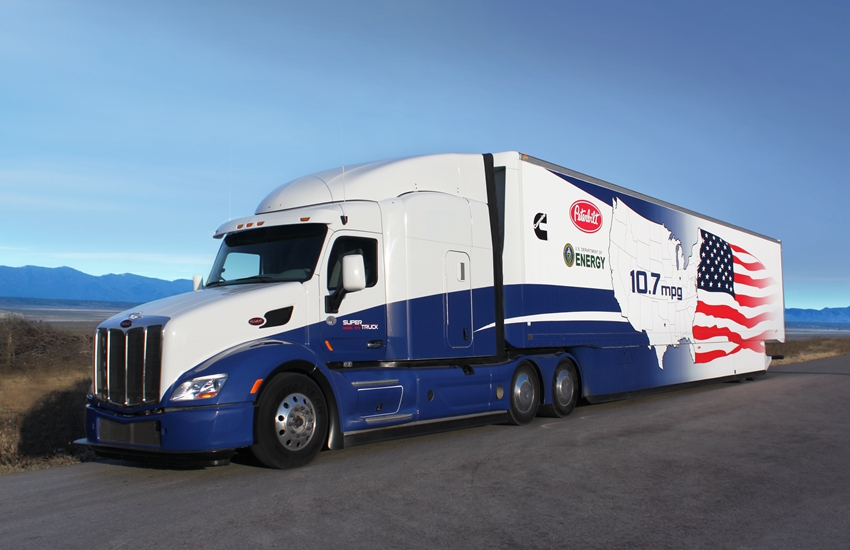 康明斯-彼德比爾特 SuperTruck原型車的柴油油耗為10.7 mpg (21.98L/100km)
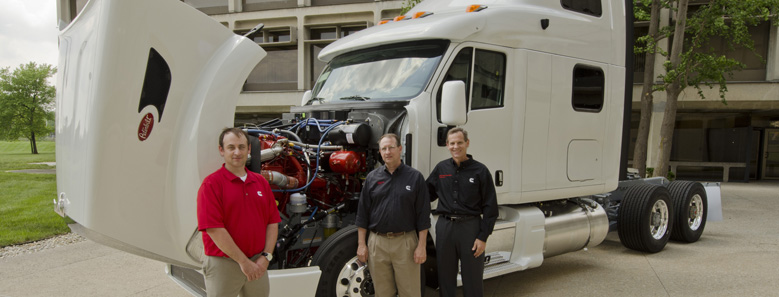 2012年測試開始前,康明斯SuperTruck團隊成員站在牽引機旁邊,最右為Wayne Eckerle。
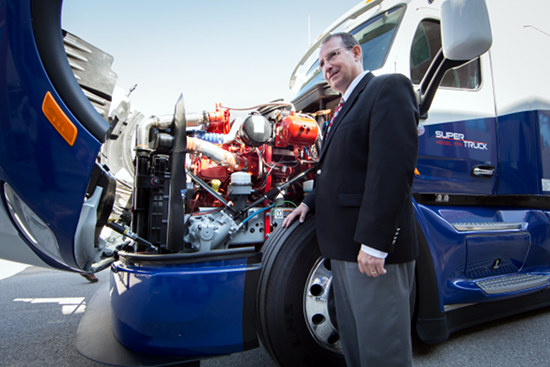 康明斯-彼德比爾特SuperTruck計劃首席研究員David Koberlein正在展示節油的渦輪增壓柴油發動機。
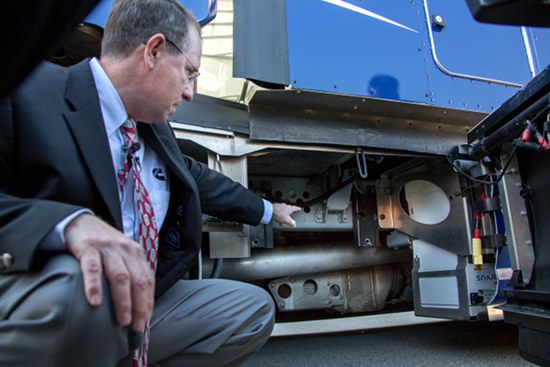 康明斯的Koeberlein指出康明斯-彼德比爾特SuperTruck的有機朗肯循環廢熱回收系統。
 康明斯-彼德比爾特SuperTruck 55% BTE柴油發動機的將會成為次時代卡車標配。