自1972年保時捷在威猛的917/10 Can-Am賽車上首次使用增壓發動機以來,“保時捷”和“渦輪增壓”這兩個詞就成了超高性能的同義詞。在2016車型年里,保時捷將推出全新的渦輪增壓3.0L水平對置六缸發動機,以代替目前在911 Carrera和Carrera S上使用的自然進氣式3.4L和3.8L發動機。但名字中帶有“渦輪增壓”的911 Turbo仍將使用3.8L渦輪增壓發動機。
3.0L Carreras將于2015年法蘭克福車展上亮相。這款輕量化增壓式水平對置發動機將使Carreras的效率和動力提升至全新的水平。Carrera的動力將增加15 kW (20 hp),峰值輸出達到272 kW (365 hp)。Carrera S也將增加15 kW (20 hp),達到309 kW (414 hp)。這兩款全新的發動機都將使用BorgWarner渦輪增壓器,每排氣缸組配備一臺。
S版3.0L發動機改進了渦輪壓縮機,特制了一個排氣系統,并對發動機管理系統進行了調整。Carrera的增壓為0.9 bar (13 psi), 而Carrera S為1.1 bar (16 psi)。新發動機還能產生更高的峰值扭矩,當轉速從1700升至5000rpm時,兩款的峰值扭矩分別可以達到450 N·m 和 500 N·m (331和368 lb·ft),較舊款增加了60 N·m (44 lb·ft)。兩款發動機的最高轉速都為7500 rpm。
Carrera和Carrera S的性能都得到了輕微提升,搭載PDK(雙離合器變速箱)和跑車計時套件的Carrera S的百公里加速時間只需3.9秒,最高時速可達307 km/h (190 mph)。然而,得到提升的不僅是性能,燃耗與排放也明顯改善不少。搭載PDK的S整車百公里耗油量為7.7L,比舊款少了1.0L。在二氧化碳排放方面,Carrera的公布數據為169 g/km,S為174 g/km。
保時捷技術發言人Nick Perry表示,這兩款911新車型不會使用“Turbo”名號。因為在渦輪增壓方面,超高性能的911GT系列“需要單獨討論”:“現有的Turbo將維持原狀;這款車型的形象和特征與Carrera不一樣。我們在Panamera、卡宴和Macan上都安裝了渦輪增壓,但Turbo只能用在里程最高的車型上。”
新發動機的內部情況
道路跟蹤技術的轉讓是保時捷最重要的工程信條之一,但911賽車系列可以通過自然進氣式發動機來達到法規要求。“我們的911賽車將繼續使用自然進氣式GTRS 4.0L發動機,” Perry解釋道。“但路面車輛必須達到多種標準,因此我們正在開發新發動機。”
他將這臺新發動機稱作“階躍變化”。3.0L發動機是一臺全新的產品,而非3.4或3.8發動機的衍生物。這一舉動的重要意義相當于保時捷在1998車型年采用的液冷技術。后者成功實現了降低駕駛噪音、提高性能與效率、提高發動機承受高溫的能力、改進燃燒性能等目標。另一項階躍變化則是2008年的直噴燃油技術。
至于包括博克斯特和Cayman在內的其他車型是否將使用3.0L新發動機,保時捷沒有發表正式聲明,但可以預見新車型會在未來登場。
新發動機中使用的壓力感應技術要求在車輛后部配備一套全新的氣流系統與中間冷卻器,以輔助發動機的燃燒。首先,發動機將燃燒空氣集中在后擾流板的前方,隨后氣流穿過空氣過濾箱的兩個水平出口,抵達通向下方渦輪增壓器的兩個感應通道。接著,經過壓縮并加熱的空氣流經位于車輪拱罩后方水平放置的兩個中間冷卻器,并通過節流閥板向上抵達發動機的感應歧管。另外還有兩根導管將高溫燃燒空氣導向中間冷卻器(包括來自后部風擋的熱空氣)。
新發動機的噴射器位于燃燒室的中心,這樣做可以提高燃燒效率。2個燃油泵為其注油,每排氣缸組配備1個泵,運行時的系統壓力最高可達250 bar (3626 psi)。可變尾氣凸輪軸正時技術可以精準地控制增壓交換。在進氣方面,保時捷繼續使用VarioCam Plus(可變氣門正時與揚程)系統,對氣門升程與開門時長進行調節。
此外,保時捷工程師還表示,新發動機采用了一種全新的汽缸壁表面加工技術,用等離子束在膛壁上噴涂鐵涂層的工藝,有助于減少摩擦損耗。另外,工程師們在設計階段進行了大量FEA分析后,成功將鋁制曲軸箱的重量減輕了1.5 kg (3.3 lb)。采用工程塑料制作的全新油底殼也比舊款輕了2 kg (4.4 lb)。
新水泵上增添了一只由熱管理系統控制的離合器,在冷卻劑溫度較低的時候可以保持脫離狀態。不工作的水泵不再磨耗發動機的動力,因此冷卻劑可以緩慢循環。減少的摩擦使發動機可以更快地到達工作溫度。此外,空調壓縮機也使用了這一機制,借助離合器來實現完全脫離。
可以轉換模式的傳動系統
為配合3.0L發動機的高扭矩,傳動系統中引進了一個雙盤離合器,以使運作更為流暢。而保時捷的PDK系統也采用了一套全新的工作邏輯。和911 GT3以及保時捷的其他賽車一樣,駕駛員現在可以通過向后拉變速桿來選擇升檔,向前推選擇降檔。此外,保時捷還用具有離心擺的雙質量飛輪、智能超速切斷裝置與“虛擬”齒輪和PDK搭配使用。
離心擺也可以在手動變速箱中使用。保時捷工程師解釋,該裝置的自適應減震器可以在大幅度的轉速范圍內吸收傳動系統的振動。
除了跑車計時套件和PDK系統,911駕駛員還能享用一種全新的“模式轉換”機制。該系統中新增的“跑車反應”按鈕可以激活一個事先調整好的傳動系統反應模式,使最大加速度持續長達20秒。在此狀態下,齒輪嚙合與發動機管理都調整到最佳狀態,以最出色的自主反應模式應對超車等情況。
主動后橋轉向與懸掛系統
為了配合傳動系統的改進,保時捷911對底盤也進行了不少修改,其中包括主動后橋轉向系統——這也是Carrera S的可選配置。該技術是在911 Turbo、911 GT3以及非911車系的限量版918 Spyder的基礎上改進而成的。
主動后橋轉向技術是專門為增強911的入彎性能而設計的,可將轉彎半徑減少0.5 m (1.6 ft)。保時捷目前使用的方向盤直徑為360 mm (14-in),比之前短了15 mm (0.6-in)。
整個Carreras車系的2016版本都將使用保時捷的主動懸掛管理系統(PASM),底盤高度較先前低了10 mm (0.4 in)。可以選配的液壓升降系統,通過位于前懸架的提升氣缸將車輛離地間隙增加了40 mm (1.6 in),以應對車庫內的陡坡和減速帶等障礙。
保時捷表示,為Carreras引進渦輪增壓發動機是合乎邏輯的下一步計劃,符合已經延續了四十年的技術發展路線方向。1974年推出的首臺Turbo渦輪增壓發動機輸出功率為194 kW (260 hp),每百公里消耗20.9 L高辛烷值汽油。與之相比,2016年最新版水平對置六缸發動機使用相同的排量,但功率卻提高了42%,燃油經濟性也高出2倍以上。這是多么驚人的進步!
作者:Stuart Birch
來源:SAE《汽車工程雜志》
翻譯:SAE 上海辦公室
Porsche unveils new downsized, boosted 3.0-L boxer six
The words “Porsche” and “turbo” have been synonymous with ultimate high performance since 1972, when the automaker first used boosted engines in the mighty 917/10 Can-Am racecars. For 2016MY, the company is introducing all-new turbocharged 3.0-L flat-six engines for the 911 Carrera and Carrera S road cars, replacing naturally aspirated (NA) 3.4-L and 3.8-L units. The 911 that carries the specific "Turbo" designation, however, will continue to use a 3.8-L engine.
The 3.0-L Carreras will be unveiled at the 2015 Frankfurt Motor Show. The downsized-and-boosted "boxer" brings new levels of efficiency and added power; the Carrera gets an extra 15 kW (20 hp) taking peak output to 272 kW (365 hp). The Carrera S produces 309 kW (414 hp), also a 15-kW improvement. The new engines use two BorgWarner turbos, one per cylinder bank.
The S version of the 3.0 L features modified turbine compressors, a specific exhaust system and tuned engine management. Boost pressure is 0.9 bar (13 psi) in the Carrera and 1.1 bar (16 psi) in the Carrera S. The new engine also produces more peak torque – an added 60 N·m (44 lb·ft), delivered from 1700 to 5000 rpm, to provide 450 N·m and 500 N·m (331 and 368 lb·ft), respectively. Both variants are rev-limited to 7500 rpm.
Performance of both the Carrera and Carrera S is slightly improved, the S fitted with PDK (dual clutch) and Sport Chrono Package achieving a claimed 0-100 km/h in 3.9 s, and top speed of 307 km/h (190 mph). But fuel consumption and emissions are markedly better; the S with PDK achieves a combined figure of 7.7 L/100 km, an improvement of 1.0 L/100 km. Claimed CO2 emissions are 169 g/km for the regular Carrera, 174 g/km for the Carrera S.
According to Porsche technology spokesperson Nick Perry, the new 911 models will not be badged “Turbo.” He also explained that the very high performance 911 GT variants were a “separate topic” with regard to the application of turbocharging: “The current Turbo will continue to be described as that; the model offers a different image and attributes to those of the Carrera. We have turbochargers in the Panamera, Cayenne and Macan, but there, too, we use the designation Turbo for top of the range versions.”
Inside the new boxer
Track-to-road technology transfer is a major element of Porsche’s engineering creed but its racing 911s have NA engines to meet regulations. “The NA GTRS 4.0-L engine will continue to power our 911s in the motorsport realm," Perry explained. "But for road cars there is a multitude of criteria to meet, which is why we are introducing the new engine."
He described the new engine as a "step-change"—the 3.0-L being all-new and not a derivative of the 3.4 and 3.8 engines. The move is similar to when Porsche went to liquid cooling (1998MY) to reduce drive-by noise, improve performance and efficiency, running the engines hotter and achieving better combustion. Another step-change came in 2008 with the introduction of direct fuel injection.
Porsche is making no formal comment about the new 3.0-L turbo family forming the basis of engines for other models ranges including the Boxster and Cayman, but siblings can be expected.
The use of forced induction has required a new engine airflow system for combustion and intercooling at the rear of the Carreras. The engine gets its combustion air centrally in front of the rear spoiler. From two lateral ports on the air filter box, the airflow reaches two induction channels to the lower-mounted turbochargers. The compressed and heated air then flows through two intercoolers located laterally behind the wheel arches and onwards to the engine's induction manifold via the throttle plate. Two other ducts guide the air for cooling the heated combustion air (also from the air screen in the rear lid) to the intercoolers.
The 3.0-L’s injectors are located in the center of the combustion chamber for greater combustion efficiency. They are fed by two fuel pumps, one per cylinder bank, operating on a system pressure of up to 250 bar (3626 psi). Variable exhaust-camshaft timing facilitates precise control of the charge exchange process. On the intake side, Porsche continues to use VarioCam Plus, adjusting both valve lift and opening duration.
A new cylinder wall coating process, in which a plasma beam coats the bore surface with iron, helps reduce friction losses, according to Porsche engineers. And extensive FEA analysis during the design process helped cut the weight of the aluminum crankcase by 1.5 kg (3.3 lb). A new engineered-plastic oil pan is 2 kg (4.4 lb) lighter than in the previous generation engines.
The water pump now has a clutch that is controlled by thermal management and can remain disengaged at low coolant temperatures. The deactivated pump no longer draws any engine power, and the coolant just circulates slowly. Friction is reduced and the engine reaches its operating temperature more quickly. The same applies to the air conditioning compressor; it can also be completely deactivated via a clutch.
Mode-switching drivetrain
Transmission developments include introduction of a two-disc clutch for the new engines for comfortable operation despite the new 3.0-L’s high torque. And the PDK has new operating logic. As in the 911 GT3 and many Porsche racecars, pulling the selector lever back now provides upshifting; pressing it forward triggers downshifting. Porsche is now using a dual-mass flywheel with a centrifugal pendulum in conjunction with the PDK, as well as intelligent overrun cut-off and "virtual" gears.
The centrifugal pendulum is also used with the manual transmission. It has an adaptive vibration absorber that dampens vibrations in the drivetrain over a broad range of engine speeds, according to Porsche engineers.
In combination with the Sport Chrono and PDK systems, the 911 driver now has a “mode switch” which has an additional “sport response” button which activates a pre-conditioned drivetrain response which provides maximum acceleration for 20 s, the optimum gear engaged and engine management adjusted for optimum spontaneous response such as for overtaking.
Active rear-axle steering and suspension
Complementing the new powertrain developments, chassis changes for the 911 include active rear axle steering as an option for the Carrera S, The technology is adapted from the 911 Turbo and the 911 GT3 as well as the exotic limited-production 918 Spyder.
The active rear axle is designed to enhance the turn-in behavior of the 911 and reduces the car’s turning circle by 0.5 m (1.6 ft). Porsche is offering a 360-mm-diameter (14-in) steering wheel that is 15-mm (0.6-in) smaller than the previous wheel.
Porsche Active Suspension Management (PASM) is fitted to all Carreras for 2016. It lowers ride height by 10 mm (0.4 in). An optional hydraulic lift system increases the car’s ground clearance by 40 mm (1.6 in) via lifting cylinders in the front suspension struts to clear steep garage ramps and speed bumps.
Porsche states that introducing turbocharging for the Carreras was a logical next step in a technology path that began four decades ago. The original Turbo engine of 1974 had a claimed power output of 194 kW (260 hp) and consumed 20.9 L of high-octane gasoline per 100 km. By comparison, the new-for-2016 flat six-cylinder engine produces 42% more power with more than twice the fuel economy, while using the same cylinder displacement. Progress all around!
Author: Stuart Birch
Source: SAE Automotive Engineering Magazine

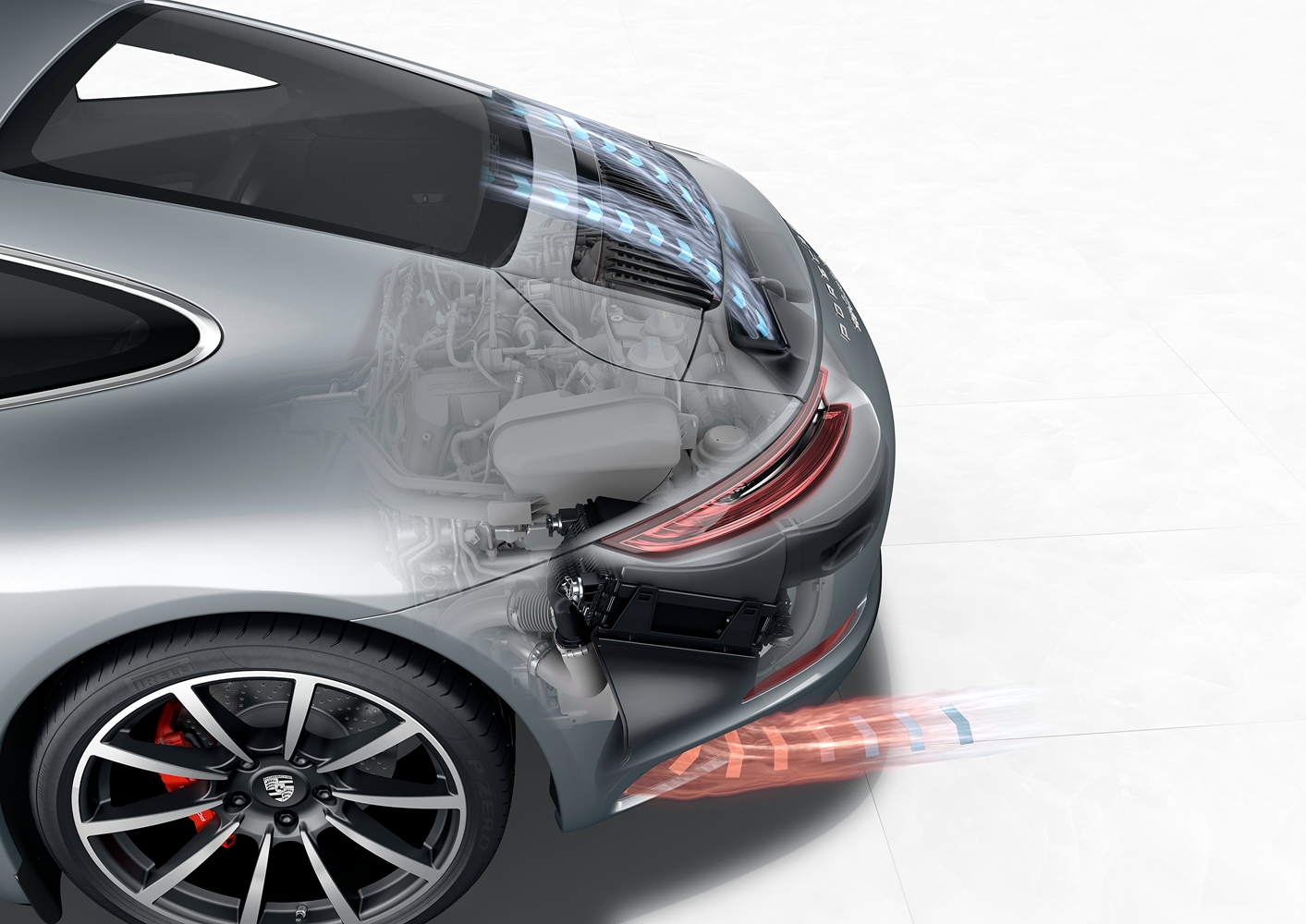 這張Carrera 2016版的半透視圖顯示出發動機的進氣和排氣管路與中間冷卻器的位置。全新的3.0 L水平對置六缸發動機,在同樣的排量下能提供比1974年 Turbo發動機高出42%的峰值功率。
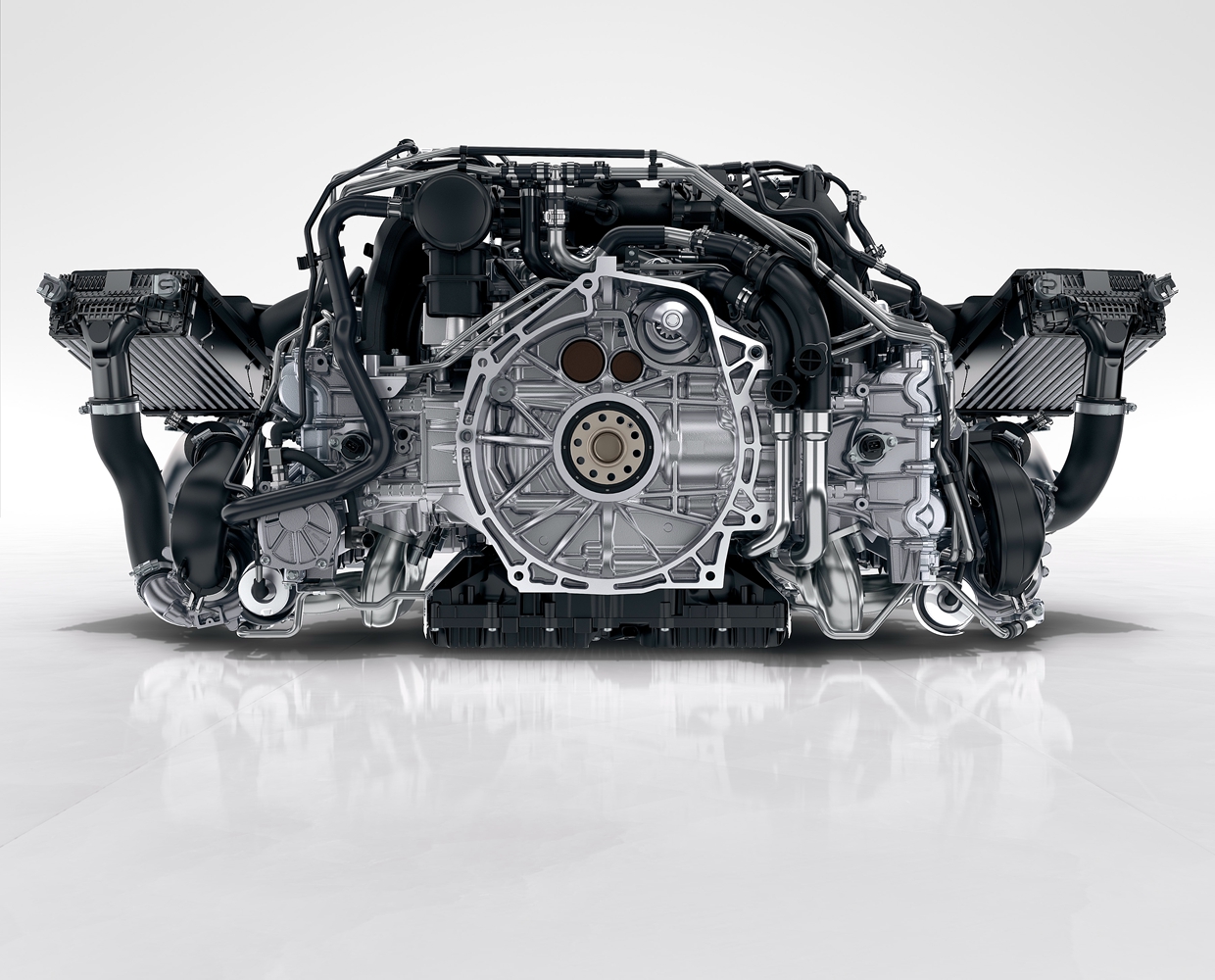 保時捷最新的水平對置六缸發動機包括以下新特性:等離子噴涂汽缸膛、經過減重曲軸箱、工程塑料油底殼、可在250 bar系統壓力下工作的直噴裝置等。水泵加裝的離合器可在發動機工作時嚙合,而在制冷劑溫度較低時保持分離狀態,以減小摩擦。
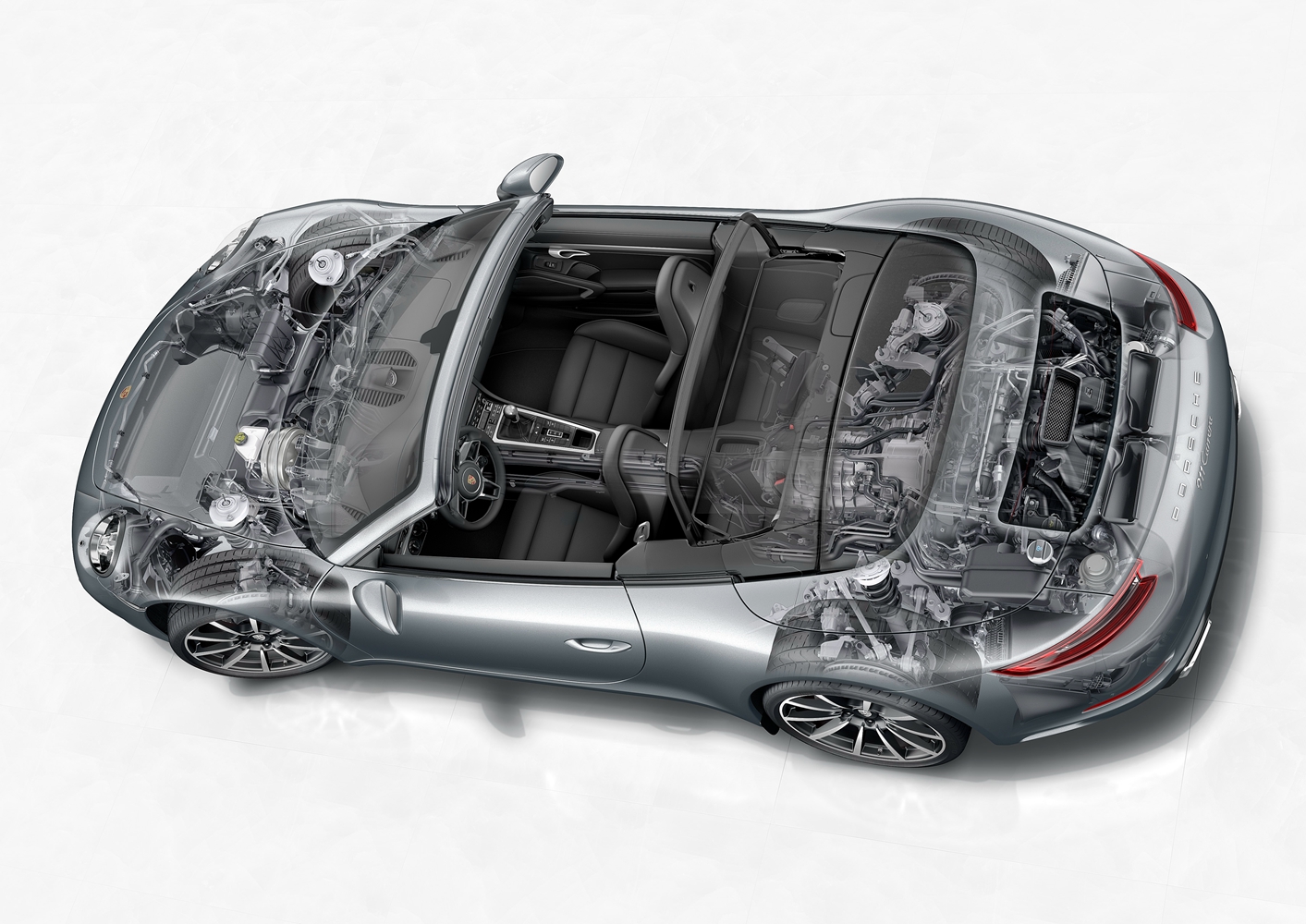 2016年保時捷911 Carrera Cabriolet的透視圖。
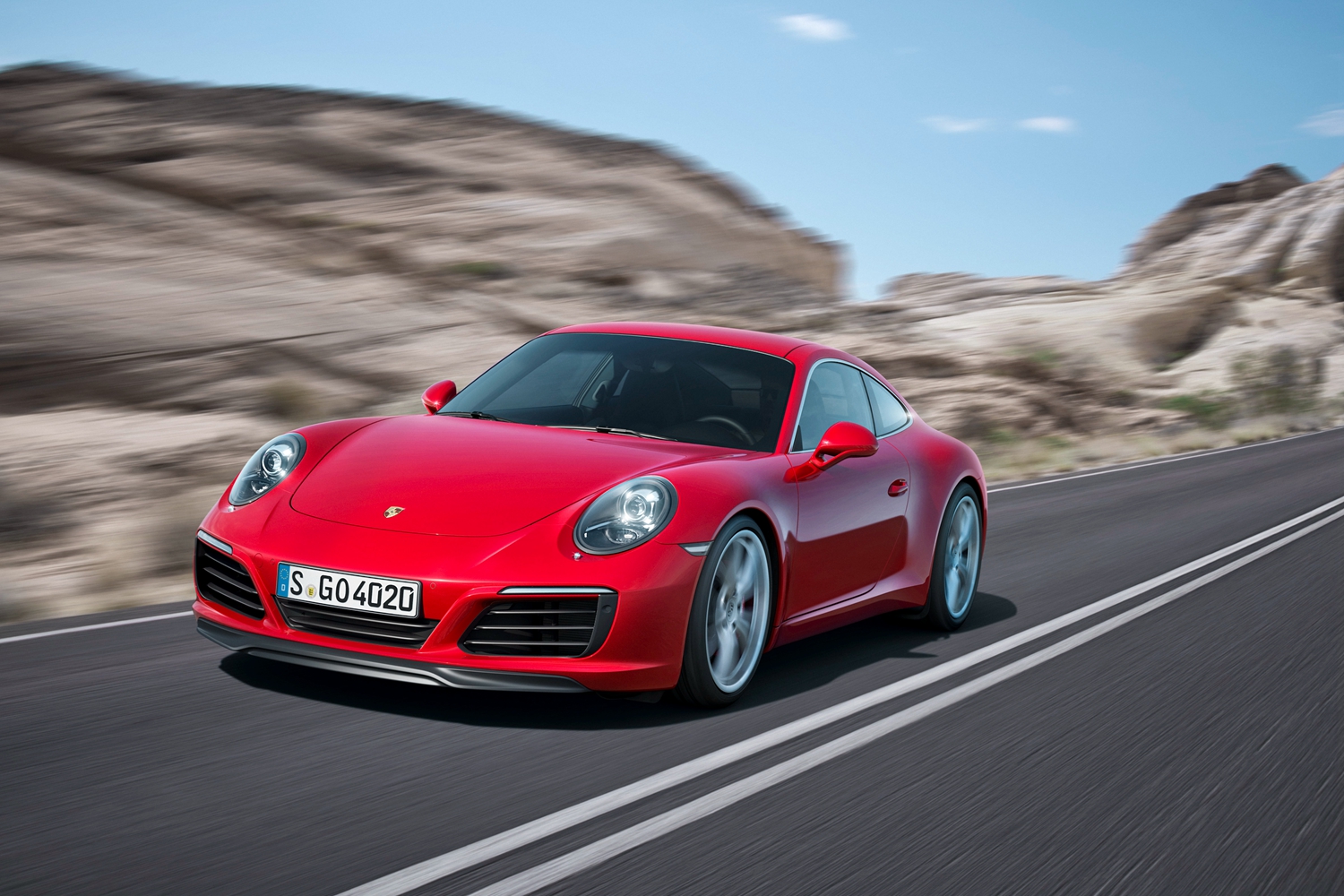 911新車型在造型上有一些細節修改,如全新的前大燈,但最重要的改變則是3.0 L雙渦輪增壓發動機。