交通堵塞、交通事故和尾氣排放問題,都是人們的心頭大患,因此汽車行業面臨的一大隱性挑戰就是如何為全社會開發合適的技術,并加以應用。
數據表明,2013年洛杉磯的駕駛員平均在交通擁堵中所花費的時間為90小時。同年,美國因交通事故死亡的人數為3.3萬人,而甚至連尾氣排放都能導致死亡。
“這個數據讓我很震驚:從全球來看,道路交通污染直接導致5.3了的萬人死亡,大多數是尾氣煙塵造成的,”大陸公司執行董事HelmutMatschi表示。“這個數字非常高,會讓我們懷疑繼續生產汽車是否還有意義?但答案顯然是肯定的。”
在底特律科博會展中心的AVL劇場,也就是2015SAE全球年會的會場,Matschi是周二早上的主題演講嘉賓。
汽車互聯技術有助于降低事故率,減少交通擁堵,并降低排放。
“過去的汽車無法通過互聯網相連,而今天,越來越多的汽車可以聯網。未來的汽車將會成為萬物互聯網絡(IoE)的一部分,” Matschi說。
大陸汽車集團電子地平線(eHorizon)戰略的下一步計劃,就是基于IoE概念進行研發。
目前所生產的eHorizon平臺主要依賴于傳感器和地圖數據,于2012年首次推出。eHorizon的客戶之一為商用卡車制造商Scania。使用其車輛的車隊運營商通過使用這一產品,可以提早對下一段行駛路線中發生的變化做出調整。該系統的一個主要優勢就是可以幫助用戶降低燃油消耗。
“這個系統已經幫助我們節約了3%的燃油。借助(基于傳感器的)靜態eHorizon平臺,我們至今已經節約了2300萬加侖柴油,相當于實現了239噸二氧化碳的減排成果,” Matschi稱。今年晚些時候,將會有另外4家重型卡車的OEM在其生產的車輛上使用大陸汽車的eHorizon。
大陸汽車新推出的Dynamic eHorizon是一個基于云平臺的產品。大陸汽車與IBM、思科和位置云公司Here聯手開發,將數字地圖變成了一個高度精準、實時更新的信息載體。
“做到了這一點,我們就能在安全度、舒適度和排放這些方面實現很多提升,” Matschi表示。DynamiceHorizon還支持其他科技,包括駕駛員輔助系統、導航系統和增強現實平視顯示器等。
但這些先進技術都會增加軟件的復雜程度。
“軟件的需求越來越高,” Matschi指出,一輛常見的豪華車可能裝有160個以上傳感器、多達100個ECU、以及170多個的執行器。“再加上未來車間互聯的可能性,不同電子元件之間的信息通訊還將更加密切。”
通過行業合作,我們可以實現這一目標。
“如果我們能夠像現在這一齊心協力,提升駕駛的舒適度和安全性,并減少二氧化碳排放,那么汽車還將會在未來的道路上繼續行駛。” Matschi說。
作者:Kami Buchholz
來自:SAE Automotive Engineering Magazine
Continental's Matschi: mobility is changing
Traffic gridlock, accident fatalities, and vehicle emissions are not good things. So the underlying challenge for the auto industry is to develop and use technologies appropriately for society.
Data shows that in 2013, Los Angeles drivers spent 90 hours stuck in traffic. That same year there were 33,000 fatalities on U.S roads. Even vehicle emissions caused death.
“This was really for me a surprising (statistic): Globally, 53,000 fatalities were directly attributed to road traffic pollution, mostly because of exhaust fumes," said Helmut Matschi, Executive Board Member at Continental. "That’s a real high number. So that could lead to the question: Does it really make sense to work further on cars? But clearly for us the answer is yes.”
Matschi was the Thursday morning keynote speaker in the AVL theater inside Detroit’s Cobo Center at the 2015 SAE World Congress.
A connected vehicle could help reduce accidents, traffic congestion, and emissions.
“In the past, vehicles had no access to the Internet. Today, more and more vehicles have Internet access. Tomorrow, the vehicle will be part of the Internet of Everything (IoE),” according to Matschi.
The next evolution of Continental's electronic Horizon (eHorizon) strategy underscores the concept of IoE.
The current production version of eHorizon relies on sensors and map data. Launched in 2012, fleet operators using Scania commercial trucks can adjust to changes in an upcoming route early. A major benefit is reduced fuel consumption.
“This has already saved three percent of fuel. With that static (sensor-based) eHorizon, we have up to now saved 23 million gallons of diesel. When we convert this into CO2, that’s an equivalent of 239 tons,” said Matschi. Continental’s eHorizon will be used by four other heavy-duty truck OEMs later this year.
Continental’s new Dynamic eHorizon is cloud-based. In collaboration with IBM,Cisco, and the location cloud company Here, it turns the digital map into a highly precise and up-to-date information carrier.
“With that we can enhance a lot of activities on the safety side, on the comfort side, (and) emissions side,” said Matschi. Dynamic eHorizon also supports other technologies, including driver-assistance systems, navigation systems, and augmented-reality head-up displays.
All of these various advanced technologies add software complexity.
“The software demand is increasing and increasing,” said Matschi, noting that a typical luxury vehicle can have more than 160 sensors, up to 100 ECUs, and more than 170 actuators. “And with the possibility of connectivity there is even more interest that different electronics communicate with each other.”
Industry partnerships can bring it all together.
“In order to enhance the driving comfort, to have safer driving, and to reduce CO2, if we stick together as an industry--as we do--then we are ready for vehicles, which are always on for future mobility,” said Matschi.
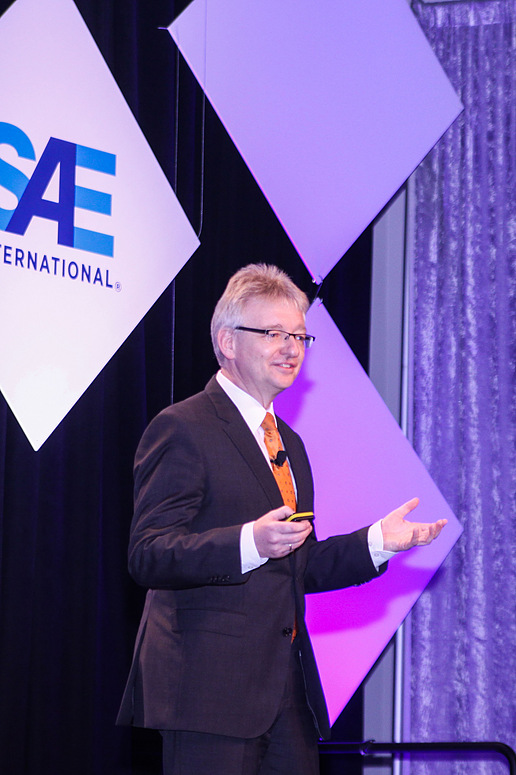 德國大陸集團執行董事Helmut Matschi在2015 SAE全球年會上發表主題演講。
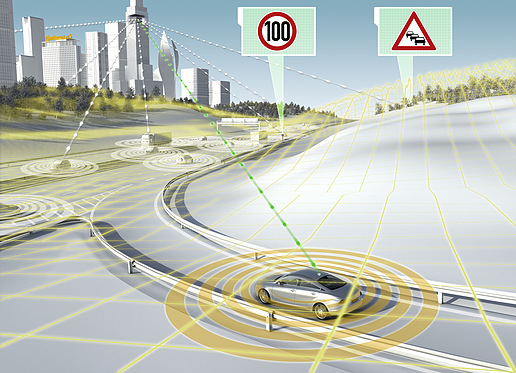 德國大陸集團新推出的eHorizon是一個與IBM、思科和Here公司共同開發的基于云平臺的產品。