無標題 1
在全自動駕駛汽車完全替代駕駛員之前�����,電子科技仍然需要人在異常情況下做出決策。在正常駕駛條件下��,自動控制技術可以負責駕駛�,但在需要做出復雜決策時仍需人力的介入�。
奧迪最近公布了其自動駕駛車輛項目的技術細節���,作為該計劃的一部分���,今年早些時候,一輛奧迪A7概念車完成了從舊金山到拉斯維加斯的行駛�。這輛車在大部分路段中都采用自動駕駛模式,但駕駛員必須保持警惕��,這樣當警報器提醒其重新掌握駕駛時���,可以順利完成交接����。
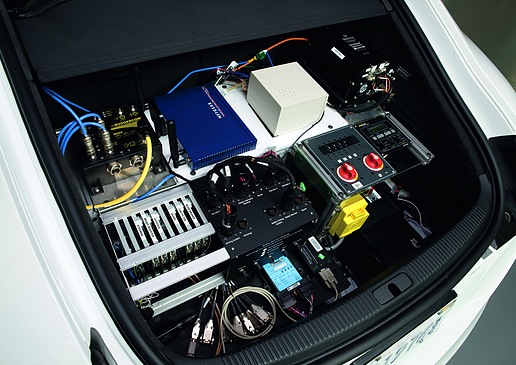
這輛概念車的車身中配置了一系列計算機�����,奧迪工程師打算在未來將它們縮減成一塊主板���。該技術的核心是一系列攝像機����、雷達和超聲波傳感器,并由一個名為zFASd的主板負責控制這些設備��。該主板可以將各種傳感器的輸入數據結合起來,綜合構建車輛對外部世界的感知�。
“傳感器收集到的所有原始信號都會在一個傳感器融合箱內匯聚,”奧迪架構駕駛員輔助系統主管Matthias
Rudolph最近在Nvidia GPU技術論壇上如是說���?!巴ㄟ^這些輸入的數據,可以建立一個虛擬的環境?���!?span lang="EN-US">
zFAS主板的基礎是由四個半導體元件構的��。Nvidia k1處理器可收集四個攝像機的數據�����,并可“在低速行駛過程中完成各種任務��,”
Rudolph說����。Infineon Aurix處理器負責其他額外工作�����,Mobileye的
EyeQ3負責視覺處理�����,而Altera Cyclone FPGA(現場可編程門陣列)則負責進行傳感器融合�����。
軟件架構也是多層的,其中感知傳感器為第一層�����。在此之上是融合層�����,該層架構可將傳感器數據與地圖�、路標和其從他來源獲得的信息結合起來����。Rudolph指出,這種結合可以同時提升信息的質量和分析的準確性。
“雷達并不擅于確定車輛的寬度�����,” Rudolph表示�����?!暗珨z像機可以做到這一點���。我們把二者結合起來��,就得到關于車輛前方情況的信息了?��!?span lang="EN-US">
有一項要求至關重要,那就是確保zFAS主板能夠預測潛在威脅���,并進行正確回應�����,且不得出現誤報���。如果車輛為了躲避并不構成危險的事物而停止或轉彎�����,那么駕駛員很有可能不再使用該系統��。
“如果車輛在空無一物的地方突然剎車����,會破壞司機對系統的信任�,” Rudolph表示�?����!拔覀兊南到y沒有出現過誤報�,這已經在1萬小時的駕駛測試中得到了證明���,在該測試中車輛的平均速度為60kph
(37mph)����,且需要經過包括降雪和凍雨在內的各種氣候的考驗?��!?span lang="EN-US">
奧迪將注意力放在移動物體上��,并根據車輛的駕駛路徑和速度分析它們的潛在影響����。而所有靜止物體都被視為一個單一的目標����。
“我們對所有的靜止圖像一視同仁��,” Rudolph表示���。“不管是一堵墻還是一輛停在路邊的車,我們都要確保不會撞上去���?���!?span lang="EN-US">
對所有自動駕駛系統來說,行人都是最大的挑戰之一����。行人比車輛更難定位和識別,而且他們行為更加不可預見����。奧迪的系統使用一個單目攝影機尋找行人。鑒于某些行人移動方式的不規律性�,奧迪決定不讓汽車因為行人的存在而停下來,除非行人的行為的確會構成切實的威脅���。
“在偵測行人時,我們會計算接觸時間����,” Rudolph表示�?��!爱斳囎油O聲r,車和人之間的距離非常短�。這就是我們想要做到的��。這個距離幾公分就夠了����,我們不想大老遠地就把車停下來。”
盡管領航系統的目標是避免碰到行人和其他絕大多數物體�����,但奧迪也意識����,到碰撞是無法百分百預防的。
“如果一場事故實在不能避免����,那我們就會引導車輛使用車身結構部件來承受沖撞,以將人員傷害降至最低�����,”
Rudolph表示����。
車輛的這種行為主要是在駕駛員未能及時接手駕駛的情況下發生的�。奧迪使用LED報警系統告訴駕駛員交接的時間。他們可以通過急剎車或急轉彎避免碰撞���。一臺車內攝像頭時刻在觀察駕駛員����,好讓系統知道是否需要將LED警報升級成聲響警報��。
“在領航駕駛模式下�����,我們可能會需要駕駛員重新掌控駕駛,所以我們得知道駕駛員在做什么,”
Rudolph表示�。
Audi details piloted driving technology
Before autonomous vehicles make drivers obsolete, electronic technologies will depend on people to make decisions when something unusual happens. During normal driving conditions, autonomous controls could pilot the vehicle, relying on humans when complex decisions are required.
Audi recently provided technical insight into its piloted vehicle project, in which an Audi A7 concept car drove from San Francisco to Las Vegas earlier this year. The vehicle drove itself most of the journey, though drivers had to remain alert to take over when alerts directed them to resume driving.
The concept car has a range of computers in the trunk. Audi engineers plan to reduce them to a single board over time. The mainstays of the piloted vehicle technologies are an array of cameras, radar, and ultrasonic sensors that are controlled by what’s called the zFAS board. It combines sensor inputs to give the car its view of the world.
“All raw signals from the sensors is collected in a sensor fusion box,” Matthias Rudolph, Head of Architecture Driver Assistance Systems at Audi AG said during the recent Nvidia GPU Technology Conference. “From that input, a virtual environment is created.”
Four semiconductors are the basis of the zFAS board. An Nvidia k1 processor collects data from four cameras and “does everything while driving at low speeds,” Rudolph said. An Infineon Aurix processor handles additional chores. Mobileye’s EyeQ3 performs vision processing, while an Altera Cyclone FPGA (field programmable gate array) performs sensor fusion.
The software architecture is layered, with the perception sensor programs forming the first layer. Above that, there’s a fusion layer that blends data from the sensors with information from maps, road graphs, and other sources. Rudolph noted that combining inputs provides better information and increases confidence in the analysis.
“Radar is not good at determining the width of a car,” Rudolph said. “A camera does that well. If we fuse data from each of them we get good information on what’s ahead.”
Ensuring that the zFAS boards detect potential threats and respond to them correctly without false alerts is critical. If vehicles stop or swerve to avoid something that isn’t a true danger, drivers are likely to stop using the system.
“If the car brakes and nothing’s there, it will destroy the confidence of the driver,” Rudolph said. “We have had no false positives; that’s been proven with over 10,000 hours of driving at an average speed of 60 kph (37 mph) in situations including snow and freezing rain.”
Audi looks at moving objects to analyze their potential impact given the vehicle’s driving path and speed. All stationary items are viewed with a single goal.
“We look at static images as the same,” Rudolph said. “It doesn’t matter if it’s a wall or a parked car, we don’t want to hit it.”
Pedestrians are a major challenge for all types of autonomous systems. They’re harder to spot and categorize than vehicles, and they have more degrees of freedom. The system uses a single monocular camera to search for pedestrians. Given the erratic behavior of some walkers, Audi doesn’t stop for pedestrians unless they’re truly in harm’s way.
“When we detect pedestrians, we compute the time to contact,” Rudolph said. “We’re close when the vehicle stops. We want to be close, just a few centimeters away. We do not want to stop far away.”
Though the piloted system aims to avoid pedestrians and most everything else, Audi realizes that collisions can’t always be prevented.
“If we can’t avoid an accident, we steer to use the structure of the car to minimize the chance of injury,” Rudolph said.
Such an action would occur mainly when the human driver didn’t take over in time to avoid a collision. Audi uses an LED alert system to tell drivers when they need to take charge. They can do that by hitting the brakes or making a sharp steering wheel movement. An internal-looking camera watches drivers so the system knows whether the LED alert needs to be augmented with an audible warning.
“In the piloted driving mode, we may need to get the driver back, so we need to know what he’s doing,” Rudolph said.