一份車輛評(píng)估研究表明,在車輛的完整使用周期中,大量使用先進(jìn)高強(qiáng)度鋼材料 (AHSS) 的車型在溫室氣體排放方面的數(shù)據(jù),低于使用鋁材料的同類車型。
2018 年芝加哥車展期間,美國(guó)鋼鐵市場(chǎng)發(fā)展研究所 (Steel Market Development Institute) 汽車市場(chǎng)副總裁 Jody Hall 博士在接受《汽車工程》采訪時(shí)表示,“過(guò)去幾年中,我們已經(jīng)進(jìn)行了大量類似的研究,但這次是我們首次對(duì)車輛在完整使用周期中的溫室氣體排放進(jìn)行對(duì)比研究。”
鋼鐵市場(chǎng)發(fā)展研究所的研究主要集中在五種不同類型的 2016 款車型,分別為轎車、多功能車、皮卡、混合動(dòng)力車和純電動(dòng)汽車。所有接受測(cè)試的車型都曾經(jīng)過(guò)重新設(shè)計(jì),每種車型中均包括一款主要使用鋼材料的版本和一款主要使用鋁材料的版本。Hall 博士表示,“我們發(fā)現(xiàn),在所有車型中,采用鋼材并進(jìn)行汽車輕量化設(shè)計(jì),都是廠商最環(huán)保的選擇。”
來(lái)自哈佛大學(xué)、麻省理工學(xué)院、美國(guó)阿崗國(guó)家實(shí)驗(yàn)室及德國(guó)斯圖加特可持續(xù)發(fā)展咨詢公司、Thinkstep 等多方的代表評(píng)估了該機(jī)構(gòu)有關(guān)“輕量化汽車在完整使用周期中的溫室氣體排放和能源消耗”的研究。
經(jīng)過(guò)長(zhǎng)達(dá) 10 個(gè)月的審查和驗(yàn)證,各方代表最終證實(shí)鋼鐵市場(chǎng)發(fā)展研究所的研究符合ISO要求。Hall 博士表示,“專家小組已經(jīng)認(rèn)可了我們所有的研究方法、參數(shù)選擇及數(shù)據(jù)來(lái)源。”
自美國(guó)國(guó)家環(huán)境保護(hù)局宣布全美所有車輛廠商均需在 2025 年前達(dá)到 54.5 mpg 的平均公司燃油經(jīng)濟(jì)性指標(biāo)以來(lái),車輛減重工作都一直是各大汽車廠商的首要任務(wù)(注意,最新的燃油經(jīng)濟(jì)性指標(biāo)數(shù)據(jù)可能會(huì)在未來(lái)幾個(gè)月中有所變化,可參見(jiàn)昨天的微信推文)。
在 CAFE 標(biāo)準(zhǔn)公布之初,AK 鋼鐵公司首席執(zhí)行官 Roger Newport 表示,大家都僅關(guān)注排氣管處測(cè)量的尾氣排放數(shù)據(jù),“但我們真的必須從全局考慮,而不是只看這一個(gè)具體指標(biāo)”,也就是說(shuō),在衡量車輛的環(huán)保水平時(shí)應(yīng)考慮車輛在完整使用周期中的所有溫室氣體排放,甚至車輛材料的可回收性也必須考慮在內(nèi)。
鋼鐵市場(chǎng)發(fā)展研究所的研究顯示,除了鋼材料以外,鋁材料在生產(chǎn)過(guò)程中溫室氣體排放最低,是鋼材的有力競(jìng)爭(zhēng)對(duì)手。
Hall 博士認(rèn)為,汽車材料在生產(chǎn)過(guò)程中溫室氣體排放也應(yīng)計(jì)入車輛在完整使用周期中的碳足跡中。她指出,在北美地區(qū),鋁材料在生產(chǎn)時(shí)比鋼材料排放地溫室氣體多 4 到 5 倍,而在全球范圍內(nèi),鋁材料生產(chǎn)的溫室氣體排放更是至少要比鋼鐵多 8 至 9 倍。此外,生產(chǎn) 1 公斤鎂材料的溫室氣體排放約為鋼材生產(chǎn)的 20 倍。
Hall 博士稱:“在車輛的完整生命周期中,也就是大約 10 到 12 年的時(shí)間內(nèi),使用鋁材取代鋼材以實(shí)現(xiàn)輕量化汽車設(shè)計(jì)所帶來(lái)的環(huán)保優(yōu)勢(shì),完全不足以抵消鋁材在生產(chǎn)過(guò)程中比鋼材多排放的溫室氣體。”
A vehicle lifecycle assessment study shows that cars extensively using advanced high strength steels (AHSS) emit lower greenhouse gas (GHG) emissions than aluminum-intensive vehicles.
“We’ve done studies like this for several years, but this is the first time that we’ve had a study on vehicle lifecycle greenhouse gas emissions peer-reviewed,” Jody Hall, PhD, Vice President, Automotive Market, Steel Market Development Institute (SMDI), said in an interview with Automotive Engineering at the 2018 Chicago Auto Show.
The SMDI study focused on five different 2016MY vehicles (sedan, sport utility, pickup truck, hybrid-electric, and battery electric). Each vehicle was redesigned as an AHSS intensive- and an aluminum intensive-body to reduce weight. “In every case, we found that lightweighting with steel was the most environmentally friendly material choice,” she said.
Representatives from Harvard University, Massachusetts Institute of Technology, Argonne National Lab, and the Stuttgart,Germany-based sustainability consulting company, Thinkstep, evaluated SMDI’s “Life Cycle Greenhouse Gas and Energy Study of Automotive Lightweighting” document.
The 10-month review and validation process confirmed the study’s conformance to the International Organization for Standardization (ISO). “The panel approved all of our methods, all of the input parameters, and all of our data sources,” Hall said.
Vehicle weight reduction has been a top priority for automakers since the U.S. Environmental Protection Agency announced a Corporate Average Fuel Economy (CAFE) requirement of 54.5 mpg for passenger vehicles by 2025. (The mpg number could be revised in the coming months.)
According to Roger Newport, Chief Executive Officer of AK Steel Corporation, when CAFE standards were established, the tailpipe became the emissions target. “But you really need to look at the total picture, instead of just a section of it,” said Newport, noting that a start-to-finish GHG emissions evaluation includes the vehicle’s material recyclability.
The SMDI study pinpoints aluminum as steel’s closest GHG emissions competitor. According to Hall, GHG emissions released during a material’s production phase can be a big part of a vehicle’s environmental footprint.
Aluminum produced in North America releases four to five times more GHG emissions than steel, noted Hall. She added that for aluminum produced globally, it’s eight to nine times more GHG emissions than steel. And, it’s about 20 times more GHG emissions versus steel to produce a kg of magnesium.
"The dramatic increase in material production emissions for vehicles that are lightweighted with aluminum instead of AHSS is never offset by emissions reduction benefits during the vehicle's useful lifetime, which is the 10-12 years that the vehicle is driven," Hall claims.
Author: Kami Buchholz
Source: SAE Automotive Engineering Magazine
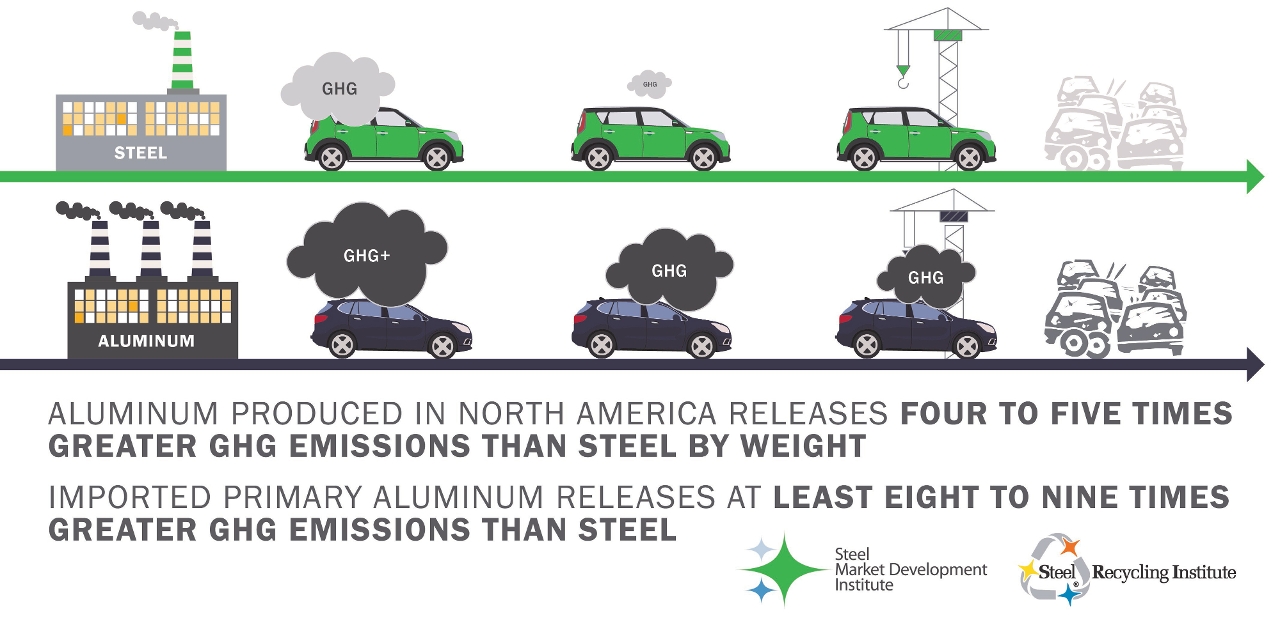 研究發(fā)現(xiàn),在五種不同類型的車輛中,使用鋼材料的車型在完整使用周期中對(duì)環(huán)境的影響最小。(圖片來(lái)源:美國(guó)鋼鐵市場(chǎng)發(fā)展研究所)