對于非公路車輛來說,有時新型“汽車”功能和技術可能只是一種市場宣傳的噱頭,但這的確也反映了一個重要事實——公眾普遍認為乘用車技術更加先進、更加尖端。事實上,在更多情況下,一些非公路車輛的確采用了“汽車”技術。無論是道路工程車輛,還是天天翻滾在灰塵泥土中的建筑機械,汽車領域的技術和功能確實開始逐步應用于這些非公路車輛。
近期,非公路領域出現的一款概念設計“天才駕駛室(Genius Cab)”就是一個證明。這款“天才駕駛室”專為建筑、農業和工業機械設計,預計可在未來2到3年內進入市場。在13個參與“天才駕駛室”聯合研發項目的合作伙伴中,絕大多數為非常成熟的汽車企業。另外,多家參與項目的供應商也表示,公司的汽車業務部為“天才駕駛室”項目做出了巨大貢獻。
作為參與項目的供應商之一,德國博世集團(Robert Bosch)主要為“天才駕駛室”供應車身電腦,從而協助操作員通過CAN(SAEJ1939)/LIN總線或直接實現傳感器和促動器的集中控制,而且還能同時控制安裝在駕駛室外部的超聲波傳感器。“天才駕駛室”采用的外部超聲波傳感器可以展示車輛周邊物體的相對位置和附近障礙物,提示駕駛員注意危險情況。操作員可通過“天才駕駛室”的顯示終端和安裝在車頂的Hella Scenario Light工作指示燈獲取信息。
“我們在汽車行業積累了豐富的系統整合經驗,這為我們進入建筑機械領域提供了巨大的優勢。”博世商用車及非公路設備業務部銷售與系統工程高級經理Kai Bohne表示,“目前,我們在非公路領域的業務主要集中在液壓、燃油及次處理系統;公司下一步的研發重點將放在HMI(人機接口)和電子系統上。”
Bohne表示,“天才駕駛室”使用的超聲波傳感器技術“與乘用車非常類似”,項目會將超聲波傳感器安裝在車輛的前保桿上,協助高級預警系統發揮作用。
項目的另一個主要汽車供應商Hella公司也指出,“天才駕駛室”LED工作燈的研發主要基于之前已經應用于汽車領域的矩陣光束技術。具體來說,矩陣光束LED系統由多個細小單位組成,每個部分均可根據實際情況調亮或調暗,從而避免“眩光”的發生。舉個例子,當輪式裝載機的鏟斗舉起來時,光線不會被鏟斗完全擋住,而是會從其他角度穿過去。
在長達18個月的研發周期中,系統整合一直是“天才駕駛室”合作伙伴的重點工作之一。舉例來說,駕駛室前方由Fritzmeier Systems公司提供的鋁制梁結構也同時充當了整合矩陣光束工作燈的散熱器。
“天才駕駛室”還順應了汽車領域的輕量化趨勢。這款概念駕駛室采用了最新研發的模塊化結構,可成功減重30%。“天才駕駛室”采用了焊接鋁材,而后加裝了鋼制EXO-ROPS/FOPS(即翻車保護系統/墜物保護系統)。Fritzmeier表示,用戶可根據實際需求選擇不同型號的保護系統,重量從11到55噸不等。
此外,“天才駕駛室”還率采用了一款MEKRA Lang公司的可變視角后視攝像頭系統,替代了傳統的后視鏡設計,這可以為操作員提供更高的可視度,黑暗中的表現尤佳。目前,這款攝像頭系統已經登陸了多款概念公路卡車,可以在駕駛艙內的顯示器上顯示一些傳統視角很難觀察到的區域,而且還能對車輛振動進行補償,從而提供更加穩定的畫面。
汽車電纜供應商S.M.A. Metaltechnik也參與了項目的研發,主要為“天才駕駛室”提供一款內部熱交換器。該公司聲稱,這款交換器可協助建筑機械實現“效率提升”,是同類產品中的首創技術。從概念設計階段起,S.M.A就參與了“天才駕駛室”的空調系統研發。這家公司率先采用了已經在汽車領域成功通過測試與驗證的元件,包括高密度連接技術,及具備低損耗和高靈活性等優勢的制冷劑軟管。
Grammer Eia Electronics公司產品經理Marko Boving表示,由該公司與德累斯頓工業大學(Dresden University of Technology)聯合研發的人機接口,靈感也來源于汽車內飾設計,即在操作員的指尖觸控區域設計了多功能控制區。他說,“為什么挖掘機不能采用這種設計呢?這就是我們要努力的方向。”
正如道路上的駕駛員一樣,建筑機械領域的人機接口研發也面對著操作員防干擾的更高要求。“雖然我們可以顯示大量信息,但你也完全可以選擇忽視或隱藏部分內容。對廠商而言,這在汽車平臺很容易實現。由于僅涉及軟件,因此修改推廣并不困難。
在介紹系統原理時,Boving還很自然地使用汽車領域中一個常見術語——認知系統工程。“我們的工作,就是為滿足用戶的感知需求而進行工程設計。”
我們可以從“天才駕駛室”的概念看出,未來的很多汽車技術,都將對非公路設備的研發設計帶來更大影響。
Describing new features and technologies for off-highway vehicles as “automotive-style” sometimes comes off as marketing hype—words meant to tap into views that passenger vehicles are more progressive and closer to the cutting-edge. But often the link is more substantive—engineering know-how actually migrated from pavement-bound machines to those that call dirt home.
The latter scenario holds true for a recent concept cab envisioned for construction, agricultural and industrial forklift application that consists of near-series (capable of employment in off-highway within the next two or three years) components and systems. Many among the 13 partners that jointly developed the Genius CAB are firmly established in the automotive industry, and quite of few of these suppliers note the influence their automotive arms played in their contributions to the project.
Robert Bosch is one such company. The Tier 1 contributes the body computer, which enables centralized control of the sensors and actuators via CAN (SAEJ1939), LIN or directly, as well as the ultrasound sensors integrated into the exterior of the Genius CAB to detect dangerous situations by displaying relative positions and nearby obstacles. The information is communicated to the operator via the display terminal and a Hella ScenarioLight installed in the roof.
“We have a lot of experience [with systems integration] coming from the automotive industry, so using that on a construction machine really gives us a big advantage,” said Kai Bohne, Senior Manager of Sales and System Engineering, Commercial Vehicle and Off-road Business. “Our main business in off-highway currently is hydraulics, fuel systems and aftertreatment systems; HMI [human-machine interface] and electronics is the next step on top of that.”
The ultrasonic sensors are “similar technology from pass car,” he said, which would be mounted in the bumper for advanced warning systems.
Hella, another major automotive supplier, notes that development of the cab’s LED worklights was based on its previously-deployed-in-automotive matrix beam technology. Subdivided into multiple units that can be dimmed up or down according to the situation, matrix beam LEDs avoid “dazzling” operators. For example, while the bucket of a wheel loader is raised, it is not illuminated and the light is routed past it.
During the 18-month development process for the Genius CAB, systems integration was a key focus for the partners. One example is the aluminum front beam structure, manufactured by Fritzmeier Systems, doubling as a heat sink for the integrated matrix beam worklights.
The Genius CAB also taps into a trend that is huge in automotive now: lightweighting. The cab features a newly developed modular structure that results in a 30% reduction in weight. A “soft cab” is made from welded aluminum special profiles, and a steel EXO-ROPS/FOPS (rollover protection system/falling object protection system) is attached over the cab as an add-on. This exo-structure can be variably adapted to suit the weight of the machine, according to Fritzmeier, ranging from 10 to 50 t (11 to 55 ton).
Instead of mirrors, a camera system combined with a variable view reversing camera from MEKRA Lang—used for the first time in a cab for an off-highway vehicle—provides enhanced surround visibility, especially in the dark. The system, which has been demonstrated in future-looking on-highway trucks, displays hard-to-see areas at the rear of the vehicle on screens inside the cab, while compensating for the vehicle’s vibrations.
Automotive cable supplier S.M.A. Metaltechnik also contributed to the project, supplying an internal heat exchanger that the company claims is the first “efficiency boosting component of this nature” to be used in a construction machine. Involved in the cab’s air-conditioning system since the concept phase, S.M.A. decided up front to use components that had undergone successful testing and deployment in the automotive sector, including high-density connection technologies and refrigerant hoses featuring low loss and high flexibility.
The inspiration behind the HMI setup developed by Grammer in collaboration with Dresden University of Technology was the car interior—having multifunctional controls at the operator’s fingertips, according to Marko Boving, Product Manager, Grammer EiA Electronics. “Why can’t you do that in an excavator? This is what we focused on,” he said.
As with drivers on the road, operator distraction is a major consideration in HMI design. “Although we can show a lot of information, you can disengage [certain functionalities] or not show them. For OEMs, it’s easy for vehicle platforms; it’s just software, so the modification factor is high.”
Boving used a term common in automotive, of course, to describe the discipline: cognitive systems engineering. “We engineer what you can perceive, and that’s what we did here.”
If the Genius CAB concept is an accurate indicator, it’s easy to perceive automotive technologies and sensibilities having an even greater influence on off-highway cabs in the near future.
Author: Ryan Gehm
Source: SAE Truck & Off-highway Engineering Magazine

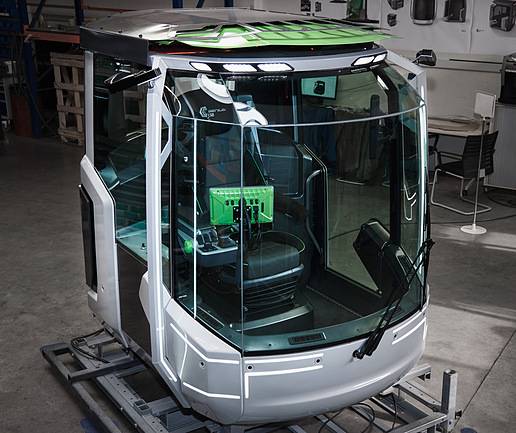 未來,由13個合作伙伴共同研發設計的“天才駕駛室”將有機會應用于建筑、農業和工業叉車等設備。這款駕駛室采用了很多乘用車領域的部件和系統。
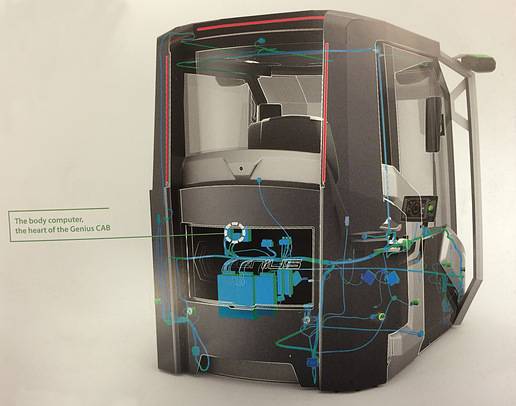 博世為“天才駕駛室”提供了車體計算機系統,可協助操作員通過CAN/LIN總線或直接集中控制駕駛室的傳感器和促動器。
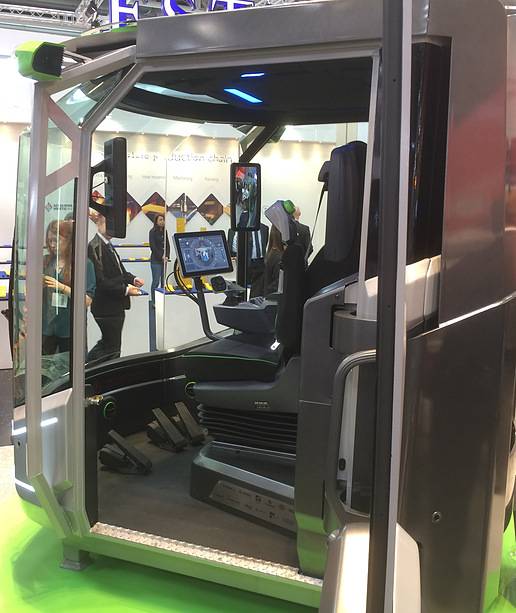 “天才駕駛室”外觀如圖所示,我們可以看到,駕駛室外部的A柱也同時充當了Hella標志性照明系統的軌道。
 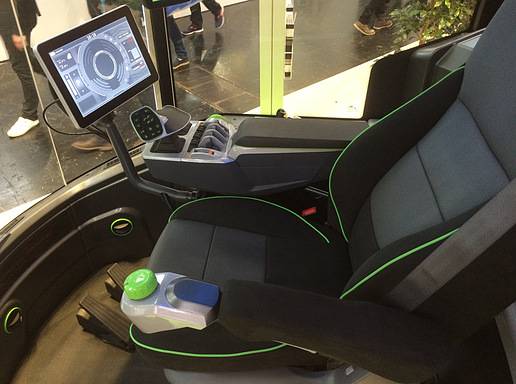 Grammer公司為“天才駕駛室”提供了完整的用戶接口系統,其中包括懸浮座椅、多功能電子扶手及一款12英寸的多點觸控顯示屏。