車禍的發生往往就在一眨眼的工夫,而在這關鍵的一剎那間,碰撞產生的力將如何穿過車身,作用于車內人員身上?要想打造更加安全的汽車,了解這些細節信息至關重要。
數十年來,在通用汽車(General Motors)位于密歇根州的米爾福德試車場(Milford Proving Ground),以及其他汽車生產商的試車跑道上,為了給汽車安全工程師提供更多關鍵數據,碰撞測試中的假人必須忍受無數次強烈碰撞的沖擊。通用實驗室工程集團經理、技術專家Jack Jensen表示,這種人們熟知的靶心假人由鋼材、橡膠、乙烯和泡沫等材料組成,經過年復一年的發展,已經變得越來越成熟。
Jensen表示,如今的碰撞假人中安裝了各式各樣的最新儀表,從本質上已經成為了一種移動數據記錄器,就好像是一個人體形狀的黑盒子。過去的假人可能還會受到各種儀器連接線的限制,但最新的假人已經采用了各類無線獨立傳感器,完全可以實現自由移動。“這種新型假人擁有140個數據通道,可以達到每毫秒10個樣本的傳送速度,很快就能積累大量數據。”
首美安全系統設備(Humanetics Innovative Solution)公司位于密歇根州的普利茅斯市,是一家處于領先地位的擬人測試設備(ATD)供應商。
Jensen解釋說,如今的ATD設備中裝滿了加速器、測力傳感器、角速度傳感器和位移計,可以承受“極大的加速度和負載,并實現毫米級別精度的形變控制。”舉例而言,“我們可以通過測試胸腔的壓縮程度或胸骨與脊椎之間的距離變化”,判斷假人的形變情況。這些數據可以幫助工程師預測,車上人員可能會在真實碰撞中受到何種程度的傷害。
Jensen繼續說,“我們大約擁有190到200個不同尺寸、形狀,代表年齡不同的碰撞測試假人。”這些假人并不便宜,單個價格可能超過12萬美元,有的甚至可能高達50萬美元。
數字化假人
Jensen表示,如今,越來越多的汽車廠商都開始進行虛擬碰撞測試,數字化假人也在虛擬碰撞測試中日益流行起來。這種模擬碰撞測試主要利用CAD(計算機輔助設計)和CAE(計算機輔助工程)系統進行有限元建模,可以在真正開始硬件制造之前,幫助工程師在早期設計階段獲得更多信息,并最終通過一系列測試案例,逐步優化車輛性能。
Jensen指出,“不過,在米爾福德,我們仍會進行大量實際的碰撞測試。”這是由于雖然虛擬碰撞測試可以驗證模型、確認對系統性能的預測,或在系統功能尚未定型的情況下發揮作用,但并無法捕捉到真實碰撞中的所有細節,而且ATD設備也很難測量到所有數據,因此通用汽車并不會完全用虛擬測試替代實際測試,真實假人和虛擬假人都能在這里發揮作用。此外,由于政府的相關安全條款是根據真實碰撞測試制定的,因此通用汽車還會用軟件為真實假人的表現建模。
“我們可能會進行一次物理碰撞測試,了解車輛或車輛安全系統在碰撞中的表現。”他說,“接著我們就可以通過大量計算機模擬,比如說20次模擬,進行一系列漸進式優化,并最終打造出新的最優化車型,或最優化的系統,用于進行下階段的真實碰撞測試。雖然CAE技術能夠幫助我們大幅減少分析某一特定情況所需進行的實際碰撞的次數,但我們仍必須不斷發現新的危險狀況,從而建立新的測試案例,而這意味著需要我們完成的汽車碰撞測試將會越來越多。”
虛擬駕駛員和乘客
2003年,豐田汽車公司(Toyota)推出了一款虛擬人體建模軟件THUMS,以供業界使用。汽車安全工程師兼生物醫藥工程師Jason Hallman表示,這款軟件是與豐田汽車中央研發實驗室(Toyota Motor Central R&D Lab)聯合開發而成,是最受歡迎的汽車乘客安全模擬軟件之一。目前,這款軟件擁有大約150名用戶,主要為汽車廠商、座椅供應商、交通安全研究中心及學術機構等。
“目前,我們的THUMS軟件已經開發到4.0版本,是一種可以具體定義各類人體軟、硬組織的有限元模擬工具,可以細致到骨頭、器官、肌肉、韌帶和肌腱等。”Hallman表示,“這樣一來,建立一個模型可能涉及200萬個要素。”
美國維克森林大學(Wake Forest University)正是THUMS 4.0的學術機構用戶之一,“我們重新構建了大約11起造成急性傷害的汽車碰撞事故,這里面既有正面碰撞,也有側面碰撞。”該大學生物醫藥工程系助教Ashley Weaver表示,“通過模擬真實車禍情況,我們可以研究汽車的設計參數、安全功能及乘客因素在事故中發揮的作用,并借此提高車輛的安全性。”
豐田專攻生物力學的高級首席工程師Steve Ham表示,THUMS系統支持三種體型分類,即高大男性、中等身材男性和較小身材女性,而CHARM 10.0版本還可以提供另外兩種分類,即幼兒和老年女性。
“大體而言,CHARM 10.0版本的技術背景與THUMS軟件差不多,”Ham表示,“但你確實需要專門的兒童和老人模型,因為他們的身體形狀和組織構成與成年人并不相同。”他說,10歲兒童頭部與軀干之間的比例肯定與成人不同,而且他們的盆骨也并未完全閉合,而70歲的婦女則一般會有骨質疏松的情況。
可以看到,碰撞測試需要更多不同類型的身體分類,但建立一個模型可能耗時數年。因此,Hallman和他在密歇根大學(University of Michigan)的團隊正在開發一種可以加快建模速度的新方法。Hallman的團隊借助人口調研中的身體數據統計,通過數學方法改變現有的有限元骨骼與組織模型,從而使其覆蓋更多體型和尺寸。(見http://papers.sae.org/2016-01-1491/ 點擊原文直達)
Ham指出,對細節的控制越有力,工程師就能夠針對更多乘員身材類型的需要,對車輛的安全氣囊、座椅安全帶和被動安全等系統進行更加具體的調整。同理,THUMS 5.0版本可以針對車內乘客處于無準備的放松狀態或,或是做好準備的不同情況,更好地模擬乘員身體形態和肌肉狀態,從而提供更有針對性的撞后傷亡分析,因而也能為汽車安全設備的評估提供更多幫助。
作者:Steven Ashley
來源:SAE《汽車工程》雜志
翻譯:SAE 上海辦公室
Digital dummies in virtual collisions augment traditional crash tests
A car crash takes half a blink of an eye. Detailed knowledge of the crucial split-second when the crash impact energy flashes through a vehicle’s body and then onto the occupants’ bodies is critical to building safer cars.
For decades at automakers’ test tracks such as GM’s Milford Proving Ground in Michigan, crash test dummies have endured repeated near ballistic collisions to provide that key data to safety and vehicle engineers. Through the years, the familiar bull’s-eyed manikins of steel, rubber, vinyl, and foam have grown increasingly sophisticated, said Jack Jensen, Engineering Group Manager at the lab and GM Technical Fellow.
Fitted with the latest instrumentation, crash dummies have essentially become flight-data recorders, black boxes in human form, as the sensors and transducers are now self-contained and wireless, whereas previous dummies needed cables that could restrain free movement, Jensen said. “The new dummies can have 140 channels of data delivering at a rate around 10 samples a millisecond, which quickly fills huge files.”
Humanetics Innovative Solution of Plymouth, MI, is the leading supplier of anthropomorphic test devices, or ATDs.
ATDs are fitted with accelerometers, load cells, angular rate sensors, and displacement gauges, which “gives you so many g’s, so many Newtons of load, millimeters of deflection,” he explained. The deflection numbers, for instance, “let us measure the compression of the chest cavity or distance between the sternum and spine.” These metrics help define injury criteria for predicting the statistical risks of injuries.
“We have about 190 to 200 crash-test dummies in a wide range of sizes, shapes, and ages,” Jensen continued. Dummies are not cheap; they can go for $125,000, even a half-million dollars a copy.
Digital dummies
More and more at the automakers nowadays, digital crash test dummies made of zeroes and ones are taking the big hits in virtual vehicles, he said. The simulated crash tests using computer-aided design (CAD) and engineering (CAE) systems to do finite element modeling and analysis allow GM engineers to learn earlier in the design process, before the hardware is available and built, and also optimize the performance across a broad range of test conditions.
“We still do a lot of physical crash tests here at Milford,” Jensen noted. The collisions are used to validate the models, confirm performance predictions, or when system capabilities are still evolving. Real dummies will be needed because simulations fail to capture everything that happens in a crash test or that an ATD can measure, so GM uses both physical and virtual dummies. They also use the software to model the behavior of physical dummies themselves because governments define safety regulations according to real-world crash tests.
“We might run a physical crash test to get a baseline regarding how the vehicle or safety system performs,” he said. “Then maybe we’d implement a series of incremental improvements using say, 20 computer simulations, and finally, build the new optimized vehicle or system for testing. But even though CAE allows us to reduce the number of physical collisions for analyzing a given engineering condition, the constant search for new hazardous conditions to consider means we’re doing more vehicle crashes than ever before.”
Virtual drivers and passengers
In 2003, Toyota introduced for public use the Total Human Model for Safety (THUMS) virtual human model software. THUMS, which was co-developed withToyota Motor Central R&D Labs, is the most popular vehicle passenger safety simulation, said Jason Hallman, a vehicle safety engineer and biomedical engineer. The software today has 150 users and licensees including automakers, seat suppliers, research transport safety centers, and academic institutions.
“Right now we’re on THUMS v. 4, which is a finite-element physical framework in which the body’s hard and soft tissues—the bones, organs, muscles, ligaments, tendons—have been simulated in detail,” Hallman said. “The result is a model with 2 million elements.”
One of the academic institutions that uses THUMS 4 is a team of modelers at Wake Forest University: “We’ve reconstructed about eleven motor vehicle crashes—both frontal and side impacts—that caused acute injuries,” said Ashley Weaver, Assistant Professor of Biomedical Engineering. “By simulating real-world crashes, we can study the effect of vehicle design parameters, safety features, and occupant factors to improve safety.”
The THUMS system models three body categories: a large male, a medium man, and small woman, whereas two other classifications—young child and elderly female—are simulated by Collaborative Human Advanced Research Models v. 10 (CHARM 10), said Steve Ham, Toyota Senior Principal Engineer, who focuses on biomechanics.
“The technical background behind CHARM 10 and THUMS are substantially the same,” Ham said. “But you need specific models to represent children and the aged because their body geometries and the materials properties of their tissues are not the same as those average adults.” For a 10-year-old, the head-to-body ratios are different and the pelvic bone still has a weakness, a gap in it, he said. A 70-year-old woman typically has osteoporosis.
More specialized body types are needed, but because it can take several years to build one, Hallman and a team at the University of Michigan are developing a way to produce them quicker. Using body data from population studies, they mathematically morph existing finite-element models of skeletons and whole bodies across multiple body sizes and shapes. (See http://papers.sae.org/2016-01-1491/)
The greater scalability of the details would let engineers better fine-tune airbags, seatbelts, and passive safety systems to a wider range of bodies, Ham noted. Likewise, THUMS 5, which is being readied for release, will help evaluation of safety equipment by enabling more detailed analyses of post-crash injuries because it better simulates the body attitude and muscular state of a vehicle occupant when relaxed or braced for impact.
Author: Steven Ashley
Source: SAE Automotive Engineering Magazine

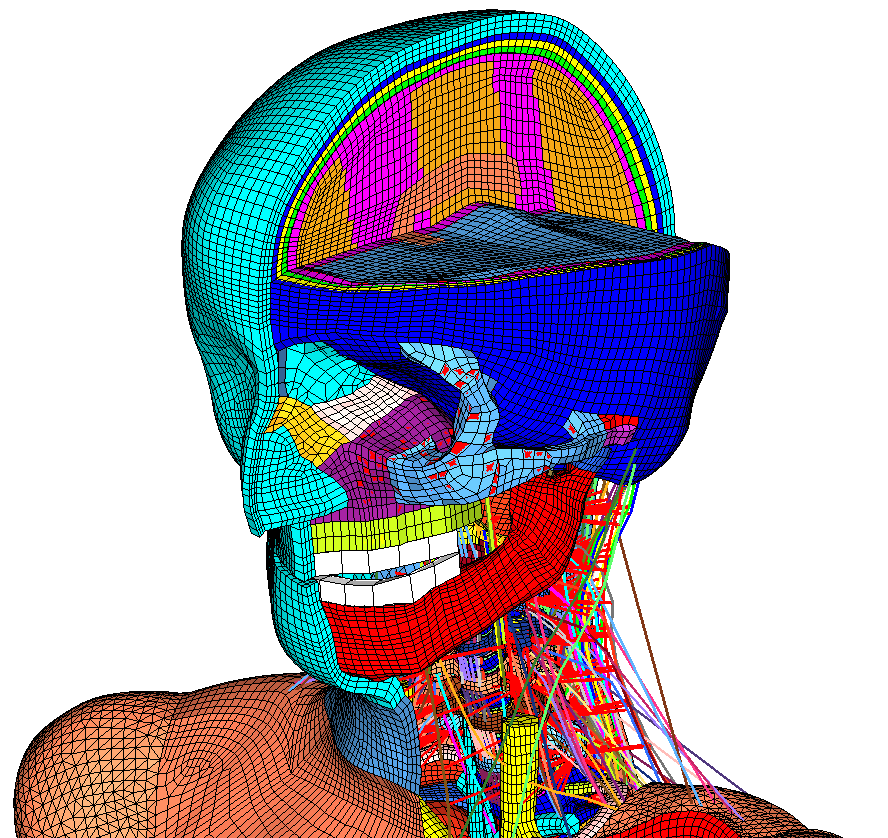 美國韋恩州立大學的CHARM 10.0人體模擬系統,能夠在內臟和身體組織的層面模擬人體在汽車碰撞中的情況。
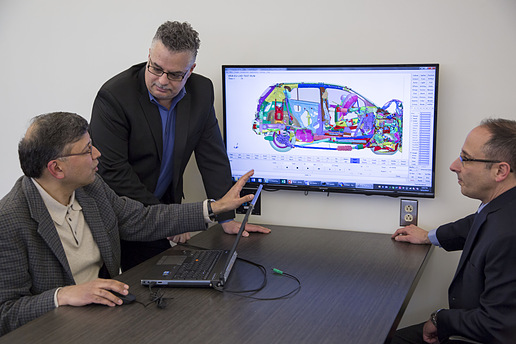 密歇根州沃倫市,通用汽車工程師正在討論CAE模擬的結果,這種模擬可以準確描述2015款Trax的結構和各個元件在碰撞中的表現。
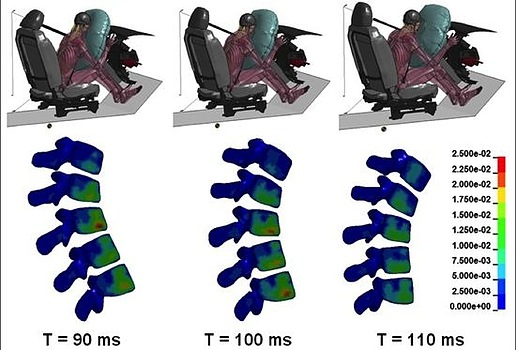 美國維克森林大學的研究員借助豐田的THUMS 4.0系統,建立了人體腰椎在正面碰撞中的受力模型。
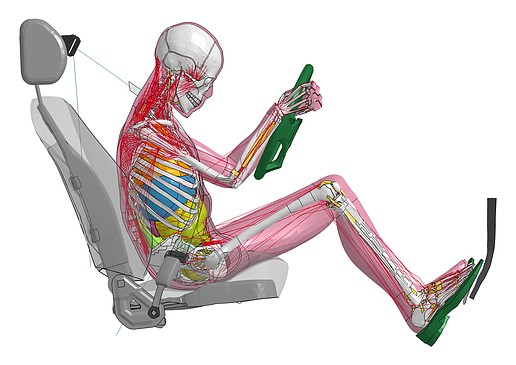 豐田THUMS 5.0系統建立的模型可以反映乘客在碰撞發生前的不同姿勢和肌肉張力水平。