捷豹路虎(JLR)下定決心要大刀闊斧研究汽車節能方案,Wolfgang Epple博士,JLR公司研發總監,向記者表示: “我們正試圖通過在車輛上使用新興技術來進一步減輕汽車的自身重量,譬如使用碳纖維亞麻混合材料。”
JLR正著力推進一項大膽的汽車電氣化策略,Epple博士認為,如果要將CO2 平均排放量降到100g/km (56 mpg)以下,對于高端汽車制造商來說,電氣化方案將是必由之路。如果僅僅是想單靠“混合動力及電池動力系統”來提高燃油經濟性是遠遠不夠的,但他也強調,JLR正在與12家技術合作伙伴聯合開發“Evoque-e”項目,其中全新獨特的高性能、模塊化設計的電動電機是其研究項目之一。
CARBIO碳纖維/亞麻混合材料
Epple強調,為了減少阻力系數、摩擦、電氣以及加熱、制冷和通風系統所產生的寄生損失,必須運用來自不同領域的技術,制定一套完整的解決方案,同時也需要運用創新手段來減輕車輛自身重量。亞麻、碳纖維正是我們所要尋找的新材料。
Simon Black,JLR車身高級經理、Epple博士團隊成員,“CARBIO項目通過運用環保腰果油樹脂將碳纖維層和亞麻層結合在一起。我們之所以選擇亞麻是因為其吸音的固有屬性。CARBIO材料結合了碳纖維的堅韌性和輕量化優勢,以及亞麻材料的可持續性和低成本優勢。雖然CARBIO材料的制造成本與常規的碳纖維材料持平,但材料成本卻可以降低三分之一。”
CARBIO材料制成的部件比鋁制輕28%,比鋼制輕55%。Black指出,得益于CARBIO的優異的NVH屬性,因此可以減少隔音材料的使用。
甚至是一些不能減重的材料,也可以通過LANDS(輕量化和噪聲)研究項目降低用量,LANDS項目旨在研究新型NVH材料用量削減方法的研發工作。其中一種方法是,利用回收的塑料,與通過糖精制工藝制造的填充物結合。用這種方法生產的輪拱內襯原型比現用的典型樣式輕9%,但降噪效果卻幾乎相同。
針對那些不能減重的材料,我們也可以通過LANDS項目(輕量化與噪聲)通過使用新型NVH
材料來減少其用量。其中一種方法是,利用回收塑料填充制糖過程中產生的副產物。使用這種方法生產的輪拱內襯比現有產品輕9%,但降噪效果卻幾乎相同。
CARBIO項目選用Composites Evolution公司的Biotex Flax亞麻材料,打造了一款碳纖維/亞麻混合材料車頂。除了其減振屬性外,亞麻纖維可再生、成本低,而且還是一種碳中和材料。相較于合成環氧樹脂,由腰果殼液(CNSL)制成的生物環氧樹脂的堅韌性、減振性和可持續性更卓越。
在這種混合生物復合材料中,碳纖維和亞麻成分各占一半,Composites Evolution公司提供Biotex Flax亞麻材料,并由SHD Composite Materials公司預浸,該材料為實現項目目標作出重大貢獻。該混合生物復合材料的抗彎剛度與碳纖維材料相仿,但成本低15%,重量輕7%,減振效果則提高了58%。
采用該材料的車頂原型由德爾塔汽車運動公司(Delta Motorsport)設計,由KS Composites公司制造。CARBIO項目獲得了Innovate U.K.(英國政府創新機構)的部分贊助,克蘭菲爾德大學也是該研究項目的合作方之一。
PLACES高效碳座椅的高級輕量化架構項目
Varcity是JLR涉足的另一項重大項目,旨在評估如何將碳纖維材料融合到現用的混合材料策略中,以便打造出NVH性能更優良的車身結構,且優于現行的碳纖維應用效果。項目的目標是,與鋁制白車身相比減重20%。
為了能達到與鋁制白車身相比減重20%的目標,JLR開展了另一項重大項目名為Varcity。主要目的在于為了提升現有碳纖維材料的NVH屬性,尋求將碳纖維融合到現有的車身架構混合材料中之策略。
“Varcity項目始于捷豹C-X75概念車,”Black表示。“這款車的車身采用了非熱壓成型技術,適合
極薄的印刷電路板有望替代車輛的線束及電子元件,達到車輛減重的目的。就以路虎攬勝為例,車輛線路總長6000米,重約94KG。
Black表示,使用熱塑性材料生產的座椅結構的輕量化道路更為有前途,經PLACES(高效碳座椅的高級輕量化架)項目重新設計的座椅,比傳統鋼制結構輕了30%,但絲毫其不影響舒適性。
為了達到強化該結構件的目標,生產運用了熱塑性復合材料沖壓成型工藝。
探索新型電機架構
JLR執管理團隊正在嘗試通過紅外線反射玻璃等技術,打造一個“氣泡”,用其來達到調控車內溫度的作用。
JLR同時還在嘗試運用紅外面板,僅僅在有人的特定空間內加熱,以此來降低能耗。從先前的測試中我們顯示,該技術比的能耗僅為目前空調系統8-12kW的一半。
雖然這些研究都很重要,但動力總成仍是JLR獨一無二的節能重心。JLR低碳汽車首席技術專家Mike Richardson表示,Evoque-e合作研發項目(有12個合作伙伴,由Innovate U.K.資助部分經費)旨在探索2020年之后的解決方案,內容涉及先進電氣動力總成技術的所有方面。其中的關鍵領域之一是研發新的電機架構。
雖然先前的提供的科研項目都重要,但是動力總成才是JLR科研項目的重中之重。Mike Richardson,JLR低碳汽車首席技術專家表示,Evoque-e合作項目立項目標便是超越2020年,探索先進電氣化動力總成技術各個方面,其核心之一就是開發新型電機架構。
“輻射通量電機(radial flux machines)是該項目的核心技術,該款電機體積小、重量輕,但動力非常強勁,”Richardson表示。“其功率和扭矩達到目前市面量產技術兩倍,該電機采用了模塊化設計,可以滿足各種車型的規模化生產,并與未來常見的通用部件與系統相兼容。”
新電機還有一項環保優勢:“對于那些不需要極致性能要求的應用,我們使用稀土釹磁替代鐵基鐵氧磁鐵,用銅線圈替代鋁線圈。”他表示,這樣的配置在經濟和環保效益都更好,“有了這么靈活的電氣架構,我們幾乎可以滿足任何混動及純電動動力系統。”
Evoque-e技術適用于輕度混合、插電式混合和純電動配置。輕混HEV可搭載功率為66 kW(88.5 hp)的3缸柴油試驗用發動機,標準9速自動變速箱,以及集成在兩者之間的15 kW(20 hp)的輻射通量電機。該動力單元與48 V的電氣系統和48 V的鋰離子電池相連。
插電式混合動力車可搭載JLR的2.0 L 4缸Ingenium發動機,一個8速自動變速箱,以及一個集成在兩者之間的輻射通量電機模塊(連接320 V鋰離子電池,最大輸出功率可達150 kW)。
純電動車則可搭載一個功率可達70 kW的鋰離子電池和前后兩個電機,為電驅動橋供電。前橋集成了一個單速變速器和一個85 kW(114 hp)的電機,電機使用鐵磁和鋁線圈;后橋則集成了一個較小的145 kW(194 hp)的電機。為提升性能,后橋電機采用了常規的釹磁和銅線圈,但需要搭配2速變速箱器。
為了致力于更多研究項目工作,Epple表示,在未來兩年內該研發小組將擴充至500人,著重多學科長期研究:“電氣化、智能化、車關網和人機界面都將有助于我們實現低碳的未來。”
JLR還將進行更多研究。Epple博士表示,兩年內,公司先進研發小組的人數將翻一番,達到500人,并致力于解決多學科長期研究的挑戰:“電氣化、智能化、車聯網和人機界面都有助于幫助我們打造低碳未來。”
當然,也少不了“亞麻”。
作者:Stuart Birch
來源:SAE《汽車工程雜志》
翻譯:SAE上海辦公室
JLR lightweight materials research blends flax, carbon fiber and cashew-nut oils
Jaguar Land Rover (JLR) is literally intent on harvesting energy saving solutions. “We are researching a range of new technologies to drive even more weight out of our vehicles, including how we could mix carbon fiber with flax,” reveals its R&D Director, Dr. Wolfgang Epple.
He says JLR is pursuing a bold electrification strategy and believes electric solutions are a must for premium carmakers to drive fleet average CO2 emissions below 100 g/km (U.S. 56 mpg). But creating vehicles which are more fuel-efficient and sustainable "cannot be achieved by the introduction of hybrid and battery powertrains alone," he asserted, while noting that JLR's ‘Evoque-e’ research project with 12 technology partners includes a new and unique design of high performance, modular electric motor generators.
A high CARBIO diet
The wider, complementary technologies are needed to achieve the holistic solutions required, Epple stressed, including parasitic losses in all areas: drag coefficient, friction, electrical, and heating, cooling and ventilation systems. And there is the need for more innovative approaches to weight reduction. That's where flax (a cultivated crop; textile fiber is obtained from its stem) and carbon fiber, enter the equation.
Simon Black, a JLR Senior Manager for Bodyshell and member of Epple’s team, explains: “The CARBIO project, in which we are a partner, combines layers of carbon fiber and flax with an environmental-friendly cashew nut oil resin. Flax was chosen for its inherent sound dampening properties. CARBIO combines the strength and lightweight benefit of carbon fiber with the sustainability and lower cost of flax. While the manufacturing cost of CARBIO is similar to that of traditional carbon fiber, the material cost of mixing carbon fiber and flax is one-third cheaper.”
Components made from CARBIO are 28% lighter than aluminum and 55% lighter than steel. Its NVH properties mean less use of sound-deadening material, Black noted.
But even the weight of the material that is required, could also be reduced via a research project calls LANDS (Lightweight and Sound) examining development of new NVH-abatement materials. One of these uses recycled plastic combined with filler sourced from the sugar refining process. A prototype wheel arch liner has been produced that is 9% lighter than a typical current type but provides similar noise reduction capability.
The CARBIO project has developed a carbon/flax hybrid automotive roof using Composites Evolution's Biotex Flax material. Together with vibration damping properties, flax fibers are renewable, lower in cost, and are CO2 neutral. Bio-epoxy resins based on cashew nut shell liquid (CNSL) can offer enhanced toughness, damping and sustainability over synthetic epoxies.
A 50/50 carbon/flax hybrid biocomposite, made from Biotex Flax supplied byComposites Evolution and prepregged by SHD Composite Materials, has contributed to achieving the objectives of the project. With equal bending stiffness to carbon fiber, the hybrid biocomposite is described as exhibiting 15% lower cost, 7% lower weight and 58% higher vibration damping.
The prototype roof was designed by Delta Motorsport and manufactured by KS Composites. The CARBIO project is part-funded by Innovate U.K. (the British Government’s innovation agency). Other partners include Cranfield University.
Going PLACES
Another significant project involving JLR is Varcity, evaluating how the company could introduce carbon fiber materials into its existing mixed material strategy for body structures with enhanced NVH properties, compared to current carbon fiber applications. The target is to achieve a 20% weight saving against an aluminum BIW.
“Varcity’s starting point was the Jaguar C-X75 concept,” says Black. “The bodyshell used an out-of-autoclave molding technique compatible with higher volume manufacturing.” Varcity is continuing R&D work on processing and forming technologies that could meet cost and volume requirements.
Vehicle wiring loom and electrical components are also getting the weight-loss R&D treatment, with the possibility of replacing them with wafer-thin printed electronic circuits. Typically a current Range Rover carries some 6000 m (19,685 ft) of wiring weighing 94 kg (207 lb). Use of thermoplastics for lighter seat construction are showing promise and the project PLACES (Premium Lightweight Architecture for Carbon Efficient Seating) has demonstrated seat structure 30% lighter than an equivalent in steel with no sacrifice of comfort, stated Black.
A thermoplastic composite stamping process is used. The structural components work as part of the comfort system for consolidation of parts.
New e-motor architectures explored
JLR’s thermal management team is looking at the possibility of heating or cooling a cabin via what it terms an “air bubble” to maintain an equable temperature via several technologies including infra-red solar reflective glass, bespoke for specific temperature zones.
JLR also envisages infrared panels invisibly embedded parts of the cabin to warm occupants’ skin instead of maintaining the entire cabin at a specific temperature. Early tests show that it is possible to halve HVAC energy consumption from the current 8-12 kW.
All this is significant work, but it is powertrain that remains JLR's main single focus for energy saving. Mike Richardson, JLR’s Chief Technical Specialist, Low Carbon Vehicles, explains that the Evoque-e collaborative research project (12 partners and part-funded by Innovate U.K.) aims to look beyond 2020 to explore all aspects of advanced electrified powertrain technology. One of the key areas is to develop new, electric machine architectures.
“The radial flux machines that form the core technology for this are slim, light and extremely powerful,” states Richardson. “They produce up to twice the power and torque of current production technology. And they are scalable, capable of supporting any size of vehicle in our range and being modular, compatible with generic future components and systems.”
There is an added environmental plus for the new electric machines: “For applications where ultimate performance is not the priority, we are developing a version of the motor which trades iron-based ferrite magnets for typically used rare-earth neodymium, and copper windings instead of aluminum windings.” Savings are financial as well as environmental, he said: “An electric machine architecture this flexible will allow us to produce virtually any hybrid or battery electric vehicle configuration we choose.”
Evoque-e technology demonstrators embrace mild hybrid, plug-in hybrid, and battery-electric configurations. The mild HEV has a 66-kW (88.5-hp) 3-cylinder diesel research engine with a 15-kW (20-hp) radial flux electric machine integrated between the engine and a standard 9-speed auto transmission. This power unit is connected to a 48-V electrical system and 48-V lithium ion battery.
The plug-in has a prototype JLR Ingenium 2.0-L 4-cylinder engine and also has a radial flux electric machine (capable of up to 150 kW linked to a 320-V lithium ion battery) module between it and an 8-speed automatic.
The pure electric vehicle has a 70-kW lithium ion battery and electric machines front and rear powering electric drive axles. The front axle is integrated with a single speed transmission and 85-kW (114-hp) machine using a ferrite magnet and aluminum winding; the rear a smaller 145-kW (194-hp) machine. It uses traditional neodymium magnets and copper windings for added performance but driving through a 2-speed transmission.
There is more to come, and Dr. Epple reveals that JLR will double the size of its advanced research team to 500 within two years, focusing on long term multi-disciplinary challenges: “Electrification, smart and connected cars, and HMI (Human Machine Interface), all of which will help us deliver a low carbon future.”
And supported by "flaxable" solutions, of course.
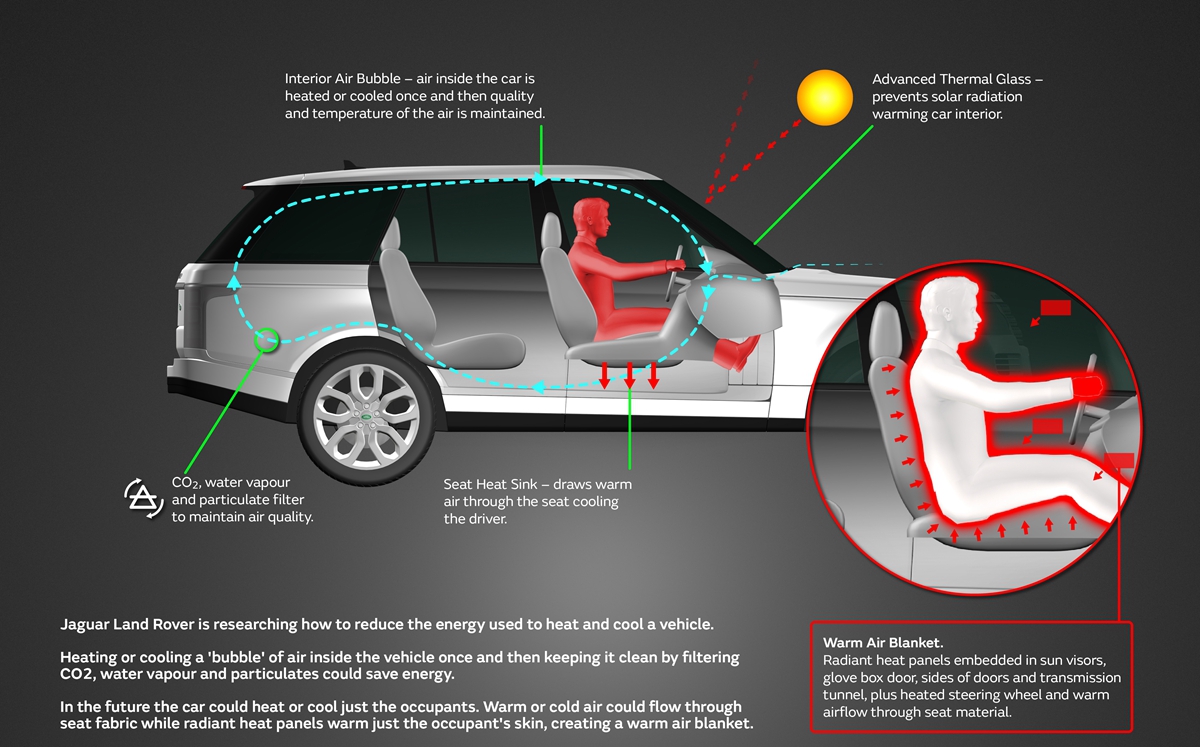 JLR正在研發新型的車內加熱和制冷節能方案,“氣泡”是其概念之一。
 Wolfgang Epple博士表示,在未來兩年內,他所帶領的JLR研發團隊人數將翻一番達到500人。
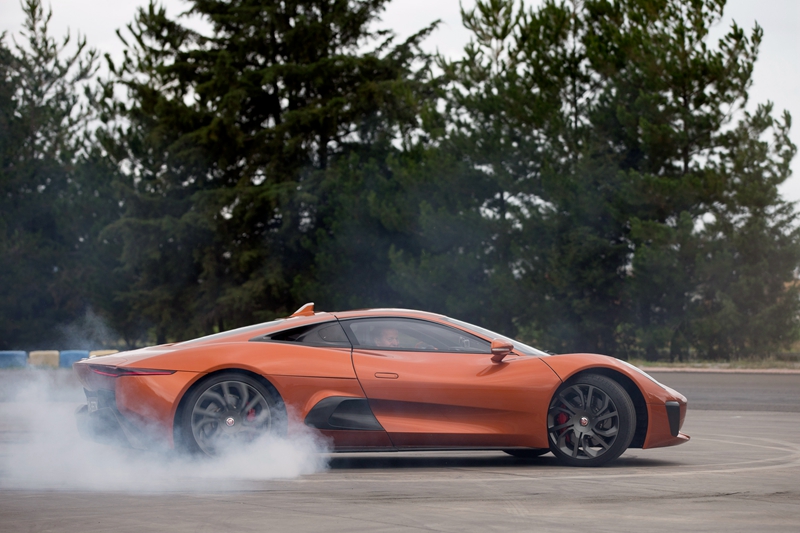 在探索混合材料策略的過程中,捷豹C-X75概念車的車身采用了非熱壓成型技術。
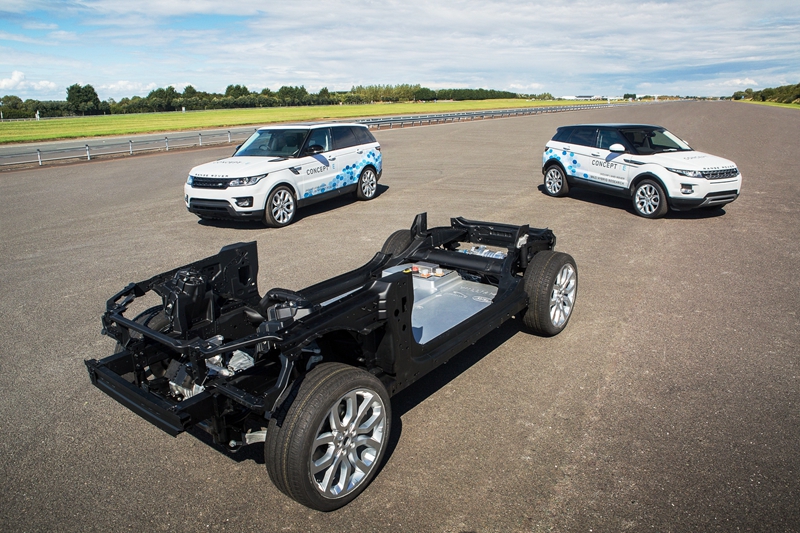 Evoque-e合作研發項目是JLR研發工作的重要組成部分。