F-35為調試初始作戰能力進行冷處理
位于弗洛里達州埃格林空軍基地的第96試驗飛行中隊的麥金利氣候實驗室,從1947年開始成為一個重要的低溫天氣測試機構,至今已為各種飛機進行過相關測試。從B-29超級空中堡壘與P-51野馬到洛克希德F-117、波音787以及空中客車A350 XWB,參與過測試的機型不勝枚舉。
最近,來自馬里蘭州巴塔神河綜合測試連隊的一架洛克希德馬丁F-35B在該實驗室接受了嚴格的天氣測試,以在其進行初始作戰能力調試(IOC)的過程中,確保在各種氣候條件下,性能水平得到萬無一失的發揮。F-35B于2014年9月到達麥金利實驗室,在接下來的6個月中,它將接受風、太陽輻射、霧、濕氣、雨水浸入/倒灌、雨夾冰、冰凍云、結冰、渦流結冰與降雪等多種天氣條件下的性能測試。
由于目前F-35項目涉及到13個國家,因此其將要飛行的所有國家的代表性天氣都必須經過測試,其中包括澳大利亞南部的炎炎烈日,以及加拿大與挪威上空北極圈的刺骨嚴寒。
F-35將承受-40°到+120°F的測試溫度范圍,“以及該溫度中的任何可能出現的天氣情況,”在F-35上進行極冷測試操作的測試飛行員Billie Flynn表示。“它已經在100°F以上的高溫和零下低溫中飛行過了。在測試的最初幾天,它將飛越冰凍天氣和包括傾盆大雨和颶風在內的其他惡劣天氣。我們每天都會多了解一些飛機的情況。”(點擊此處觀看Flynn談論F-35天氣測試項目的完整視頻)
而實驗艙可以進行“幾乎所有天氣條件的模擬,無論在普通還是垂直起飛模式下,飛機馬力全開時可能遇到的所有天氣條件,”麥金利天氣實驗室的技術人員Dwayne Bell表示。
由于F-35今年就要在美國海軍陸戰隊開始IOC服役了,因此STOVL(短距起飛/垂直降落)測試將比之前的飛機在程序上多一些變化。埃格林空軍基地報告稱,F-35B的升力風扇系統需要設計一個用于“限制與支持”的結構,高度為12英尺,并與通風管系統結合在一起。這一裝置使飛機實驗室建筑內部也能用大馬力運行,不論是使用普通模式還是STOVL模式。
為了給噴氣口通風,以使艙內溫度保持穩定,必須不斷地泵送調節過的空氣,以確保飛機內的壓力永遠高于發動機周圍管道內的壓力,并高于飛機其他開口處的壓力。這一壓差可確保噴射排氣會通過管道流出艙外,從而使整個飛機維持在恒定的溫度水平。
在數日的高溫天氣測試后,發動機的測試溫度穩步上升至最高測試溫度——120°F。實驗艙內溫度維持在預設溫度上,同時飛機上方的太陽燈為飛機表面照上了強烈的日光。之所以這么做,是因為空氣溫度是不會在一天內保持不動的,它會隨著太陽的升起溫度升高,并在下午晚些時候達到最高點。而在實驗艙內,工程師們創造了一天24小時的溫度波動模擬條件。
在短短數日內,實驗艙的環境就從亞利桑那州的酷暑轉成了北極圈的嚴寒。麥金利實驗室的制冷系統將室外空氣冷卻至極低溫度,并將其推入艙內。當飛機結束測試時艙內溫度已累積降至-40°F。在如此低的溫度下,飛機系統中的液體開始變稠,各種機械的運行也開始變緩,這些都是測試工程師密切監控的重點。
在此之后,F-35需要迎戰冰雪的猛烈攻擊。在冰凍天氣中,當一架飛機以高速穿越云層時,飛機外側將迅速聚集起大型冰塊。厚重冰塊可能發生斷裂并傷害飛機,進入發動機,或造成外物侵入的損害。因此,結冰是天氣測試中最危險的元素之一。
一個由三個巨型圓柱體組成的大型裝置以金字塔形堆疊起來,并與地面呈平行放置于F-35測試機體的前方。圓柱體內部安裝了9個導管風扇,它們將一股巨大氣流,吹入前方的一個漏斗內。漏斗前端安裝的一個噴桿,能夠產生由各種直徑的小水滴組成的“云”。
這些小水滴朝著飛機的方向噴去,并在接觸的同時凍結起來。盡管實驗室不能產生飛機實際經歷的精確風速,但實驗艙內的這一獨特裝置卻能夠產生高達120 mph的恒定風速,這是F-35墜落時承受的速度。
冰雪測試可衡量飛機冰凌防護系統的有效性,以及飛機在冬季天氣中的運行能力。
F-35 gets cold treatment in step toward IOC remedy
Since it first became an active cold-weather testing facility in 1947, the 96th Test Wing's McKinley Climatic Laboratory at Eglin Air Force Base, FL, there have been a wide variety of aircraft to undergo testing at the facility, ranging from the B-29 Superfortress and P-51 Mustang through to the Lockheed F-117, Boeing 787, andAirbus A350 XWB.
Most recently, one of Lockheed Martin’s F-35Bs from the F-35 Patuxent River Integrated Test Force in Maryland underwent rigorous climatic testing at the laboratory to verify its all-weather capabilities on its way toward Initial Operating Capability (IOC). The F-35B arrived at McKinley in September 2014, to begin a six-month assessment of the aircraft's performance in wind, solar radiation, fog, humidity, rain intrusion/ingestion, freezing rain, icing cloud, icing build-up, vortex icing, and snow.
With 13 countries currently involved with the program, the F-35 must be tested in all the meteorological conditions representative of those locations from which it will operate, ranging from the heat of northern Australia to the bitter cold of the Arctic Circle above Canada and Norway.
Testing for the F-35 can be done from -40° to +120°F “and every possible weather condition in between," said Billie Flynn, an F-35 test pilot who performed extreme cold testing on the aircraft. "It has flown in more than 100°F heat while also flying in bitter subzero temperatures. In its final days of testing, it will fly through ice and other conditions such as driving rain with hurricane force winds. We are learning more and more about the aircraft every day.” (Click here to view Flynn discussing the F-35 climatic test program.)
The chamber allows for the simulation of “virtually any weather condition—all while flying the jet at full power in either conventional or vertical takeoff mode," said Dwayne Bell, the McKinley Climatic Laboratory technical chief.
As the F-35 approaches its IOC debut for the U.S. Marine Corps this year, testing for the STOVL (short takeoff/vertical landing) variant required a few more adaptations to procedures than aircraft before it. Eglin AFB reports that the lift-fan system of the F-35B required the design of a 12-ft high “restraint and support” structure interwoven with a system of ventilation ducts. This apparatus secures the aircraft and allows it to operate at high power in both conventional and STOVL mode while inside the building.
To ventilate the exhaust and thus maintain a stable temperature inside the chamber, conditioned air is constantly pumped in to ensure the pressure in the building is always higher than the pressure inside the ducts surrounding the engine and other openings on the aircraft. This difference in pressure is a safeguard that maintains the jet exhaust is flowing out of the chamber through the ducts, allowing the facility to sustain a constant temperature.
Over days of high-temperature climatic testing, the temperatures of the engine runs were steadily and incrementally increased until it reached the test maximum of 120°F. While the chamber itself was set to a pre-determined temperature, additional solar lamps above the aircraft recreated the intense heat of the sun on the surface of the jet. This is done for the obvious reason that air temperature does not remain constant throughout the day—it increases each hour the sun is up, reaching its apex in the late afternoon. In the chamber, engineers recreated the temperature fluctuation of a 24-h day.
In a matter of days, the chamber transitioned from a seemingly Arizona sauna to the Arctic Circle. Outside air was super-cooled using McKinley Lab’s refrigeration system and pushed into the chamber. In increments, the chamber temperature fell to -40°F while the jet completed test runs along the way. At such frigid temperatures, aircraft fluids start to thicken and mechanisms operate slower—all points upon which test engineers monitor closely.
The F-35 then faced a harsh barrage of snow and ice. When an aircraft flies through clouds at high speeds in freezing climates, large pieces of ice can form quickly on the exterior. Heavy chunks of ice could potentially break off and damage the aircraft, errantly fly into the engine or create a foreign-object-damage concern. For this reason, icing is one of the most dangerous elements in climatic testing.
A large apparatus composed of three massive cylinders stacked in a pyramid, parallel to the ground, was placed in front of the F-35 test aircraft. Inside the cylinders were nine ducted fans that blew a large amount of air through a single funnel in the front. Attached to the front of this funnel was a spray bar capable of producing “clouds” of various water droplet sizes.
Those droplets were blown toward the plane and froze upon contact. While the lab cannot generate the precise wind speeds experienced by airborne aircraft, the unique setup inside the chamber is capable of producing sustained wind speeds up to 120 mph—all while subjecting the F-35 to precipitation.
Snow and ice testing gauges the effectiveness of the aircraft’s Ice Protection System and the ability of the jet to perform in winter weather.

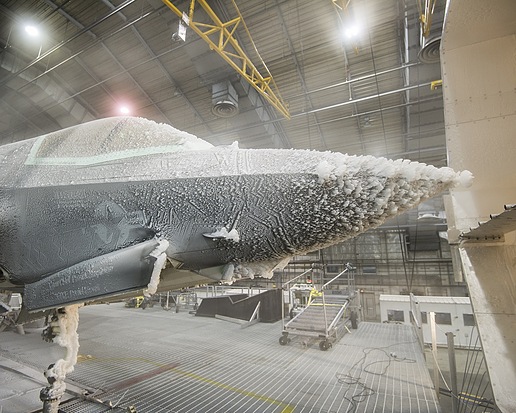 第96試驗飛行中隊麥金利天氣實驗室中,一架F-35正在承受冰凍天氣的溫度。飛機正在實驗室中接受天氣測試,以證明機隊有能力在全球任何地方部署。
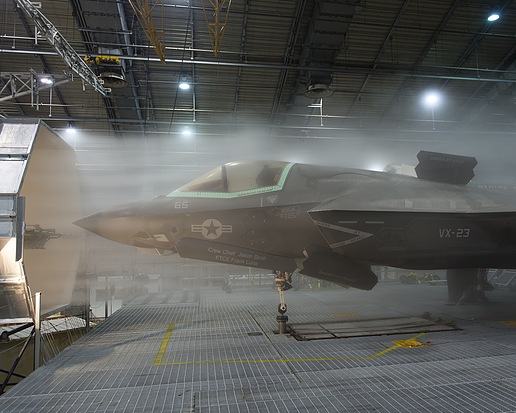 在冰凍天氣中,當一架飛機以高速穿越云層時,飛機外側將迅速聚集起大型冰塊。厚重冰塊可能發生斷裂并傷害飛機,因此結冰是天氣測試中最危險的元素之一。
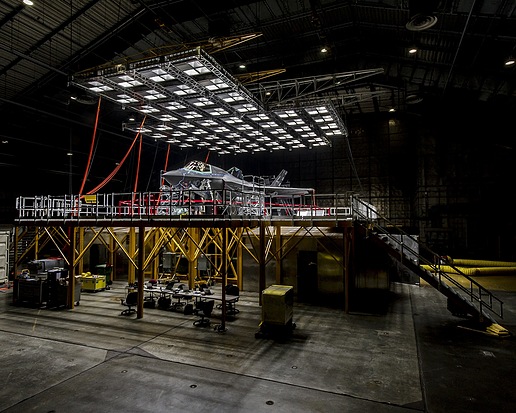 麥金利實驗室中,一架F-35正在一臺巨型太陽燈下接受極端測試。
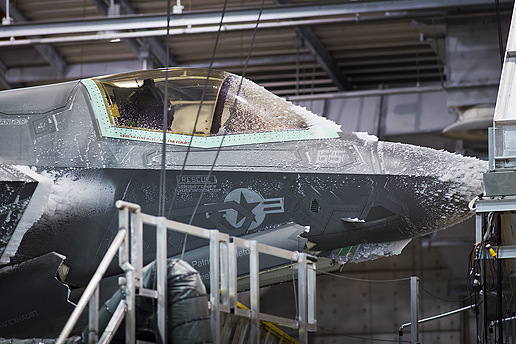 麥金利實驗室中F-35承受的測試溫度范圍為-40°至+120°F,且該溫度中任何可能遇到的氣候條件都需得到測試。
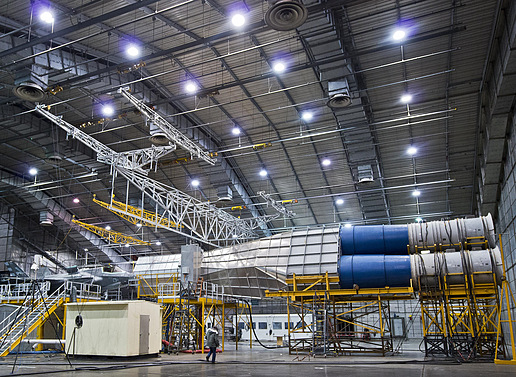 麥金利實驗室已成為自1947年起研發的幾乎所有飛機的天氣測試中心。