在底特律舉行的2015年北美國際車展上,橡樹嶺國家實驗室(ORNL)帶來了一項集成了設計與運動元素的3D技術成果——通過這一快速傳播的技術所復制的經典超跑Shelby Cobra。
這輛約重1400磅(600千克)的Shelby Cobra中有500磅(200千克)的部件是通過3D打印制造的,所使用的是含量為20%的碳纖維材料。
汽車的3D打印是在美國能源部橡樹嶺國家實驗室(ORNL)完成的。ORNL有一臺BAAM(大面積增材制造)設備,能夠使用復合材料制造出大于1立方米(35立方英寸)的輕質而牢固的部件。
整個團隊花了六周的時間設計、制造并組裝Shelby,其中3D打印僅耗時24小時。所用的新BAAM系統是由ORNL與辛辛那提公司(Cincinnati Inc.)共同開發的,其打印速度比當今的工業用增材制造設備快500-1000倍。ORNL的研究員們認為,下一代增材制造設備驚人的制造速度為汽車行業,特別是交通工具的原型制造帶來了新機遇。
“你甚至能夠在幾天至幾周的時間內打印出一輛可以行駛的車輛”,ORNL制造系統研究團隊負責人Lonnie Love說,“你還可以對所打印車輛的外形、裝配與功能進行測試。我們快速創新的能力產生了巨大的變化。在交通運輸領域的這種快速創新,甚至能夠促使一個全新行業的誕生。”
據辛辛那提公司稱,BAAM設備仍然處于原型階段。近期取得的進展是打印珠尺寸更小了,這能夠使成品的表面更為光滑。各種熱塑塑料,包括纖維增強熱塑塑料都可作為打印的原料使用。
打印完成后,由總部位于諾克斯維爾(knoxville)的TruDesign公司對Shelby進行打磨拋光,最后為北美國際車展呈現了這件外觀一流的展品。
橡樹嶺的機械制造與交通工具研究員計劃將3D打印而成的Shelby作為一個車輪上的實驗室使用。該車的設計都旨在實現各個組件的“即插即用”,電池組與燃料電池技術、混合系統的設計、電力電子學、以及無線充電系統等,都能夠在車輛上更加便利地搭載,使研究員可以快速嘗試新的技術設想。
Shelby是Local Motors公司與ORNL合作完成的全3D打印車輛Strati的基礎上的進步。BAAM設備為Strati制造了包括結構件在內的各種部件。Strati不但參加了Local Motors舉辦的比賽,還參展了11月在芝加哥舉辦的國際制造技術展(International Manufacturing Technology Show)。
制造Shelby所用的碳纖維增強ABS塑料由沙伯基礎創新塑料(Sabic)提供,動力系統則來自雷諾捐贈的Twizzy,它的部分機械部件也是從Twizzy借用的。另外西門子的Solid Edge軟件為Shelby的結構性設計提供了支持,Fifteen52則提供了車輪。
BAAM設備由直線電機驅動,目前的工作行程為2 x 4 x 0.87米(6.6 x 13.1 x 2.9英尺),擠出速率約為38磅/小時(17千克/小時)。它所能夠打印的聚合物部件比現目前所使用的制造設備大10倍。研究人員計劃將工作行程增加到2.4 x 6米(8 x 20英尺),并在Sabic的幫助下將擠出速率增加到100磅/小時(50千克/小時)。辛辛那提公司表示,另一項工作重點是增加Z軸行程,即所制造部件的可加工高度。
Oak Ridge National Laboratory (ORNL) put a very pretty and sporty face on its 3-D printing technology at the 2015 North American International Auto Show in Detroit, showing off a replica of a classic Shelby Cobra made via the rapidly propagating technology.
The approximately 1400-lb (600-kg) vehicle contains 500 lb (200 kg) of printed parts made of 20% carbon fiber.
The car was printed at the U.S. Department of Energy’s ORNL facility, which houses a so-called BAAM (Big Area Additive Manufacturing) machine that can produce lightweight and strong composite parts greater than 1 m³ (35 ft³) in size.
The team took six weeks to design, manufacture, and assemble the Shelby, including 24 h of print time. The new BAAM system, jointly developed by ORNL andCincinnati Inc., can print components 500 to 1000 times faster than today’s industrial additive machines. ORNL researchers say the speed of next-generation additive manufacturing offers new opportunities for the automotive industry, especially in prototyping vehicles.
“You can print out a working vehicle in a matter of days or weeks,” said Lonnie Love, Leader of ORNL's Manufacturing Systems Research group. “You can test it for form, fit, and function. Your ability to innovate quickly has radically changed. There’s a whole industry that could be built up around rapid innovation in transportation.”
The BAAM machine is still in the prototype stage, according to Cincinnati Inc. Recent improvements to it include a smaller print bead size, resulting in a smoother surface finish on the printed pieces. It uses a wide variety of thermoplastics and fiber-reinforced thermoplastics.
For the Shelby, subsequent work by Knoxville-based TruDesign produced a Class A automotive finish for the NAIAS showpiece.
The manufacturing and transportation researchers at Oak Ridge plan to use the 3-D printed Shelby as a laboratory on wheels. The car is designed to “plug and play” components such as battery and fuel-cell technologies, hybrid system designs, power electronics, and wireless charging systems, allowing researchers to easily and quickly test out new ideas.
The Shelby project builds on the successful completion of the Strati, a fully 3-D printed vehicle created through a collaboration between Local Motors and ORNL. The BAAM machine was used to make many of the various parts, including structural ones, for the Strati, which was designed as part of a contest held by Local Motors and built on site at November’s International Manufacturing Technology Show in Chicago.
Sabic Innovative Plastics supplied the carbon-fiber-reinforced ABS plastic. Renaultdonated the powertrain from the Twizzy, and some of the mechanical parts were “leveraged” from the same car. Siemens provided the Solid Edge software for the structural design elements and Fifteen52 provided customer wheels.
The linear-motor-driven BAAM machine currently has work envelope of 2 x 4 x 0.87 m (6.6 x 13.1 x 2.9 ft) and an extrusion rate of about 38 lb/h (17 kg/h). It prints polymer components up to 10 times larger than currently producible. Plans are to increase the work envelope to 2.4 x 6 m (8 x 20 ft) and, with Sabic, to increase the extrusion rate to 100 lb/h (50 kg/h). Another priority is increasing Z-axis travel (the working height for the part being built), according to Cincinnati Inc.
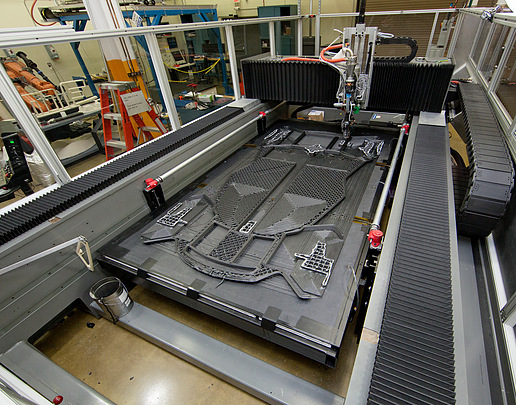 BAAM設備近期所取得的進展是打印珠尺寸變小了,這能夠使打印成品的表面更為光滑。(請點擊照片右上方箭頭查看3D打印的Shelby Cobra的圖片。)
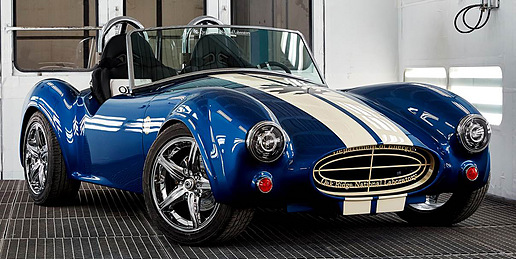 橡樹嶺國家實驗室的研究人員們計劃將3D打印的Shelby Cobra當做一個車輪上的實驗室使用,利用它進一步研究機械制造領域的新技術,以及無線充電、電力電子學、混合系統設計等課題。