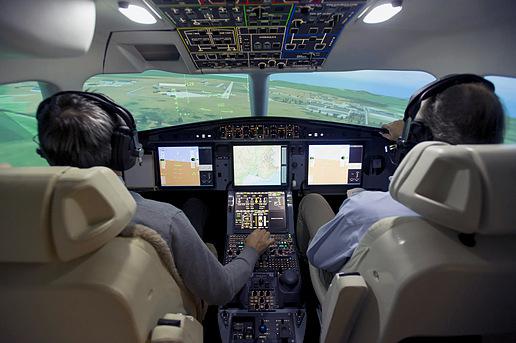
2013年11月獵鷹5X進行了首次模擬飛行,這將是該開發項目的一個重要的里程碑���。
“玻璃駕駛艙”的概念快速滲入到了商用航空業��,在數字革命的支持下開始替代傳統的駕駛艙布局,表現出多功能顯示的適應性和融合海量信息的靈活性�����。
如今����,即使是最小的通用航空型飛機,也可以配備先進的數字顯示和航電系統�����。但是��,在民航業的幾次眾所周知的航空事件之后�,越來越多的人認為信息過載和數字環境下對自動化的過分依賴,有時會給飛行員帶來非常具有挑戰性的局面��,特別是當出現問題的時候���。
一直以來�����,在具有高度自動化功能的系統��,與給飛行員保留更廣3D視景的需要之間如何做出平衡��,都是人們爭論的話題�,特別是當受損或失靈的傳感器向電腦軟件輸入了前后矛盾的數據時���,問題就會顯得尤為突出。而當飛行員在夜間或在暴風雨中飛行時��,問題會更嚴重���,因為此時飛行員缺乏視覺提示�,比如透過駕駛艙窗口看不到地平線。
但這個問題隨著不同的事情不斷的發生,在最新一代裝備EASy駕駛艙/臺的達索航空新5X公務機上,為應對這個不斷出現的問題上邁出了解決方案的第一步。那就是在提交安全飛行的管理數據時��,區分出最優先級的事項��,并在飛行過程中所需的操作進行持續追蹤。
當然��,有關整體飛行的關鍵數據�����,無論是機上信息還是飛機與其他因素之間的交互信息����,包括機場活動��、空中交通管制����、導航���、天氣和當地地形等���,都必須隨時可以獲得����。但更直觀的一個方法是在駕駛臺上對這些信息進行邏輯排序���,并在飛行員需要的時候提供相關數據給他們�����,以幫助他們更快地做出反應��。
達索將其稱為飛行員做出戰術和戰略決斷的過程�����。航電系統發展到現在��,已經能夠支持將飛行員所需的全部數據從起飛前檢查到最后停機的全過程以正確的順序自動呈現���,并且排序方式可以讓對飛機始終全權控制的飛行員更輕松����、更安全�。
最新的EASy II(II型增強型航空電子系統)致力于達到這一目標,并且具有這樣的潛力��。 “T”型配置中的4個14.1英寸的多功能顯示單元(MDU)能夠顯示飛機傳感器上影響到系統��、通信����、導航和飛機管理的全部信息����,這些信息對飛行員控制這些功能來說至關重要。
兩個外置屏幕位于飛行員正前方,用于呈現飛行員賴以做出飛行駕駛的短期“戰術”的必要信息��。而傳統的方式是將所有與發動機參數、飛機配置和機組人員警報系統的數據所有信息全部列出。
兩個內側MDU垂直放置在駕駛艙中心����,兩位飛行員都能夠看得到�。飛行員可以對這兩個MDU進行配置�,以選擇性顯示“戰略”信息��。通常上方的MDU用于控制并顯示導航功能��,下方的MDU則負責FMS(飛行管理系統)�����、系統頁面和檢查單��。
自動化檢查單的互動功能是一個新特點�����。某項動作一旦被執行���,就會經過自動感應確認核查完畢����,顏色也會從藍色變為綠色�����,同時開始核查下一個項目��。這種自動化清單還提供了安全選項�,如果有需要��,可以擱置或推遲項目的出現����。
EASy清單與全局系統顯示相連接���。比如假設一個與燃料有關的項目被選上了清單,那么清單窗口的旁邊就會彈出燃料系統圖���。圖上會顯示泵和輸送閥的實時位置和操作信息���,并伴有各個燃料罐燃料質量的圖形描述。
達索融入5X的設計飛行控制和顯示體驗的技術不僅有來自商務機中的Falcon(獵鷹)系列���,也有來自先進的Rafale(拉法勒)多用途戰斗機�。這一軍用戰斗機數千小時的飛行數據對達索來說至關重要�����,因為這為其提供了大多數商務機制造商無法獲得的第一手的直接技術反饋�。
Easy II 系統保證了飛行員能夠精確地掌控航路,在飛行形態改變時的自動配平�,并通過側桿實現自動駕駛功能����。同時內置飛行包保護設置,飛行員可獲取最佳性能(例如最大迎角)�,而不必冒險使飛機超負荷工作�����。這項特點在極端情況下的價值是無可估量的���,如遇到風切變或空中飛行的自動避讓時���。
達索的軍事背景在這一領域的設計和開發階段顯得尤其寶貴���。新的數字飛行控制系統將控制所有的飛行控制面,包括縫翼���、襟翼��,每個控制面都會是多功能的���,從而在任何時間都能實現飛機的最佳性能���。這種靈活度也體現在副翼上����,它除了實現副翼功能��,也可以充當空氣制動的角色���。
獵鷹5X是商用機中首個運用襟副翼的機型——主動高速偏轉控制面可以用作襟翼或副翼。襟副翼總是在主動模式下運行,并且會滾轉操縱功效���,但是它帶來的好處在進場時是顯而易見的�。尤其是在大角度下降時��,襟副翼會扮演傳統襟翼的角色,因為它們會在增加阻力的同時保持較高的升力系數。這會使得飛行員能夠不增加進場速度��,甚至是在正常進場速度的情況下大角度進場。達索表示,在飛行員有了良好的前方視野(因為駕駛艙窗戶比一般商務噴氣式飛機的大32%)的輔助下,這將保持飛機得到最佳控制。
5X的合成視景系統(SVS)使得當飛行員您處在一個陌生地區�����,即便是在儀表位置狀態下���,也可以觀看您的實際位置以及實際環境����。 合成視景系統(SVS)采用平視儀符號及最先進的3D地形模擬手段,為您周圍的地形建立一個在實際情況下可以采用的模擬白晝目視飛行規則(VFR)條件下的圖像。
除了SVS���,飛機還配備了綜合型視覺增強系統(EVS)極大地提高了運行環境感知力,無論是在起飛、進近�����、降落時,還是在繁忙機場進行地面調動時,均可自如應對�����。并在新一代寬視角平視儀以及駕駛艙各顯示器提供了一個圖像�,讓駕駛員能夠在諸如霧、霾和夜間等低能見度條件下看清地形和機場環境。
達索的獵鷹5X的EASy駕駛艙的窗戶比正常機型大32%���,配置雙HUD整合SVS及EVS�,同時EFB被整合進前方操控平臺。
獵鷹增強型視景系統使用液晶平視儀技術提供其他系統不具備的特性。 例如,一種具有獨特的雙模設置的更好、更明亮的視頻顯示為進近構型或通用構型優化了視屏圖像。 該系統還采用了專門為最小化假象和失真開發的特殊紅外線視頻處理技術特性���。
距5X正式服役還需要2-3年,但是作為其核心的高度復雜的航空電子系統��,無疑將有助于解決近年來許多飛行員一直在呼吁的飛行安全問題。
作者:Richard Gardner
The Falcon 5X underwent its first simulated flight, completing an important milestone in the development program, in November 2013.
The “glass cockpit” concept transitioned very rapidly in commercial aviation, replacing familiar analog cockpit layouts to embrace the adaptability of multi-functioning displays and the flexibility to incorporate vastly more information, enabled by the digital revolution.
Today, even the smallest general aviation aircraft can come equipped with advanced digital displays and avionics systems. However, within the civil sector, following several high-profile air incidents, there is a growing view that information overload and perhaps an over-reliance on automation in the digital environment can sometimes present pilots with a very challenging situation, especially when things go wrong.
The debate continues as to where exactly the balance should be between systems that have a high degree of autonomous functionality and the need for pilots to retain a wider 3-D perspective, especially if the computer software is overwhelmed by conflicting data being input from damaged or non-functioning sensors. The problems can be compounded even more when the pilots are flying at night or in storms with few if any visual cues, such as a horizon seen through the cockpit windows.
But things are changing to reflect this concern and one step toward a solution in the cockpit and incorporated in the latest iteration of the EASy flight deck on Dassault Aviation's new 5X business jet is to separate out the immediate priorities in presenting data for managing safe flight, and follow-up actions required later during the flight.
Of course, at all times key information must be available regarding the totality of the flight, both aboard the aircraft and outside where the aircraft interfaces with such factors as airport activities, air traffic management, navigation, weather, and local terrain. But a more intuitive approach on the flight deck can deal with these factors in a logical sequence and help the pilots to react quicker by giving them exactly what information they need, when they need it.
Dassault refers to this as tactical and strategic decision making by the pilots. Developments in avionic systems now allow all the information required by the pilots, from pre-flight checks to final shut down, to be shown automatically, in the right sequence, but presented in a way that makes it easier and safer for the pilots who remain in full control of the aircraft at all times.
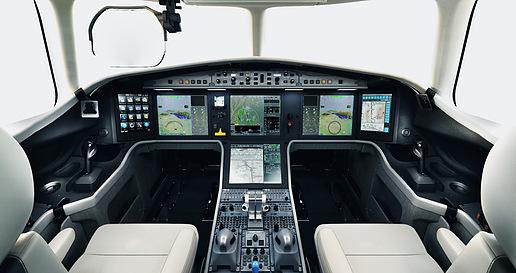
The latest EASy II system aims at doing just this, and such is its potential. Four 14.1-in multifunction display units (MDUs) in a “T” configuration can show all the information from the aircraft sensors affecting systems, communications, navigation, and flight management and are key to the pilots’ control over those functions.
The two outboard screens are directly in front of the pilots and are dedicated to short term “tactical” information essential to piloting the aircraft. The traditional presentations are permanently accompanied by data on engine parameters, aircraft configuration, and a crew alerting system.
Two inboard MDUs are stacked vertically in the center of the cockpit to be visible to both pilots and are configurable so they can show selectable ”strategic” information. Typically, the upper MDU would be used to control and display navigational functions, with the lower MDU handling the FMS, systems pages, and checklists.
A new feature is the interactive nature of the automated checklists. As soon as an action has been performed it is automatically checked off through auto-sensing and changes color from blue to green and then opens up the next item on the checklist. It also provides secure options to over-ride or defer any item if need be.
EASy checklists are linked to synoptic system displays. For example, if a fuel-related item is selected on the checklist, a fuel system diagram will pop up adjacent to the checklist window. It shows the real-time position and operation of pumps and transfer valves with a graphic description of fuel quantities in each tank.
Dassault brought into the 5X's design flight controls and displays experience not only from the Falcon family of business jets but also from the advanced Rafale multi-role combat fighter. This is particularly important for it incorporates many thousands of hours of operational military flying aboard air combat planes, and this brings direct first-hand technological feedback that is unavailable to most other manufacturers of business aircraft.
The EASy II system provides a very precise flight path control and automatic trim, with adjustments during configuration changes, and the autopilot functions through the side-stick controllers for setting heading and altitude, with full envelope protection through the digital flight control system. This allows pilots to extract the maximum aircraft performance (such as extreme angles of attack) in instances of instinctive reactions, such as wind shear or collision avoidance maneuvers, without over-stressing or stalling the aircraft.
This is an area where at the design and development stage, Dassault’s fighter heritage is much evident. The new digital flight control system will command all the flight control surfaces, including the slats and flaps and each control surface will be multi-functional to give peak performance at all times. An example of this flexibility can be seen on the aileron, which can function as an aileron, but also act as an air brake.
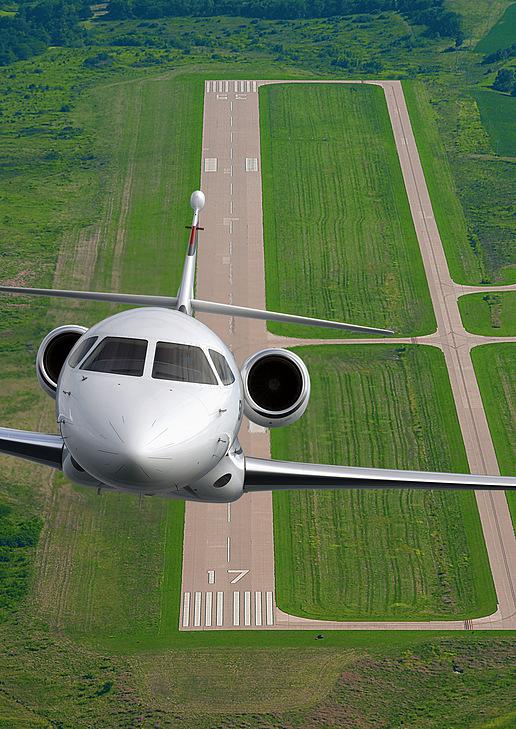
The Falcon 5X is the first aircraft in the business sector to use flaperons—active high-speed deflection control surfaces that can act as flaps or ailerons. The flaperons will always operate in active mode and will enhance roll authority, but the benefit will be seen very effectively on approach, especially in a steep descent where the flaperons will act like a traditional flap because they will increase drag while maintaining a high lift coefficient. This will allow a pilot to be able to fly a steep approach without increasing the approach speed, even on a normal approach. According to Dassault, this will maintain optimal control while giving a good forward visibility, enhanced by cockpit windows that are 32% larger than on average business jets.
The synthetic vision system (SVS) on the 5X allows the pilot to see the exact position of the aircraft even in instrument flying conditions, and is an important bonus when flying into an unfamiliar destination. The SVS creates a highly realistic image of the surrounding terrain in a simulated daylight VFR condition, using the head-up display symbology and advanced 3-D terrain simulations.
As well as the SVS, the aircraft also has an enhanced vision system (EVS) with nose-mounted sensors that are fully integrated to give even further SA during takeoff, approach, and landing, and also during ground maneuvering at busy airports. This provides an image on the new-generation wide-angle Elbit-supplied HUD and on flight deck displays and gives an improved image of terrain near the airport and of the airport environment in conditions such as fog, haze, and at night.
Dassault Aviation’s Falcon 5X’s EASy flight deck features 32% more window area, dual HUD capability with SVS and EVS, and an EFB that is integrated into the front panel.
The Falcon EVS uses LCD HUD technology features unavailable elsewhere. This gives a brighter video presentation with a unique two-mode setting, optimizing the video for either an approach configuration or a more general purpose configuration. It also takes advantage of special IR video processing developed specifically to minimize distortion.
The 5X is still two-three years from entering service, but its highly sophisticated avionics systems that are at the heart of the aircraft undoubtedly help project flight safety capabilities in the direction many pilots have been calling for in recent times.
Author: Richard Gardner